
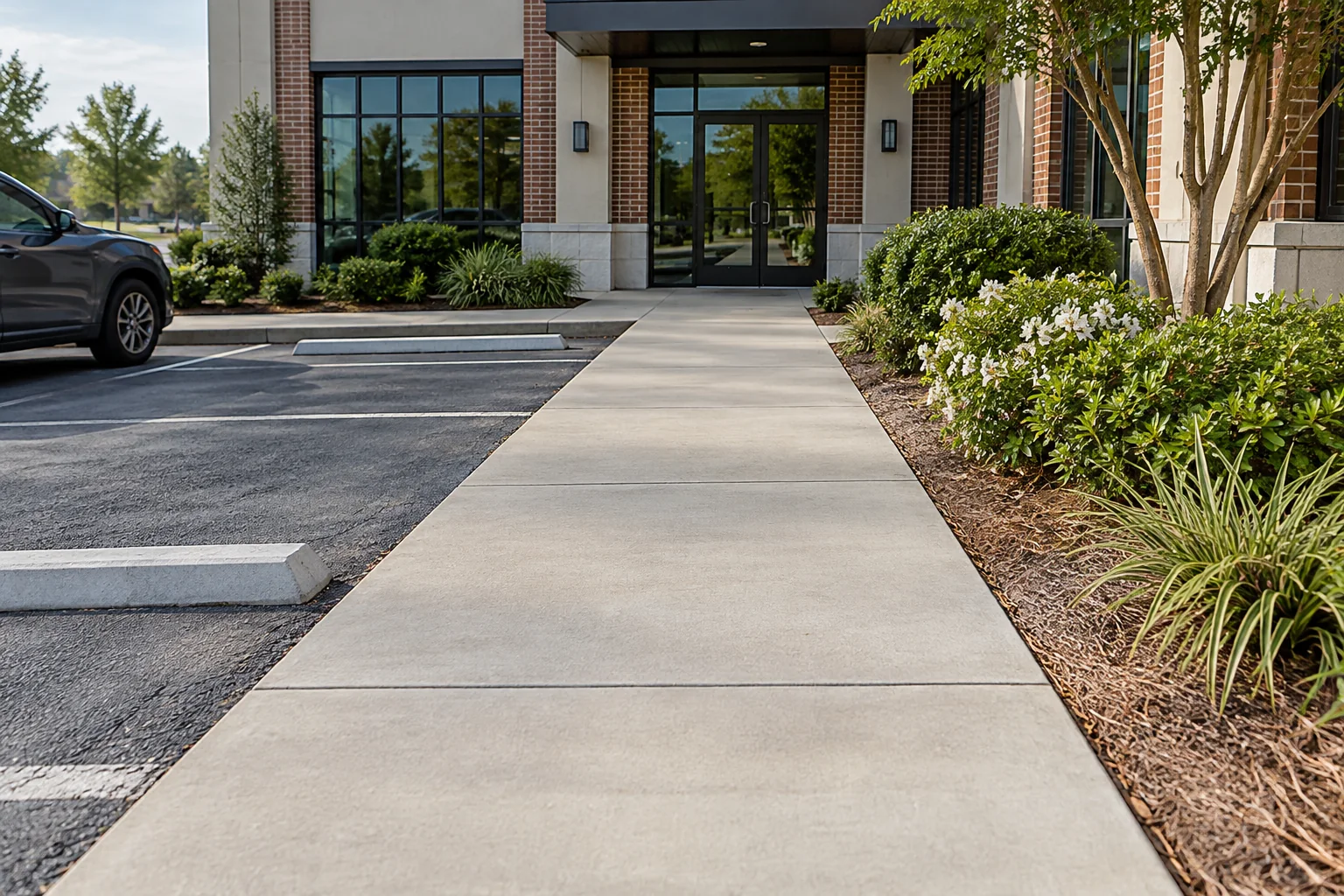
Think about a connected path across the property
An accessible route is a continuous path connecting the site elements it is required to serve. In a pavement conversation, the term helps keep attention on the complete connection rather than a single attractive sidewalk or newly marked parking space. A person needs to move between the relevant arrival point and destination. Looking at only one piece can leave an important interruption outside the proposed work.
The U.S. Access Board's accessible-route guidance describes connections among arrival points, entrances and other required elements. That broad definition is useful for an owner preparing a project discussion. It does not tell you that a particular existing path satisfies all applicable requirements. The actual arrangement, surfaces and other conditions need appropriate review. A glossary page or reference image cannot establish compliance for your property.
Start by identifying the destinations people use and the points from which they arrive. Describe the intended path between them on a simple sketch or existing plan. This helps the person evaluating the site understand the whole question. A request to repair one sidewalk panel may be appropriate, but it should not be mistaken for a review of every connection across the property.
Follow the connection rather than judging isolated pieces
A parking space, its access aisle and the route toward an entrance have related roles. Ask how the person using the parking arrangement reaches the route and continues to the destination. A bright symbol or newly painted aisle does not answer every question along that path. The useful review traces the intended connection and identifies where measurements, design decisions or separate work may be needed.
On a property sketch, label entrances, sidewalks, parking areas and any known obstacles. Note where the path crosses another surface or passes a doorway. If you are unsure which path is intended, say so. Do not invent a route simply because it is the shortest line on a photograph. A site professional may need to compare the actual arrangement with applicable requirements and the property's use before recommending changes.
Consider a manager planning a parking-lot overlay while retaining an existing walkway. The work may affect the connection between those surfaces even if the walkway itself is not being replaced. Bring that connection into the discussion before finished pavement levels are decided. The point is to coordinate the interface, not to prescribe a universal ramp, slope or construction detail from an online example.
Describe surface and obstruction concerns separately
A path can have more than one kind of problem. An owner might observe a broken section of pavement, water collecting at a connection and movable items narrowing a walkway. Those observations deserve separate descriptions because they may have different solutions and responsible parties. Repairing pavement will not necessarily change where staff store equipment, and removing equipment will not restore a damaged surface.
Provide wider photographs showing where the condition sits along the path, then close views of the concern. Record when water appears or when an obstruction is present, if that timing is relevant. Avoid attempting measurements or access tests that require entering an unsafe area. The initial information should help arrange a proper review rather than substitute for it. Images cannot establish hidden support conditions or the complete geometry of a route.
Routine operations matter too. Deliveries, outdoor displays, temporary signs and parked vehicles may affect the path after a construction crew has finished. Identify the person responsible for keeping the intended route available. A clear operating responsibility is useful alongside a construction proposal, particularly where several tenants or maintenance providers share the property. Ask how approved changes will be communicated so future maintenance does not recreate the same obstruction.
Coordinate paving, concrete work and layout decisions
Accessible-route questions can cross trade boundaries. A paving crew may work next to retained concrete, while another contractor handles a doorway, curb connection or parking markings. Tell each party about the related work and identify who holds the current approved layout or design information. Without that coordination, separate pieces can be completed according to different assumptions about the finished connection.
Ask the proposal to distinguish an evaluation from a construction task. A quote for replacing a damaged surface is not automatically a professional review of the entire route. Conversely, an evaluation may identify work beyond the small repair initially requested. Have the scope state which surfaces and connections are included, who confirms the relevant design information and what happens if a conflict is discovered during preparation.
Keep exclusions visible. If a retained entrance, off-site connection or another owner's property is outside the contractor's work, record that boundary and any dependency it creates. A surface can be newly installed while the broader access question still requires another step. Clear responsibilities help the owner sequence those steps and avoid treating a completed line item as proof that every site issue has been resolved.
Plan the path people will use while work is underway
The permanent route and temporary construction access need separate attention. If a repair closes the usual approach, tell the contractor who uses that entrance and how the property operates during the proposed work hours. Ask what temporary arrangement will be available and who evaluates it. Do not assume that an unmarked gap around the crew's equipment is a suitable route for everyone.
For an occupied business, discuss staff arrival, customer activity and deliveries before agreeing to the sequence. Identify who notifies occupants and who changes the instructions when work moves to another area. A notice sent before the first phase may no longer describe the route during a later phase. The property contact needs current information and a clear way to obtain answers from the person managing the work.
Reopening also needs an explicit release. The surface may look complete while another trade still has work at the connection or while project-specific restrictions remain. Ask who authorizes use and what conditions must be met first. Keep the release and any remaining limitations in the property record. This reduces the chance that staff direct someone through a location that the contractor still considers part of the work area.
Turn a general concern into an actionable site request
Imagine an owner reports that the parking area needs an accessible walkway repair. Before requesting a price, identify the actual path, the damaged location and the destination it serves. Add the concern that prompted the request: a broken edge, a difficult connection or a recurring obstruction. That information helps distinguish a localized surface repair from a broader route evaluation without claiming to know the final answer.
Send the site address, a sketch or plan if available and photographs that show the relevant connections. Ask what can be assessed by the contractor and whether an appropriate design or accessibility professional needs to be involved. Request a written description of construction scope, retained features, coordination duties and access during the work. These details make the next conversation more useful than an unsupported promise to make the path compliant.
Asphalt Solutions typically works at customer job sites. Call or text to discuss the actual property and the next step; visits to the Slidell contact location are by appointment. The listed phone availability is separate from construction scheduling. Keep official guidance and any property-specific evaluation with the project documents so future work starts from the intended arrangement rather than a fresh set of assumptions.
A question to settle before approving the boundary
If the quote ends at a retained doorway or sidewalk, ask what that boundary means for the route discussion. The owner may need information from a designer, another contractor or the party responsible for the adjoining area. Record who obtains that information and when it must be available. This helps avoid a situation in which each completed trade assumes the connection belongs to someone else. The responsibility note should identify the actual location so a later change can be reviewed against the same understanding.
Questions about accessible route
Meaning in plain language
An accessible route connects required site elements through a continuous usable path. Parking layout should be considered together with that route.
A practical example
The route should be reviewed from parking to the destination, including surfaces, transitions and obstructions, rather than ending at a painted symbol.
Use the term in your project discussion
Check the full route from the space to the entrance rather than just the painted symbol.
Details that matter
- Obstructions
- Changes in level
- Entrance connection
A mistake to avoid
An accessible parking symbol does not establish an accessible site route.
Continue with the right next step
Property conditions determine the final scope. These planning notes do not replace a site evaluation. How to use our pavement guidance
Official reference: U.S. Access Board accessible-route guidance.