
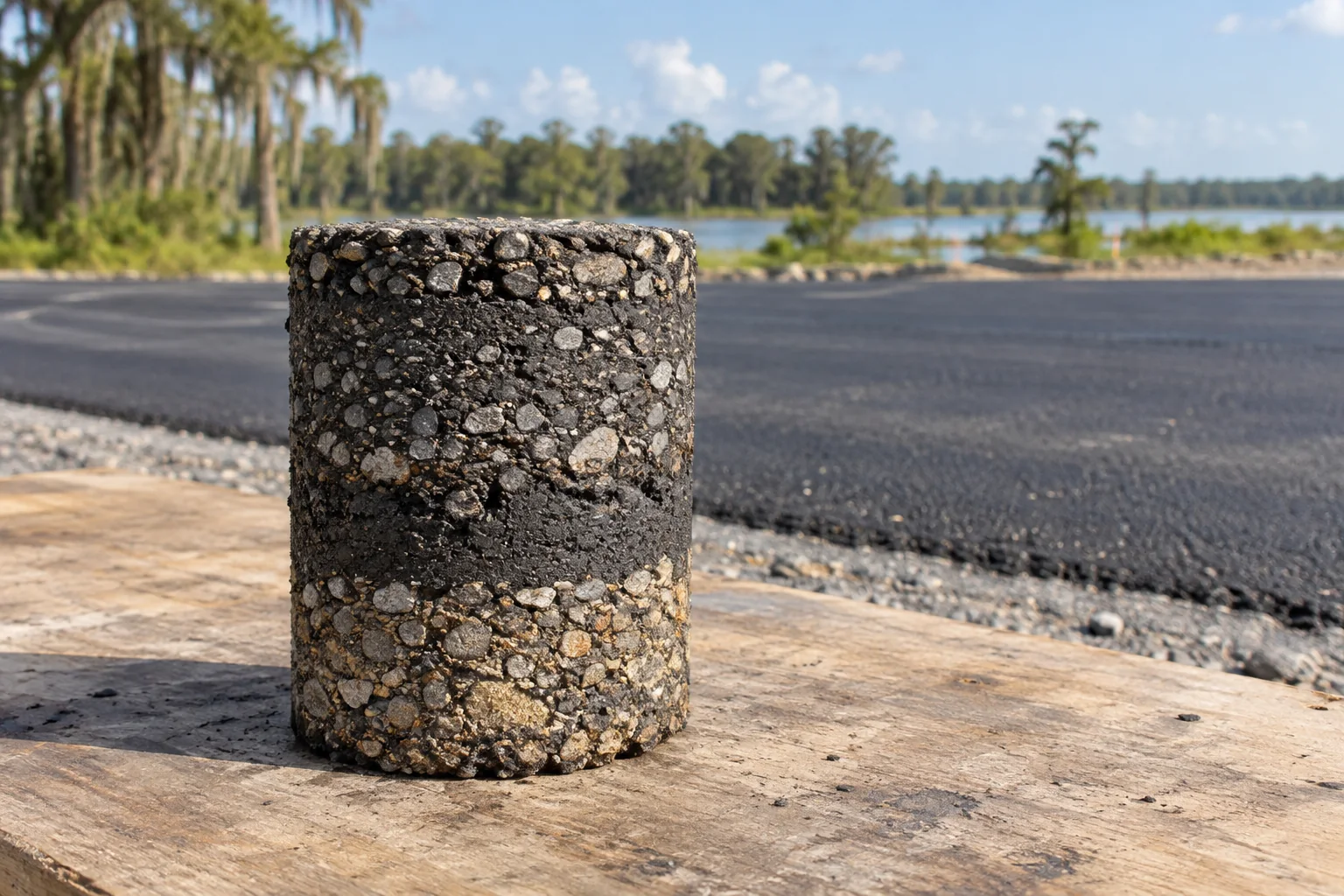
A core is a sample taken to answer a defined question
A pavement core sample is a piece removed from pavement for examination or testing suited to an investigation. It can provide information about the material at the sampled location, including relevant layer characteristics. The important starting point is the question the sample is intended to answer. A core is not a universal inspection of everything beneath a driveway or lot.
Technical pavement investigations may use cores with other observations and methods. The owner should ask the appropriate professional why sampling is proposed and how the result will influence the next decision. Do not select sample locations, quantities or dimensions from an educational photograph. Those choices depend on the purpose and scope of the actual investigation.
A visible band in a photograph should not be treated as a verified material identification. Use the example to recognize the term, then ask for the actual investigation record where sampling is performed.
Clarify why sampling is being considered
A contractor or evaluator may recommend further information before deciding on repair, rehabilitation or rebuilding. Ask what is uncertain and how a core would help address that uncertainty. The answer should connect the sampling to the property question rather than imply that every project needs the same investigation. An owner can request the reasoning without prescribing a technical method.
Different questions can involve different examination or testing. A request to document a layer is not automatically a request for every possible material test. Ask which services are included, who performs them and what result will be reported. If laboratory work is proposed, identify the testing provider and the expected deliverable in the scope. Avoid assuming that a sample automatically produces a comprehensive report.
Also ask what a core will not establish. Information from one location may need interpretation alongside conditions elsewhere. The investigation professional should explain the relevant limits and whether other methods or records are needed. A physical specimen can be useful evidence while still leaving a broader drainage, support or design question open. Keep that distinction visible when the results are later used to compare construction options.
Keep location and sample identity with the result
A sample result is most useful when it can be tied back to the location and purpose of collection. Ask how the investigation identifies samples and records where they came from. The owner does not need to design the identification system, but the final record should allow the appropriate person to connect a finding with the actual area reviewed.
Provide the evaluator with known repair locations, available plans and relevant history. A sampled repaired area may represent a different history from nearby retained pavement. That context should be available to the person selecting locations and interpreting results. If the work history is uncertain, label it as uncertain. Do not assume a core represents the whole property simply because all the visible asphalt looks similar.
If the owner expects to keep the specimen or receive photographs, confirm that arrangement before sampling. Handling, retention and reporting responsibilities belong in the investigation agreement. A photograph of an unlabeled cylinder separated from its record may be difficult to interpret later. Preserve the actual report and location information together rather than relying only on a picture saved in a general project folder.
Plan site responsibilities before intrusive work
Coring involves work on the property, so access, permissions and relevant site constraints need attention before it occurs. Ask who confirms the applicable locating and authorization requirements and who coordinates with the property contact. An owner should provide known information about utilities and restricted areas without informally declaring an unseen location clear for drilling.
Discuss how the sampled area will be managed during the work. Identify nearby traffic, entrances and pedestrian use so the responsible parties can plan appropriate access restrictions. A small sample location can still sit in an important travel path. Do not enter the controlled area or attempt to collect a sample yourself based on a web description. The investigation should be performed under the appropriate project arrangements.
Restoration of the sampling location should be explicit. Ask who restores it, what the agreed scope includes and when the area may return to use. Do not assume that sample collection, laboratory analysis and site restoration are performed by the same party. Recording those responsibilities helps prevent a useful investigation from leaving an unresolved property-maintenance task.
Read the result with its question and limitations
When a report is delivered, begin with its stated purpose and sampled locations. Ask the appropriate professional to explain what the findings mean for the decision under consideration. A measurement or test result should not be separated from its basis and turned into a general claim that the entire pavement passed or failed every possible check.
Compare the findings with the original uncertainty. Did the investigation answer it, identify another question or support a particular next step? If construction is recommended, ask how the relevant findings appear in the proposed scope. A report can inform a decision without itself being the construction design or an instruction to remove a particular area. Keep those documents identifiable so the owner knows which one governs the agreed work.
If another contractor reviews the information, provide the complete relevant record rather than only a selected photograph or number. The purpose, locations and limitations may materially affect interpretation. Where a result seems inconsistent with an earlier assumption, request clarification from the responsible professional instead of choosing the interpretation that makes one quote appear preferable.
A practical way to request investigation information
Imagine an owner comparing an offer that retains existing pavement with one that proposes more extensive removal. The owner may ask what information supports each approach. If sampling is recommended, ask what uncertainty it would address and how the result would change the comparison. Do not order a generic core simply to create a test record without understanding its role in the decision.
Now imagine a report arrives with a result from a known old repair. Ask how that location relates to the rest of the project area and whether the investigation scope intended it to represent a wider condition. The appropriate evaluator should explain the basis. This example shows why location and context matter; it does not determine how many samples a project needs or how a particular test should be interpreted.
To discuss a pavement question with Asphalt Solutions, send the job-site address, photographs and any existing investigation report. Ask what the construction evaluation can address and whether a qualified testing or design provider is needed. Most work takes place at customer properties. Call or text first; visits to the Slidell contact location are by appointment, and phone availability is separate from job-site scheduling.
Retain the complete record through the construction decision
If an investigation is used to support a later proposal, keep its actual report with that proposal. The construction decision may depend on the purpose, sampled locations and limitations as much as on a particular finding. Ask the responsible professional to explain any gap between the investigation and the work being recommended.
For example, an owner might receive a specimen photograph and assume it documents every layer throughout a lot. The photograph alone does not show the investigation scope. Request the associated record and clarification of what the sample represents. This keeps a real piece of evidence from becoming an exaggerated claim when the project changes hands or another contractor reviews the options. Retain uncertainties alongside the result instead of dropping them from the handoff.
Questions about core sample
Meaning in plain language
A core sample is a piece removed from pavement to examine layer thickness or material condition. It is one investigation method when appropriate for the project.
A practical example
A sample describes its location, not every part of a lot. Ask how sampling locations relate to the decisions under review.
Use the term in your project discussion
Ask whether further investigation is needed when existing thickness or construction is unknown.
Details that matter
- Unknown section
- Layer condition
- Sampling locations
A mistake to avoid
A single sample does not describe every part of a large lot.
Continue with the right next step
Property conditions determine the final scope. These planning notes do not replace a site evaluation. How to use our pavement guidance
Official reference: FHWA pavement investigation background.