
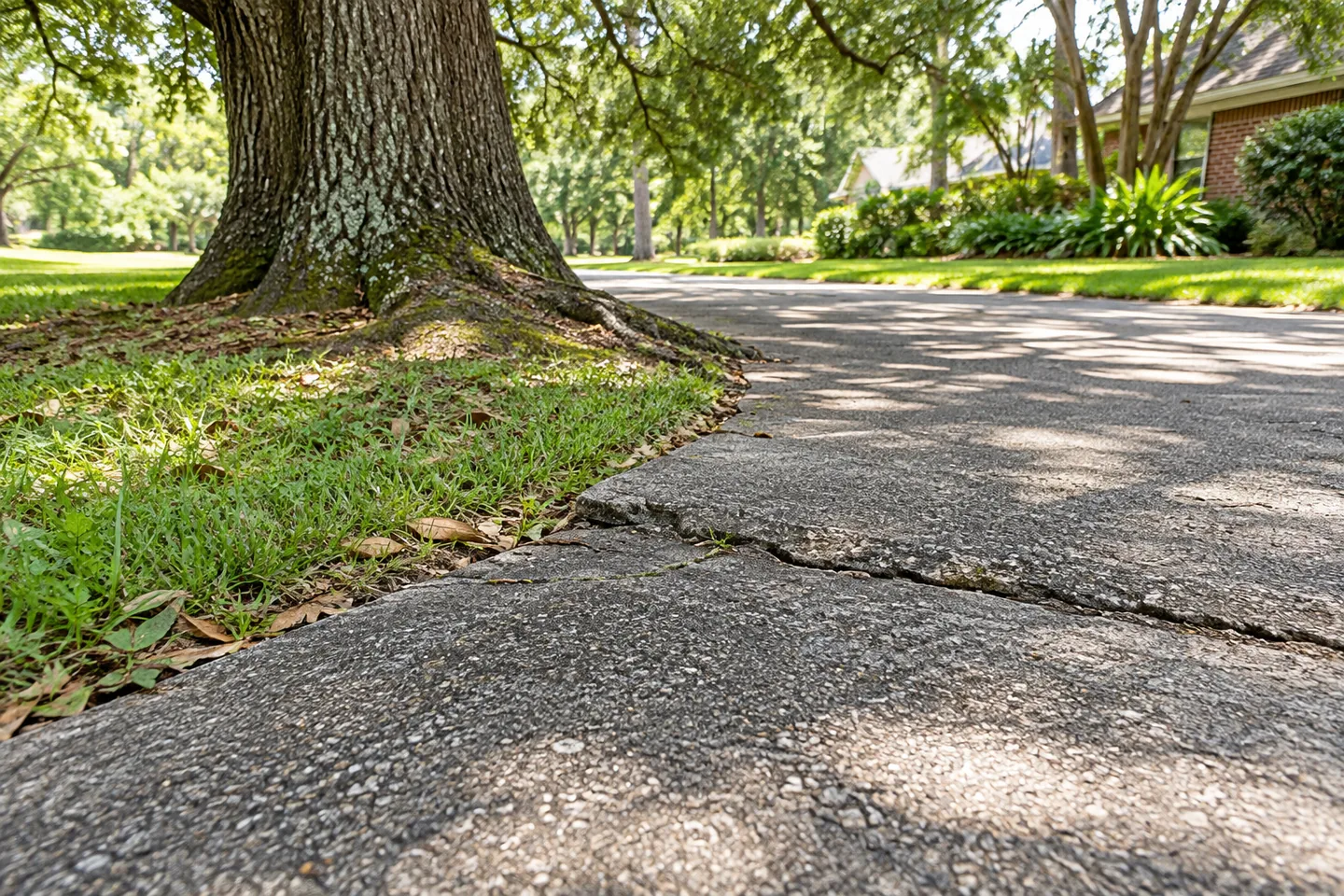
Heaving concerns upward change in the pavement
Heaving describes upward movement or uplift of pavement or its support. An owner may notice a raised section, an uneven connection or cracks around a higher area, but a current photograph does not establish the full cause or the history of movement. Begin with what is visible and any verified earlier condition. The property assessment should explain how that information affects the recommendation rather than diagnose supporting ground from the surface alone.
Distinguish an upward-movement question from a general surface ripple or an existing raised connection. Shoving describes displaced asphalt forming a bulge or ripple, while an owner may not know whether a higher area has actually changed over time. If the history is uncertain, describe the raised shape and location. Plain observations are useful without forcing a cause-related label or assuming that every higher section needs the same repair operation.
Nearby roots, moisture and ground conditions may be relevant to assessment depending on the site. Their presence is context, not proof of one cause. A tree beside a raised driveway does not establish that removing or cutting roots is the appropriate response. Likewise, an uplifted surface near a building does not diagnose the building's structure. Keep pavement observations and separate property concerns distinct so the proposed assessment and work remain understandable.
Locate the raised section and retained connections
Take a wide view showing the higher area in relation to the driveway or lot, then safe closer views of distinct cracks or transitions. Include fixed features such as retained concrete, a curb or a building corner. The wider context helps distinguish a localized rise from other uneven surfaces nearby. A close image can make a small feature appear to represent the entire route, so show the actual visible extent without assigning the final repair boundary yourself.
Where earlier photographs are available, identify the same physical location and keep known dates. If the views do not clearly match, label that uncertainty instead of presenting them as proof of movement at a specific point. Describe visible changes in plain language. Ordinary photographs can document appearance and location, but should not be treated as measurements of concealed uplift, soil behavior or the depth of an affected pavement layer.
If the raised section approaches a garage apron, sidewalk, gate or other retained feature, photograph both sides of the connection. Explain the use concern, such as a changed approach or clearance question, without selecting an exact removal dimension from image perspective. Ask which retained feature remains and what adjustment is offered. An asphalt repair scope should not silently include alteration of every nearby structure because the owner wants the entire connection reviewed.
Keep tree and ground questions within their proper scope
Show nearby vegetation and known landscaping history where relevant, without digging or cutting to investigate the concern for quote photographs. An owner should not disturb a tree root or suspected utility area merely to make the cause easier to illustrate. Give the contractor safe observations and available records. If the discussion identifies a need for another qualified assessment or separate work, keep that responsibility explicit rather than treating the paving price as authority for all ground changes.
If roots are suspected, phrase that as a question supported by the visible location. Ask how the contractor's recommendation accounts for retained vegetation and what coordination may be needed. Do not assume a pavement photograph authorizes tree work or proves the tree is responsible. A repair plan and a landscaping decision can be related while remaining separate scopes, with different people responsible for assessment, approval and the work actually offered.
Record visible wet-weather context when safe. Show the raised section and wider runoff route, including nearby retained drainage features. Describe when water was observed and what it appeared to do. Do not infer supporting-ground changes or a hidden water route from the image. The observation can guide site questions while the recommendation should explain which pavement and drainage-related items, if any, are included in the actual offered work.
Ask what the proposed repair retains and changes
A repair proposal should identify the evaluated area, the offered operation and the relationship to retained pavement. Ask what material is removed, prepared or replaced and how supporting conditions are addressed where relevant. The word heaving does not define a standard depth or unlimited scope. An owner needs an understandable description of the work recommended for the property, not a generic numerical specification selected from the name of a surface condition.
Where discoveries may affect the recommendation, agree how they are documented and approved. Identify the person authorized to decide on additional work and the pricing confirmation needed before proceeding. An allowance should name the possible work or its basis rather than hide uncertainty inside a fixed total. This makes an initial proposal reviewable without expecting the current raised surface to reveal every condition beneath or beyond it.
Compare the treatment of adjoining features across estimates. One proposal may include a particular connection or preparation item while another excludes it or assigns it to a separate party. Ask why their boundaries differ. The common request to address a higher section does not establish equivalent scopes. A fair comparison looks at offered operations, retained material, neighboring responsibilities and limitations before the owner compares the final prices.
Review access and retain a useful observation record
Explain the routes affected by the higher area and the proposed work. At a home, include garage access, ordinary turning and where vehicles can stay during closure. At a business, include pedestrian approaches, deliveries and customer movement. Do not deliberately move people or vehicles across a suspect section to demonstrate the problem. Use the property's normal access process while the actual assessment and sequence are discussed.
Ask who communicates closure changes and provides reopening instructions for the offered operation. A small raised feature can sit across the only usable entrance or an important walking route. The operating plan should be checked against that location rather than inferred from apparent repair size. Follow the contractor's written directions for the actual work and conditions; a smoother-looking surface is not independent permission for every expected use.
At closeout, keep the accepted scope, changes, available project photographs and care instructions together. Show the treated area and retained connections in wider photographs. If a raised appearance is later observed, record the same physical location and date without diagnosing a hidden cause or assigning fault from the image. Give Asphalt Solutions the property address, safe views and known history when asking which assessment and work can be offered.
Upward-change inquiry worksheet
Mark the raised section and retained connections, then match wider photographs to those references. Record known earlier condition and dates separately from uncertain movement history. Add visible vegetation and wet-weather context without digging or disturbing the area. State the practical use concern and any separate building or landscape question distinctly. A pavement record should make the inquiry clearer without turning nearby roots or a higher surface into a confirmed concealed cause.
Ask which pavement operation is offered and which coordination or separate assessment is needed. Record limits, retained features, supporting-material responsibilities and the process for approving additional work. Compare the proposed route restrictions with ordinary vehicle and pedestrian use. At closeout, use the same locations for photographs and care records. The worksheet keeps uplift-related questions tied to the accepted property-specific scope without authorizing unlisted tree work or expecting the initial image to establish every condition below the pavement.
Questions about heaving
Meaning in plain language
Heaving is upward movement or uplift of pavement or supporting ground. Roots, moisture and ground conditions may be relevant depending on the site.
A practical example
Photograph the raised area and adjacent joints or roots. Do not assume adding material around it resolves the source of movement.
Use the term in your project discussion
Photograph the raised area and nearby trees, edges and drainage.
Details that matter
- Raised limits
- Root proximity
- Surface cracks
A mistake to avoid
Do not assume a tree is the cause without investigating the site.
Continue with the right next step
Property conditions determine the final scope. These planning notes do not replace a site evaluation. How to use our pavement guidance