
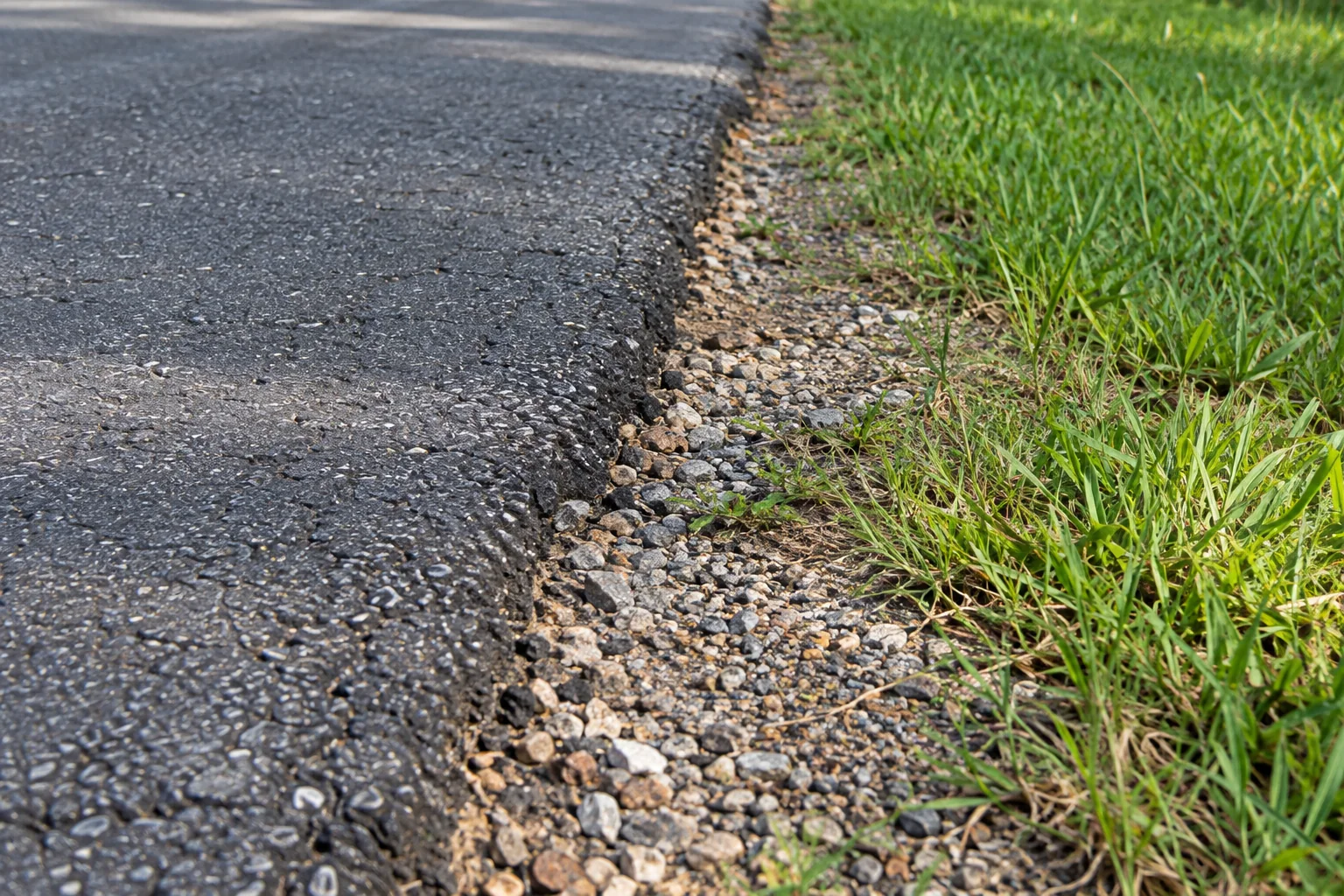
The edge is part of the pavement discussion
Pavement edge support refers to the conditions that help a pavement boundary resist movement or breakup. The edge meets the adjacent ground or another feature, so its condition cannot always be understood by looking only at the top surface. For an owner, the useful starting point is to describe what is happening at the boundary and how that part of the property is used.
An asphalt driveway may meet grass, gravel, a curb or another paved surface. Each setting creates different questions about the retained features and surrounding grade. The glossary term does not select a universal shoulder detail or imply that every broken edge has the same cause. Ask the contractor to evaluate the actual condition and explain which part of the proposed work addresses it.
Photographs should show the boundary and the area beside it. A close image of a loose fragment may not explain whether vehicles cross the edge, water collects nearby or adjacent work has changed the ground. Include that wider context when safe.
Describe vehicle use at the boundary
Tell the contractor whether vehicles travel close to the edge, turn across it or park partly beyond it. A driveway used only along its center may present a different discussion from a commercial entrance where repeated turning movements reach the boundary. Record the observed use without assuming that it proves the cause of the damage.
If the property use has changed, explain that before requesting a repair in the old footprint. A new delivery pattern, wider vehicles or different parking practice may affect what the owner needs from the edge. A localized repair can restore an area while leaving the operating question unchanged. Ask whether the proposed scope considers the way the location will actually be used afterward.
Avoid using a vehicle to test a weak-looking edge or moving heavy items onto it to see whether it holds. Identify the concern and arrange review. The appropriate person can explain interim access instructions for the observed condition. The owner's photographs and use description should help plan the evaluation, not become an improvised load test or a claim about unseen pavement strength.
Include adjacent grade, water and recent work
Look at what has changed beside the pavement. Landscaping, drainage activity, utility work or removal of adjacent material can be relevant information for the contractor. An owner may know that the ground looked different before another project without knowing the resulting support condition. Share that history as an observation and provide records where available.
Water concerns also belong in the request. Note where water collects or travels and whether the concern is associated with the edge. Photographs after rain may help explain the location when obtained safely. They do not establish the required grade or identify the correct repair. Ask whether evaluating the water issue is part of the proposed scope and whether additional information is needed.
If adjacent land or a drainage feature belongs to another party, identify that boundary early. A pavement contractor may not control work outside the owner's property or agreed area. Clarify who confirms access, permissions and any related requirements. The quote should show retained constraints and dependencies so an edge repair is not assumed to include work that another owner or authority must approve.
Compare repair of the surface with work beside it
A proposal may address damaged pavement, adjacent material or both. Ask which activities are included and how they relate to the observed concern. A surface-only repair should not be interpreted as including every support or drainage correction nearby. Likewise, adding material beside an edge should not be assumed to restore already damaged pavement. The evaluated scope needs to distinguish those responsibilities.
Ask what preparation or removal is proposed at the damaged boundary. If deterioration may extend beyond what is visible, agree on how findings during preparation are documented and approved. Do not choose a repair depth or shoulder dimension solely from an online example. The appropriate detail depends on the actual condition, intended use and relevant project information.
Retained curbs, aprons and adjoining pavement should be named separately. Ask how the repaired edge meets them and what restoration is included beside the work. If landscaping is disturbed or removed material must be disposed of, clarify those items before comparing prices. A short line item saying repair edge can otherwise leave the owner and contractor with different pictures of the finished result.
Plan access and protect the agreed work area
Edge work can affect a narrow part of a driveway while still limiting how vehicles enter or turn. Explain the actual access needs to the contractor and ask what restrictions apply during each activity. If the property cannot provide an assumed closure or vehicle move, say so before the crew arrives. A revised sequence may need a different evaluation of access and equipment space.
For a business entrance, include deliveries and pedestrian use in the discussion. An apparently open portion of the pavement may not be a suitable temporary route. Identify who plans the arrangement and who communicates it to staff and visitors. Where another trade works nearby, coordinate the sequence so completed edge work is not immediately disturbed by a separate activity that was never discussed.
Follow the project-specific release and any ongoing use instructions. Do not infer readiness from the surface appearance alone. Ask who authorizes reopening and what the owner should do if an adjacent condition remains outside the completed work. Retain those notes with the location record so future maintenance and property operations reflect the actual agreed scope.
A practical example and a useful site request
Imagine a homeowner requests repair of a crumbling driveway boundary beside a recently altered planting bed. The useful request identifies both the damaged pavement and the change beside it. Ask the contractor what can be evaluated and whether the proposed work includes the adjacent condition. The timing of the landscaping is relevant history, but it should not be presented as proof of the cause without review.
Now compare two offers for that same boundary. One may describe replacing damaged asphalt while another also includes defined work beside it. Ask both to explain their assumptions and the intended result. Compare the same locations, preparation, restoration and limitations. The example shows why an edge discussion needs more than a measured strip of surface area; it does not prescribe a construction section.
To discuss a pavement edge with Asphalt Solutions, send the job-site address, wide and close photographs, known adjacent work history and a description of vehicle use. Call or text first. Most projects take place at customer properties, and visits to the Slidell contact location are by appointment. Ask for a property-specific scope describing the damaged pavement, adjacent work, retained features, access instructions and any question that still requires evaluation.
Keep future work beside the edge in view
Tell the contractor if landscaping, drainage or utility activity is planned beside the repair after paving is complete. That later activity may affect the sequence or create a coordination question. The parties should decide who supplies the relevant information and whether the edge work depends on another step being completed first.
Keep the approved boundary and adjacent-work description with the completion record. If a later contractor changes the area, provide the earlier scope so the new work can be discussed with context. The record does not prescribe future design, but it prevents an owner from assuming the repaired pavement was evaluated under conditions that only appeared afterward. Accurate history makes a later edge concern easier to explain.
Questions about pavement edge support
Meaning in plain language
Edge support is the condition that helps pavement boundaries resist movement or breakup. Adjacent grade, water and vehicle use may matter.
A practical example
Show the shoulder or adjoining ground and describe wheels crossing the boundary. The support outside the asphalt edge matters to the discussion.
Use the term in your project discussion
Include shoulders and bordering ground in the assessment.
Details that matter
- Drop-offs
- Erosion
- Turning vehicles
A mistake to avoid
A sealed crack does not restore missing edge support.
Continue with the right next step
Property conditions determine the final scope. These planning notes do not replace a site evaluation. How to use our pavement guidance