
Lifecycle means the whole history of a pavement
A pavement lifecycle includes its construction, use, care, repairs and eventual renewal. Thinking in those stages helps an owner connect today's decision with the property's history and future needs. It does not produce a fixed expiration date for every driveway or lot. The useful question is how the actual pavement has performed and which next step is appropriate for its present condition.
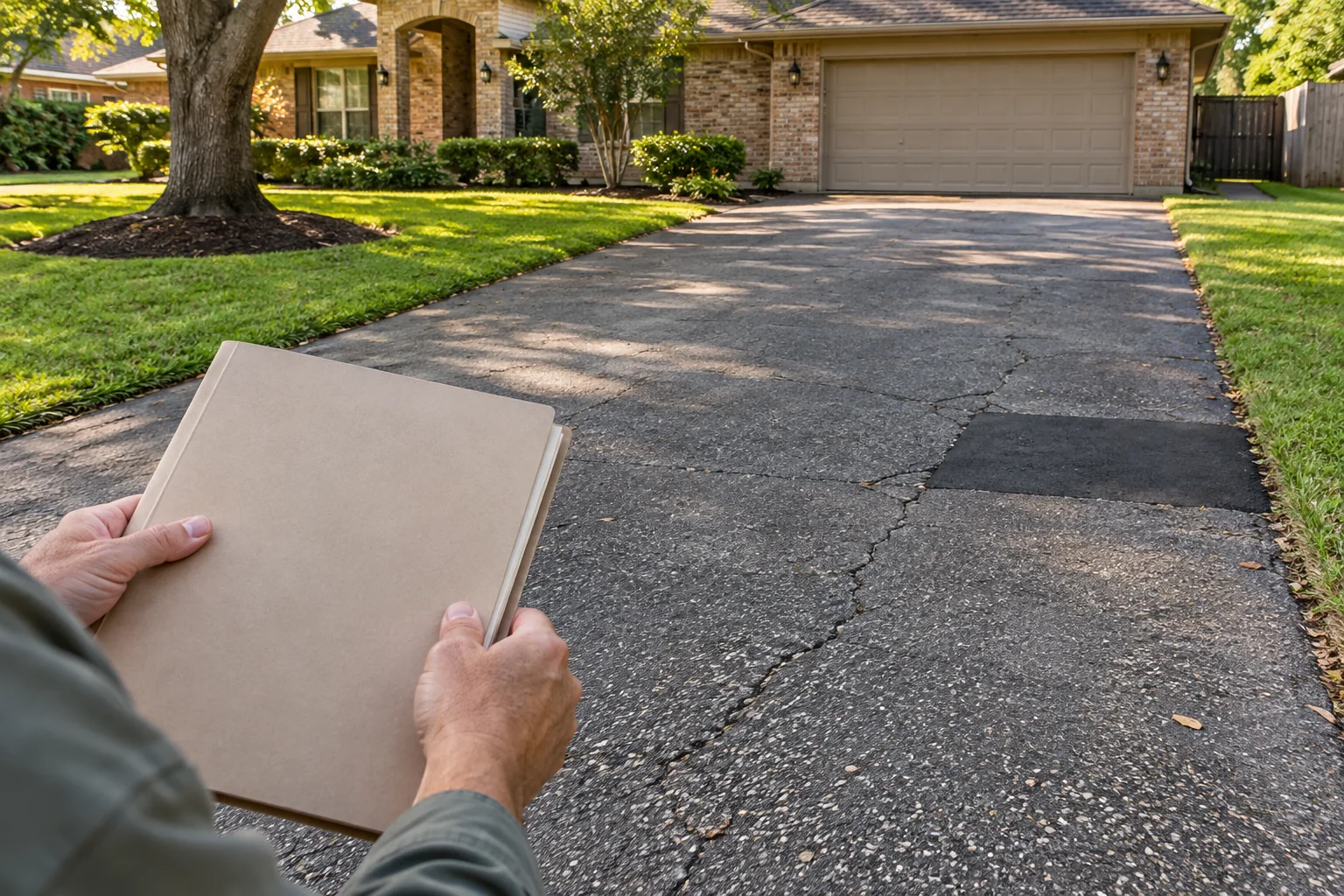
An owner may inherit pavement without knowing when it was built or what work was done later. Start with what is known and label uncertainty honestly. A visible repair establishes that some work occurred at a location; it does not establish the complete construction history of the property. A darker surface may reflect a later activity without telling you what preparation or repair preceded it.
Lifecycle planning is useful because separate decisions often become disconnected. A tenant requests a patch, a manager schedules markings and a later owner considers resurfacing without seeing the earlier records. Bringing those activities into one location-based history helps the next evaluator ask better questions. The record should support a site discussion, not replace the evaluation needed to select future work.
Build a simple history tied to actual locations
Begin with a property sketch or plan and a consistent way to name areas. A garage approach, entrance lane and rear parking row can each have different work histories. Record the date and location of known construction, repair or treatment work, and attach the scope if available. A general invoice saying pavement work is less useful than a description that identifies the affected area.
Keep photographs that show the condition before and after documented work, but do not invent missing comparisons. Images taken at different angles or on different dates can still be useful when their context is clear. Label what each image actually shows and retain the original file. An educational image on a website should never be substituted for evidence of work completed at your property.
Add observations about recurring conditions. If water collects near the same entrance or a particular patch has needed attention again, record the location and approximate sequence. Avoid assigning a cause without evaluation. The value of the history is that it shows a pattern worth discussing, allowing the contractor or appropriate professional to decide what information is needed next.
Relate changing use to future pavement decisions
A pavement's use can change over its history. A residence may gain frequent service activity, or a commercial tenant may introduce a different delivery pattern. Tell the evaluator about these changes rather than assuming the original arrangement still represents the future need. The current visible condition and intended use both belong in the next project discussion.
Also note changes around the pavement. A modified entrance, retained drainage feature or revised parking arrangement can affect the questions asked during maintenance or renewal. Keep relevant plans or evaluations with the pavement records. The aim is not to collect unrelated paperwork; it is to preserve the information that explains why a surface connection, access arrangement or project boundary was chosen.
When ownership or management changes, include the pavement history in the handoff. Identify incomplete work, continuing restrictions or a recommended review that has not occurred. A new manager should not have to infer those details from old photographs. A concise location record and the actual scope documents give the next person a clearer starting point than an unsupported claim that the lot was completely redone.
Compare options across the intended period of use
A lower initial price does not by itself answer the owner's broader planning question. Ask what the proposed work addresses now, what limitations remain and what future review or maintenance expectations are relevant. A more extensive option may carry different preparation, access and operating demands. Compare those differences openly instead of assuming that every proposal creates the same future condition.
If a contractor provides an expected service period or maintenance recommendation, ask what assumptions it depends on and whether it is part of the written agreement. Do not convert a general industry example into a guarantee for your property. Use actual proposal information and identify uncertainties. A lifecycle conversation can compare scenarios without pretending that every future repair date or cost is already known.
Property operations may also influence the decision. Repeated small projects can require repeated vehicle moves or tenant notices, while a larger project may require a different closure. Ask how each option affects the site and what owner actions it assumes. Those operating effects belong beside the construction description because the property must support the proposed sequence for the plan to be practical.
Separate condition review from a calendar reminder
A reminder to review pavement can be useful, but the calendar alone does not select a treatment. New damage, recurring failure or a change in use may prompt attention before a planned review date. Conversely, a generic maintenance interval should not be treated as proof that a specific activity is needed. Ask what observations should lead to a site evaluation and what information the owner should collect.
The review can begin with updated photographs and a comparison with the previous location record. Note what appears unchanged, what has progressed and what is newly observed. The owner does not need to diagnose the pavement to provide a useful update. Clear observations help the evaluator connect the current question with earlier work and avoid relying on a vague recollection that the area has always looked that way.
Keep the result of the review, including any recommended next step that remains undecided. If a proposed investigation or repair is deferred, record that decision without implying that the concern has been resolved. This makes the next discussion more accurate. The lifecycle record should show both completed actions and open questions rather than presenting every note as a finished maintenance task.
A practical lifecycle record and a starting conversation
Imagine a manager comparing two renewal proposals without knowing whether an entrance was repaired during the previous project. A location-based invoice and dated photographs could answer that question. If those records do not exist, the manager should state the uncertainty and ask what evaluation is appropriate. Guessing that the entire entrance was rebuilt could lead to a misleading comparison of the new options.
Now imagine a homeowner planning to sell and wanting to describe driveway work accurately. The useful record states what was done and where, with the date and actual contractor scope. It does not replace an evaluation or promise a remaining lifespan. That same approach helps a future owner decide which questions to ask instead of relying on a broad claim that the driveway is new.
For a pavement planning conversation with Asphalt Solutions, send the job-site address, photographs and whatever work records are available. Explain the current concern, intended property use and access constraints. Most work occurs at customer properties. Call or text first; visits to the Slidell contact location are by appointment and phone availability is separate from construction scheduling. Ask for the next scope and its limitations to be documented so the history remains useful.
Make uncertainty useful rather than hide it
A lifecycle record does not need perfect historical information to be useful. Divide the known work from uncertain dates or undocumented observations, then state the question those gaps create for the next evaluation. For example, an owner may know a patch appeared before a tenant change without knowing its construction details. Retain that limited observation as an observation. The next contractor can use it to frame questions while avoiding the false assumption that a complete repair history has already been established.
Questions about pavement lifecycle
Meaning in plain language
Lifecycle refers to the stages of construction, use, maintenance, repair and eventual renewal. Timing and care influence costs across those stages.
A practical example
Use condition records and operating changes to plan the next decision. Calendar age alone does not describe every pavement’s remaining usefulness.
Use the term in your project discussion
Plan recurring inspections and document repairs instead of looking only at the next coating or patch.
Details that matter
- Inspection history
- Repair records
- Future use
A mistake to avoid
A universal lifespan number cannot account for every property’s conditions.
Continue with the right next step
Property conditions determine the final scope. These planning notes do not replace a site evaluation. How to use our pavement guidance