
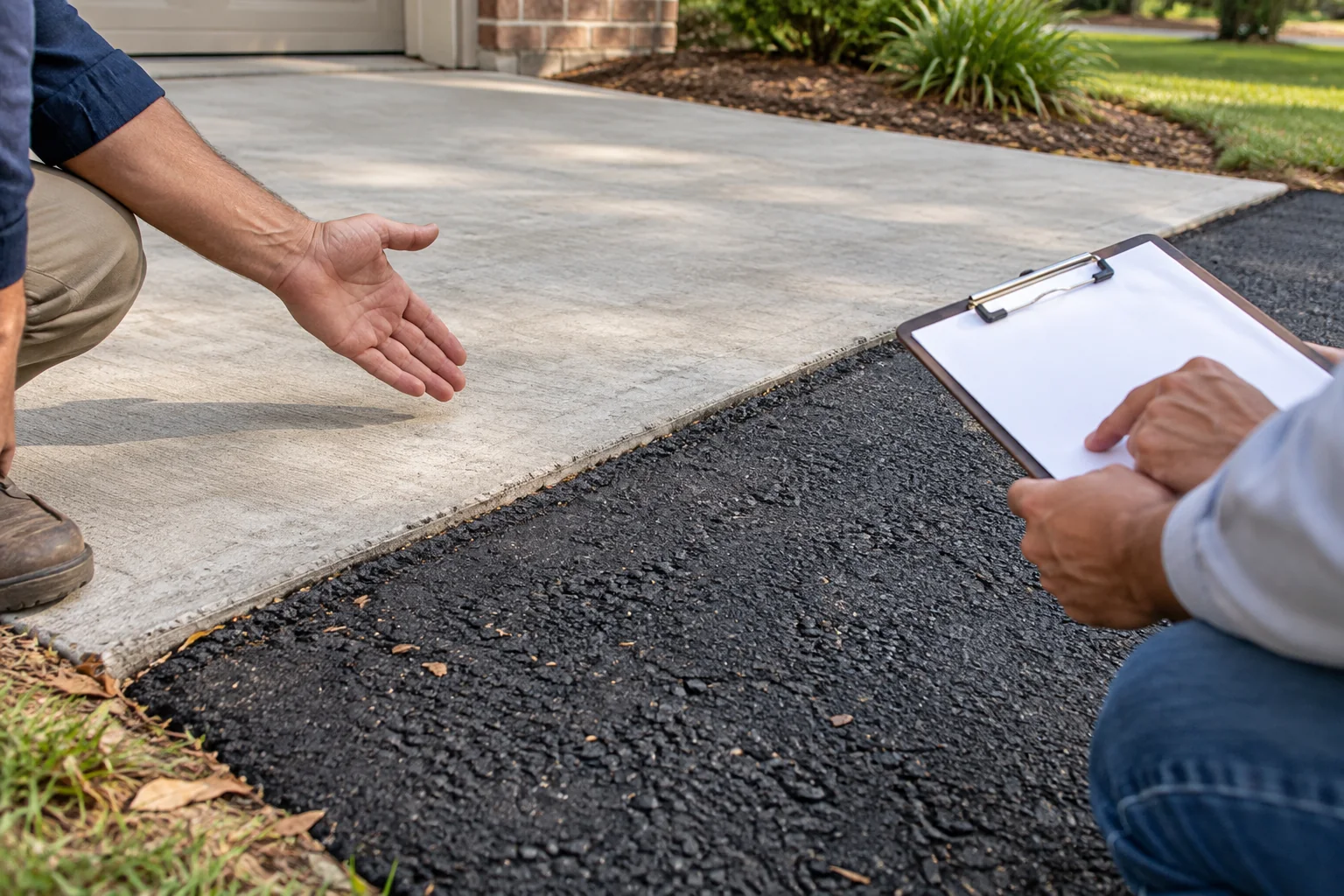
A punch list makes agreed completion items visible
A punch list records items to review or address near project completion. Its purpose is to connect the completion discussion with the written scope and approved changes. A useful item identifies the location, the concern and the agreed next step. A general statement that the job needs finishing leaves the owner and contractor to guess which part of the property is being discussed.
The list should reflect actual project information rather than a generic inspection checklist copied from another job. Different pavement work has different scope and documentation. Ask how the contractor prefers to conduct the completion review and who has authority to agree on the next action. The discussion is most useful when both parties can refer to the same accepted description of work.
This glossary explains a practical record, not contract rights, payment terms or a universal acceptance procedure. Those matters depend on the actual agreement and applicable requirements. Keep the punch list tied to the work being reviewed and obtain appropriate advice for a separate contract question. Do not treat an educational website example as a replacement for the project's agreed closeout process.
Start with the accepted scope and approved changes
Bring the relevant proposal, location sketch and documented changes to the completion discussion. They establish what work was actually agreed. An owner may remember an early option that was not included in the final scope, while a contractor may need a reminder of a later approved change. Using the same record helps distinguish an unfinished item from a new request.
Identify exclusions and retained features as well. A sidewalk, drain or adjacent pavement may remain outside the completed work even though it appears near the project. If a concern arises there, ask how it relates to the agreed boundary rather than automatically listing it as unfinished contractor work. The parties can then decide whether it needs clarification, separate evaluation or another proposal.
If a change was discussed but not clearly documented, describe the uncertainty honestly and request clarification. Do not rewrite the project history in the punch list. Record what the parties agree to do next and keep the supporting information with the item. This makes the list a useful working record instead of a collection of conflicting assumptions about the original promise.
Write each item so another person can find it
Use a recognizable location name and a concise description of the observed concern. A wide photograph can show where the item sits, with a close view explaining the detail. Avoid relying only on a file number or a very close image that could belong anywhere. The person returning to review the item should be able to identify the same spot.
Separate observations from conclusions. An owner can record loose material, a visible connection concern or an incomplete marking without claiming an unseen cause. Ask the contractor to explain the condition and proposed response. If a technical evaluation is needed, identify that next step instead of inventing a repair detail in the list.
Keep distinct items separate even when they are nearby. Cleanup, a retained-surface question and a requested addition may require different responses. Combining them into one vague note makes it harder to tell what has been resolved. A clear item can be updated with the actual action and date while leaving another nearby question open for the appropriate party.
Agree on action, responsibility and status
For each item, identify the agreed response and responsible contact. That may be a return visit, an explanation, a document, another evaluation or clarification that the item is outside the accepted scope. Not every observation necessarily results in construction work. The useful record states the next step instead of assuming the same remedy applies to every concern.
If a return activity is planned, discuss how its timing will be confirmed and what access it requires. Weather, property availability or another trade may affect the arrangement. Avoid representing a tentative date as a fixed appointment unless it has been confirmed. The property contact should know how updates will be communicated and what action the owner must take before the return visit.
Use an understandable status such as awaiting clarification, planned, completed or reviewed, consistent with the project's process. Do not mark an item resolved only because a message was sent. Record the actual response or completed action and any remaining limitation. A person looking at the list later should be able to distinguish communication from physical completion and review.
Coordinate completion with reopening and related work
A punch-list item can affect access even when the main project appears complete. Ask whether the item creates a continuing restriction or can be addressed under a separate planned arrangement. Do not infer reopening from the list's length or from the crew finishing most of the work. Follow the project's actual release instructions for the affected area.
Where several trades are involved, identify the relevant handoff. A marking task, adjacent concrete item or separate utility activity may have a different responsible party. The owner should understand which contact manages it and whether it affects the paving contractor's next action. Keep the dependency with the item rather than assume one contractor controls every remaining task on the property.
Tell occupants about any return work that changes access. A tenant or household member may reasonably believe construction has ended after the main release, so another visit needs clear communication. Identify who notifies them and what area is affected. The completion record should support ordinary property operations, not remain a private list that the people using the site never hear about.
Use a practical example to separate review from added work
Imagine an owner notes an unfinished agreed marking and also asks for a new marked area that was never in the accepted scope. Record the first as a completion item and the second as a requested addition for discussion. Combining both under finish striping would hide the scope distinction. Ask the contractor to clarify the next action for each and retain the response with the location record.
Now imagine a concern at a retained garage apron beside the new pavement. The useful item identifies the exact connection and asks how it relates to the agreed work. It should not assume that every visible condition of the retained concrete was included in the paving project. The parties can review the boundary and determine the appropriate next step using the actual agreement.
Finally, record how the item was closed. A dated note and relevant photograph may help show what was done or clarified, but do not label an undocumented test or hidden construction detail as verified. Keep the record faithful to the actual review. That makes it useful for future maintenance and avoids turning a completion conversation into a broader claim than the evidence supports.
Ask for the completion process before the job ends
During planning, ask who will review completion with the property contact and how agreed follow-up items are documented. Keep the final scope, approved changes, list status and reopening instructions together. A clear process helps both parties know what remains to be discussed without waiting for an ambiguous last-day conversation.
To discuss a project with Asphalt Solutions, call or text the actual job-site address and the work needed. Most projects take place at customer properties. Visits to the Slidell contact location are by appointment, and phone availability is separate from work scheduling.
Questions about punch list
Meaning in plain language
A punch list records agreed items to review near completion. It is most useful when connected to the written scope and discussed before final closeout.
A practical example
Connect each item to the agreed scope, its location and a photograph. Distinguish incomplete agreed work from a new requested addition.
Use the term in your project discussion
Inspect transitions, cleanup, markings and agreed project details together.
Details that matter
- Scope items
- Documented concerns
- Follow-up responsibilities
A mistake to avoid
A punch list should not introduce entirely new work that was never part of the agreement.
Continue with the right next step
Property conditions determine the final scope. These planning notes do not replace a site evaluation. How to use our pavement guidance