
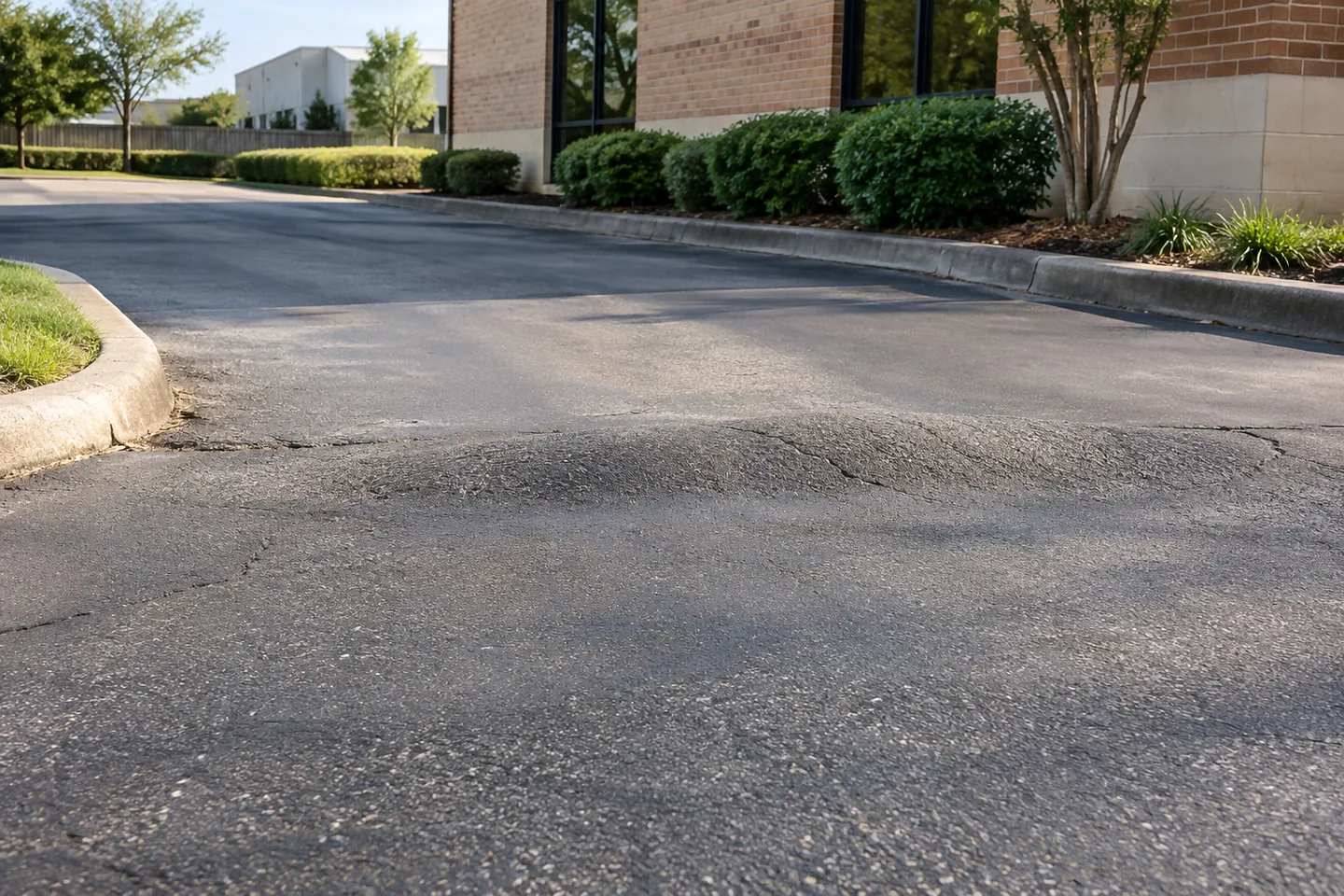
Shoving describes displaced pavement at the surface
Shoving describes displacement of asphalt that creates a localized bulge, ripple or pushed-up section. The term identifies visible deformation; it does not determine the affected layer or a complete cause. An owner may notice a raised area where vehicles turn or brake, but that location alone is not a diagnosis. Show the feature and the route around it, then ask what property assessment and work can be offered.
Distinguish a raised ripple from a low wheel-path track or a separate uneven connection. A driveway entrance may contain more than one visible feature, and one photograph can obscure their relationship. Describe whether the concern appears raised, low, displaced or simply different from retained concrete. If uncertain, use plain language and wider views. The contractor needs the actual arrangement rather than a forced technical category selected before seeing the property.
Shoving should also be kept separate from a general statement that pavement is moving. A camera image records appearance at a moment; it does not establish ongoing movement, material behavior or hidden support condition. Share dates and verified changes if available. The recommendation should explain which assessed concern it addresses and what remains uncertain instead of treating the name of a surface shape as a construction specification.
Show the bulge and ordinary approach
Take a wider view of the raised or rippled section with surrounding retained pavement. Include the approach from each side when safe, especially at an entrance or turning area. A closer view can show cracking or missing material without revealing what exists below. Identify fixed references on a sketch if several features are present. The visible high point is a location reference, not automatically the complete boundary of the contractor's proposed repair.
Explain how vehicles normally approach the feature. Note known braking, turning or stopping movements and any recent change in use. Present this as operating context rather than proof of the cause. Do not repeatedly drive over the area to demonstrate deformation for photographs. If a route appears unsafe, use the property's normal restriction process. A useful record should support assessment without creating another event or treating an informal demonstration as a technical test.
Where the raised area meets a curb, concrete apron, gate or utility feature, photograph that connection. Describe visible clearance or transition concerns without prescribing an exact removal height from the image. Ask how the proposed work relates to retained items and which adjustments are included. A localized ripple can affect a larger route, but the paving scope should not silently expand to every neighboring structure simply because they are close to the observation.
Use earlier work and chronology carefully
If the section has a known repair or surface-renewal history, share the accepted scope and dated photographs where available. A different-looking strip can provide context, but does not prove the earlier operation or hidden depth. State what is known and what is uncertain. The contractor can then evaluate the present concern without receiving an assumed chain of material failures based only on the geometry of an older patch.
If the raised appearance changed after a period of use, identify when you observed it and the location. Avoid claiming that the first observation is necessarily the start of the condition. Lighting, viewpoint and surface wear can affect what photographs show. Consistent records make the sequence clearer while keeping technical conclusions separate. The owner should explain the concern prompting review rather than prove a specific material behavior through ordinary snapshots.
Other contractors or vehicles may have used the route during the same period. Provide verified events if relevant, but do not infer responsibility solely from their timing. This helps the site discussion remain focused on the current assessed condition and offered remedy. If more information is needed before a recommendation can be fixed, record that requirement instead of pushing an uncertain explanation into the accepted repair scope.
Compare removal, preparation and retained conditions
Ask the contractor to explain what operation is recommended for the displaced area. The proposal should identify repair boundaries, preparation, material retained and material replaced. If supporting conditions need evaluation or treatment, request clear responsibility and limits. A simple line saying fix the bulge can conceal meaningful differences between a localized repair and broader pavement work. The owner needs a plain description of the actual work being priced.
If a surface-renewal operation is proposed, ask how it accounts for the raised section and nearby transitions. Do not assume another layer by itself resolves every deformation concern or automatically creates the desired connection to concrete or a gate. The contractor's explanation should connect preparation and repairs to the final surface arrangement. Keep the assessed recommendation separate from a general appearance goal such as making the entrance look uniform.
Agree what happens if preparation reveals conditions outside the initial plan. Identify the information provided, how extra work is priced and who may authorize it. An allowance needs an understandable basis rather than an unlimited implied scope. This is useful at a raised area because the surface shape alone cannot predict every concealed condition. The change procedure should let the owner make a concrete decision while preserving the accepted initial work description.
Plan the entrance during work and review the result
At a business, map customer approaches, deliveries, collection routes and pedestrian movement around the affected section. A localized repair at the entrance may influence all of them. Discuss the proposed sequence with the people managing those movements and identify who communicates the changes. A work boundary and an operating route are related but different; a small marked area does not guarantee that the remaining route accommodates every expected vehicle.
At a home, show the only driveway route, garage connection and space needed for normal turning. Mention scheduled deliveries or other work that uses the entrance. Request written closure and reopening instructions for the offered operation. Avoid deciding that the area can be used because the surface appears level or the contractor is temporarily absent. The accepted work plan should explain restrictions and how the owner receives notice when the usable route changes.
At closeout, keep photographs of the treated area and retained connections with the accepted scope, approved changes and care instructions. Record any specific visible question by location rather than declaring the whole surface satisfactory or defective from one picture. If a raised appearance later returns, document the observation and known chronology without diagnosing its hidden cause. Give Asphalt Solutions the project address and these records when requesting a property-specific discussion.
Raised-ripple repair worksheet
Locate the visible ripple or bulge on a property sketch and match it to wider views of both approaches. Note nearby retained concrete, curbs, gates and ordinary turning or stopping movements. Keep verified use and repair history separate from possible explanations. Identify the practical improvement wanted, such as reviewing the entrance connection or a localized uneven area, without prescribing a repair depth from the highest visible point.
For each proposed item, record the evaluated area, removal or preparation description and material retained. Add any supporting-material responsibility, allowance or discovery procedure. Compare the access arrangement with the movements shown on the sketch. At closeout, photograph the defined work and retained connections with the same references. This ties the visible deformation to an accepted scope and follow-up record without treating the surface shape as a complete diagnosis or an unlimited repair promise.
Questions about shoving
Meaning in plain language
Shoving is displacement of asphalt that creates a bulge, ripple or pushed-up area. Turning, braking and pavement conditions can be relevant.
A practical example
Show the displacement together with the turning or braking route. Photograph from the side when possible so the ridge is visible.
Use the term in your project discussion
Document the shape and the vehicle activity at that location.
Details that matter
- Turning point
- Braking area
- Surface movement
A mistake to avoid
Flattening a visible ridge may not address why it formed.
Continue with the right next step
Property conditions determine the final scope. These planning notes do not replace a site evaluation. How to use our pavement guidance