
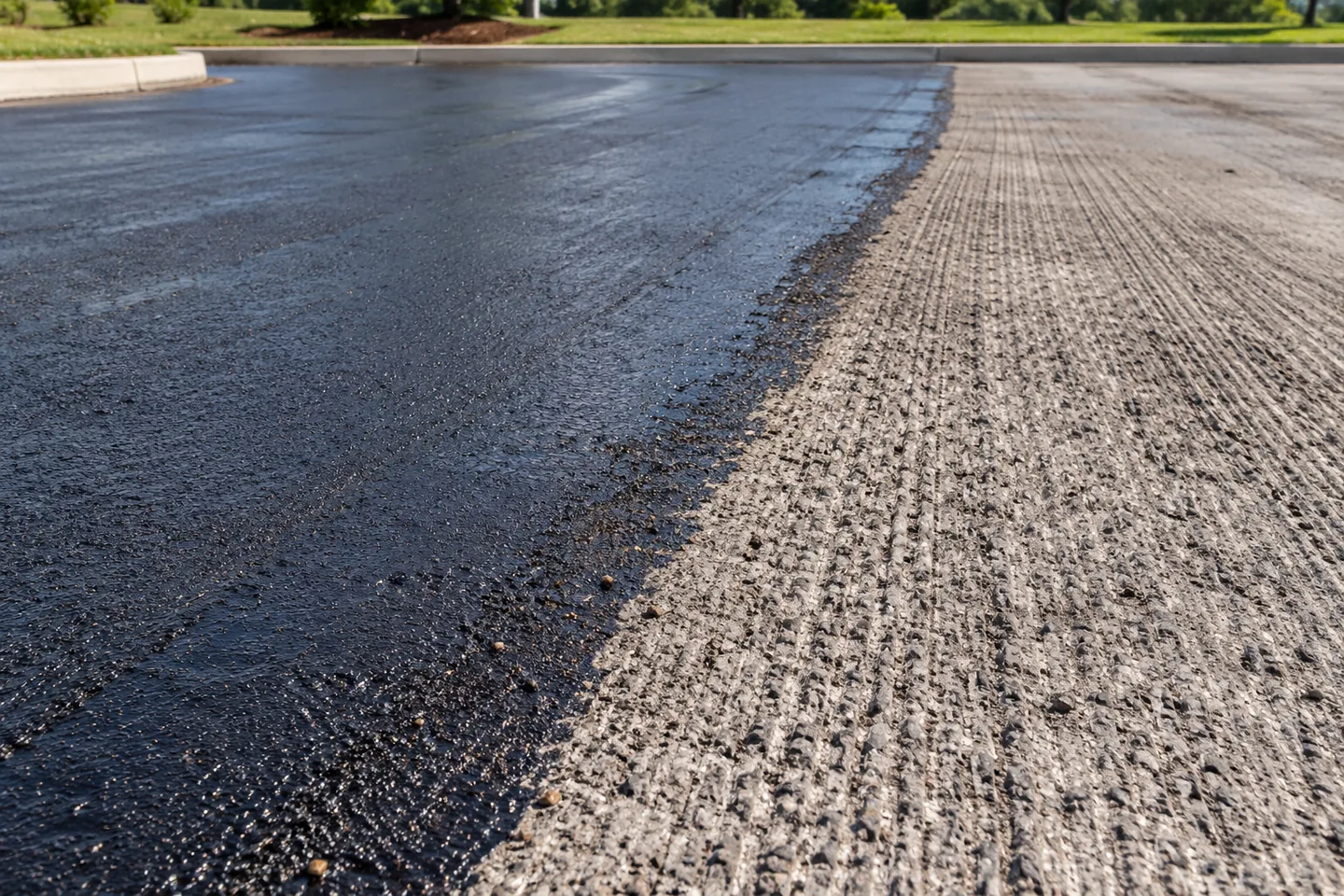
Tack coat is an interface treatment
Tack coat belongs in a discussion about the connection between pavement layers. It is not the finished driving surface and should not be confused with sealcoating applied as surface maintenance. For an owner reviewing an asphalt proposal, the central question is where the proposed paving needs an appropriate bond to the surface below it. The contractor should explain that relationship within the actual scope. A dark prepared area in a photograph may illustrate an intermediate step, but its color alone does not prove the material, application or suitability for the particular project.
Highway guidance addresses tack coat as part of a controlled construction process with project requirements, preparation and material checks. Those documents provide terminology context; they are not a private-driveway specification to copy without review. A property owner does not need to choose an application rate from a highway table to request a clear quote. Instead, identify the existing surface and ask how preparation and the relevant interface treatment are included in the proposed paving work. Keep responsibility for the technical construction decisions with the qualified parties assessing the actual project.
Identify the surface that will receive the next layer
Start with the proposed footprint and distinguish existing asphalt, a milled surface, retained concrete and areas requiring removal or repair. A broad photograph and a simple sketch can show those relationships. Ask the proposal to identify which existing surfaces remain beneath the new work and which do not. The answer affects how the contractor explains preparation and connections. Do not infer concealed construction from an overhead image, and do not assume every dark section of an old parking lot is the same material or has the same treatment history.
Where a proposal includes milling, ask how that task relates to the area being resurfaced and the retained features around it. The newly exposed texture is not the finished pavement. Owners should understand which routes remain available during the intermediate stages and which are part of the work area. A photograph of milled pavement can help explain the sequence without establishing the completed scope. Keep a record of what the contractor proposes for each named area so that preparation, interface treatment and new surfacing do not become an indistinct single line in the agreement.
Ask about preparation without prescribing the crew's procedure
A useful scope discussion identifies preparation as actual work rather than an assumption hidden behind the word overlay. Ask what the contractor will assess before the next layer is placed and how unexpected surface conditions are handled. If the answer introduces an optional or additional task, ask how the owner approves it. The goal is an understandable agreement, not an owner-written instruction for operating equipment or applying material. A glossary should not turn a generic description into a procedure for an untrained person to carry out on an active construction site.
Dust, loose material, contamination and weather are examples of matters that may be relevant to an interface-treatment discussion. They should prompt questions about the contractor's plan rather than unsupported conclusions from a photograph. Ask who determines readiness for the next operation and how changes in the work sequence reach the property contact. Avoid telling the crew to proceed because an image looks dry or because another contractor used a different timetable elsewhere. The actual material, surface and project requirements govern the construction decision, while the owner needs clear communication about access and scope.
Keep tack coat separate from the repairs it does not describe
A proposal mentioning tack coat does not, by that phrase alone, include repair of potholes, unstable-looking areas, broken edges or drainage concerns. Identify those observations independently. Ask whether preparation includes selected repairs and where their boundaries lie. If a recurring defect is present, share records without claiming that an interface treatment addresses its underlying cause. Different tasks may belong in the same paving project, but they should remain recognizable in the scope so that the owner can compare offers and understand which concerns remain open after completion.
Retained concrete aprons, curbs, drain structures and building approaches also deserve their own scope questions. Show the contractor the full connection and describe how the property uses it. Ask what will change, what stays and whether another review is needed. Do not assume a bond-related construction term settles finished elevations, accessibility or water movement. Those are separate decisions that may interact with the paving plan. Keep them in the same project record while preserving their distinct responsibilities, rather than letting a technical phrase imply that every adjoining feature has been assessed and included.
Explain the intermediate work stage to property users
The owner-side access plan should recognize that preparation can make an area unavailable before the finished asphalt is installed. Tell the contractor which entrances, deliveries, parking spaces and pedestrian routes matter. Ask how temporary boundaries will be identified and when instructions will change. An area that looks like ordinary pavement may still be part of the active sequence. Staff, tenants and household members should follow the agreed access instructions rather than deciding readiness from appearance. Choose one contact who can distribute updates consistently to people arriving at different times.
At the project handoff, retain the final scope, approved changes and any relevant construction records supplied under the agreement. A finished surface generally conceals the interface beneath it, so an after photograph cannot verify every intermediate step. If there is a question, ask about the actual records and the specified work rather than treating a stock image as proof. Describe the location and practical concern clearly. This helps keep follow-up focused on the agreement while acknowledging the limits of what an owner can establish through ordinary observation of the final pavement.
Use an interface-treatment question sheet
Start the sheet by naming the proposed resurfacing or paving area and describing the existing surface that is expected to remain. Match it to a broad photograph and identify any milled, repaired or retained-concrete section separately. Ask the contractor to correct anything the owner has identified uncertainly. The purpose is a common location reference, not a homeowner specification for which material or quantity should be applied at the interface between pavement layers.
In the preparation field, record what the proposal actually includes before the next layer. List unresolved surface questions and the person responsible for deciding whether additional work is needed. Ask how the decision reaches the owner and how any change is approved. Keep this separate from a guess about the final appearance. The completed surface will conceal the interface, so the useful agreement identifies the work and relevant records rather than relying only on an after photograph.
In the access field, identify which areas may be unavailable during preparation as well as during final paving. Note the entrances, delivery routes and pedestrian connections that need an agreed alternative. Ask how temporary boundaries and instructions will be communicated. Do not assume a dark intermediate surface is ready for use or that a route outside the main paving footprint is automatically an approved bypass. Keep the contractor's actual sequence connected to the owner-side communication plan.
In the closeout field, retain the final scope, changes and any records supplied under the agreement. If a question concerns an intermediate step, ask about that actual location and the applicable project records. Avoid using a reference image as proof that a material was applied or omitted. Clear documentation lets the contractor respond to the agreed construction rather than a photograph-based assumption, while leaving technical judgments with the responsible people who assessed and performed the work.
Questions about tack coat
Meaning in plain language
A tack coat is an application used to help asphalt layers bond when specified for the work. Surface preparation and application conditions affect the interface.
A practical example
When an overlay is proposed, ask how the old surface will be cleaned and prepared for bonding. Do not mistake the bonding treatment for the finished pavement.
Use the term in your project discussion
Ask how bonding between existing and new pavement will be addressed.
Details that matter
- Clean surface
- Material application
- Placement sequence
A mistake to avoid
The top layer should not be considered independently of its connection below.
Continue with the right next step
Property conditions determine the final scope. These planning notes do not replace a site evaluation. How to use our pavement guidance