
The decision in plain language
Label what you saw and what remains uncertain before requesting a recommendation.
The situation to discuss
Use a sketch with arrows for observed flow, and mark unseen pipes or suspected sources as questions. This prevents assumptions becoming scope facts.
Your five-point decision sheet
Use these headings on a simple sketch or in your project notes. Under each one, write the actual property observation, the question you still need answered and the person responsible for the decision. Leave an unknown item marked as a question instead of assuming it is included.
- What was actually visible, where and on which date?
- Which event timing is known and which details remain uncertain?
- How do wide and closer views refer to the same section?
- Which statements are reported observations or provider assessments?
- What specific pavement improvement is requested for review?
What not to assume
A confident-looking arrow on a sketch does not prove an unseen drainage connection.
Turn the discussion into a clear work boundary
Keep a simple reference view beside the estimate so the water observations remain connected to the section being discussed. Identify which statements are dated owner observations and which came from another source. The actual offer should name the pavement work authorized, while the observation file keeps unassessed questions clear. A later contact can then follow the record without mistaking a collection of photographs for a confirmed account of hidden conditions.
If a later observation changes the request, explain what was actually seen and where before asking the contractor to reconsider the offer. Keep any new assessment with its source and identify the authorized contact for a scope revision. An updated question should not silently become additional accepted work. Save the current written response so later observations remain distinguishable from the pavement task the owner has actually approved.
Bring the right information to the visit
Send your address, the overall project goal and photos showing this specific connection or operating area. Include a wide view for context and a closer view of the detail under discussion. Describe any timing or access constraint that affects the decision. Avoid placing yourself in traffic or entering inaccessible structures to collect information.
Begin with the question you want reviewed
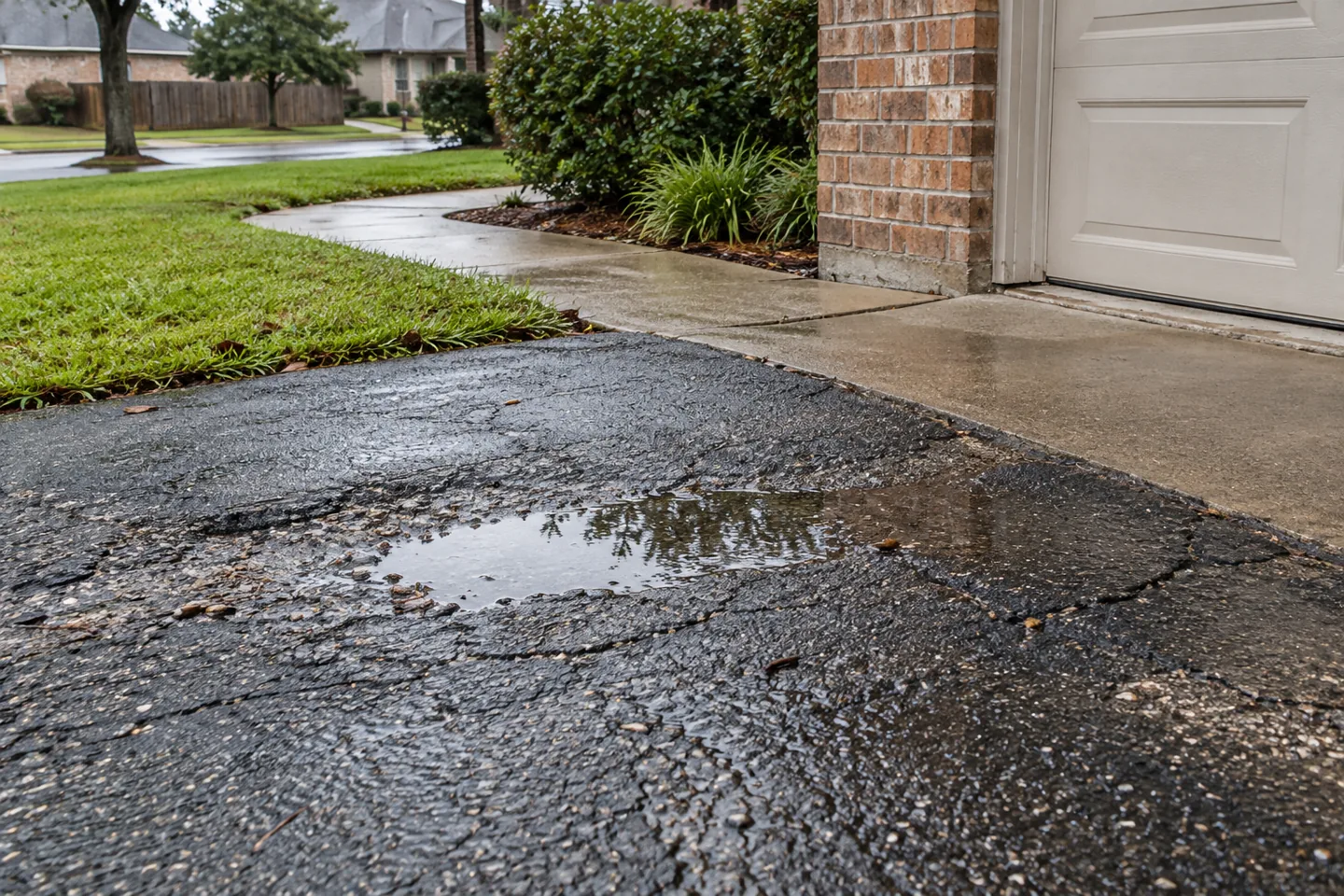
State what prompted the pavement request in ordinary language: water visible beside the garage, a damp patch near the entrance or a puddle in part of the parking area. Identify the requested section using a fixed landmark and wide view. Keep the initial question specific enough to locate without adding a hidden explanation that has not been assessed. A statement such as water was visible beside this walkway on this date gives a provider something concrete to review. It does not ask that provider to accept an owner's guess about a buried connection, the original construction or another property's contribution before the actual site question is discussed.
Give each observation its own date and location
Record when and where the photograph was taken, using the same plain section name in the file and message. If the image followed a known rain or irrigation event, note the timing information actually available. When that information is uncertain, say so rather than filling the gap with an assumed duration or amount. A collection of undated pictures can confuse the sequence and make a changed surface look like one continuous event. A short factual note beside each image lets the contractor understand what the owner actually recorded and which part of the history still needs clarification before a scope response can be offered.
Use wide and closer views for different purposes
A wide image connects the concern with the building, entrance, lawn boundary or retained drainage feature. A closer image shows a visible crack, edge or water line more clearly. Keep both when they concern the same event and explain if one was taken from a different direction. A close photograph can make a shallow feature look larger or hide an important adjacent surface. Neither view establishes every contour or hidden connection. The useful owner record explains the relationship between the pictures and the requested pavement section, allowing the provider to ask for relevant additional information without treating camera perspective as a measurement or a diagnosis.
Distinguish what you saw from what someone reported
If a tenant, neighbor or another property contact describes an earlier event, identify it as a reported observation and note who supplied it where appropriate. Keep it separate from photographs or notes made by the person preparing the current request. A second-hand account may identify a useful question, but it should not silently become a dated owner observation or a provider finding. When a professional assessment is available, retain its actual source and limits. This simple distinction helps later contacts understand the evidence behind a statement instead of inheriting an explanation that became more definite each time it was forwarded.
Use comparisons that preserve the context
When taking another ordinary permitted view, connect it to the same landmarks and note changed conditions that are known. A parked vehicle, new camera angle or intervening property work may affect what the image shows. Explain those differences rather than declaring that one photograph proves improvement or deterioration on its own. Keep the original views so the provider can see the actual sequence. Consistent context makes repeated observations more useful while leaving the technical interpretation open. The owner is organizing the question for review, not performing a controlled test or establishing a performance guarantee from a pair of differently framed photos.
Keep hidden causes as questions for assessment
Avoid presenting an assumed pipe route, base condition, slope measurement or source beyond the visible property as a settled finding. If the owner suspects a connection, phrase it as the question to be reviewed and identify what prompted it. Do not add numerical design conclusions to make the file appear more complete. A paving estimate can address an offered surface scope while a different provider reviews another feature. Keeping uncertainty explicit helps the owner see which response is still required and prevents the contractor from appearing to accept an unassessed explanation merely because it appeared in the original request.
Connect the record to the requested improvement
Explain the pavement section the owner wants reviewed and how it is ordinarily used. State whether the request concerns an isolated repair, a larger surface area or preparation for a different proposed project. Identify retained entrances, walkways, lawn edges and visible outlets that help locate the question. An observation file is more useful when it leads to a recognizable scope discussion rather than becoming a folder of water photographs with no requested next step. Ask the contractor what its offer includes at that section and which separate feature questions remain open before assuming a general driveway description resolves them all.
Track provider responses beside the relevant item
When a provider supplies an explanation or requests additional information, connect that response with the actual section and date. Distinguish a preliminary discussion from an accepted proposal or completed assessment. If another contact must obtain a record, name that next step instead of leaving the matter implied. The owner can then see whether the question has been answered, needs a separate review or remains unresolved. A message saying the contractor looked at drainage is less useful than a response tied to the specific concern, the actual offered work and the conditions or limits the provider identified in its own description.
Keep observations and proposal commitments distinct
Review included preparation, work boundaries, retained features, exclusions and selected options in the written offer. A photograph attached to an estimate does not mean every visible feature is included in the price. Ask the contractor to explain how its proposed pavement work relates to the located water concern. Keep an unselected option or separate provider task visible as its own item. This allows the owner to compare actual offers without converting an observation into an unlimited promise about future water behavior. The accepted proposal and provider instructions should remain identifiable within the wider property history.
Use the same references when reviewing completed work
After the provider permits the relevant access, locate any closeout question with the same section names and fixed landmarks used before the work. Record what is actually visible and ask the responsible contact to clarify it. Do not treat a later photograph as proof of every hidden condition or assume a changed view establishes that an excluded task was performed. Save the response and any agreed follow-up. A clear record can support a focused conversation about the accepted work while preserving the distinction between the owner's continuing observations, completed pavement scope and an unresolved question assigned to another provider.
Send a concise record that another person can follow
For an estimate discussion, share the address, a small set of recognizable current views, actual observation dates, intended use and the specific pavement improvement requested. Add relevant provider records with their sources and identify unresolved questions plainly. Keep unrelated private details out of the file. Organize the full history so it can be supplied if the contractor requests more context. A concise initial packet helps the provider understand the current question, while the dated record preserves its background without asking every reader to reconstruct the event from scattered images, guessed causes and messages that do not identify the same section.
Questions before you approve the work
Discuss the actual property and work limits
Send the property address, current photographs, intended use and access needs. Keep planning with these related decisions.
Reviewed October 14, 2026. Owner preparation guidance; the accepted proposal defines the actual work.