
Utility work and pavement restoration are related scopes
A utility cut is an opening made through pavement for work involving underground services. After the utility activity, restoration needs to address the affected opening and its relationship to the surrounding pavement. The visible surface is part of that discussion, but the project can also involve fill and support responsibilities below it. Ask which party performs each portion of the work.
The utility contractor, pavement contractor, property owner and another responsible party may have different roles. A quote to restore the surface should not be interpreted as including utility repair or verification of concealed work unless the agreement actually says so. Identify what has been completed, what remains open and what information the restoring contractor needs before proceeding.
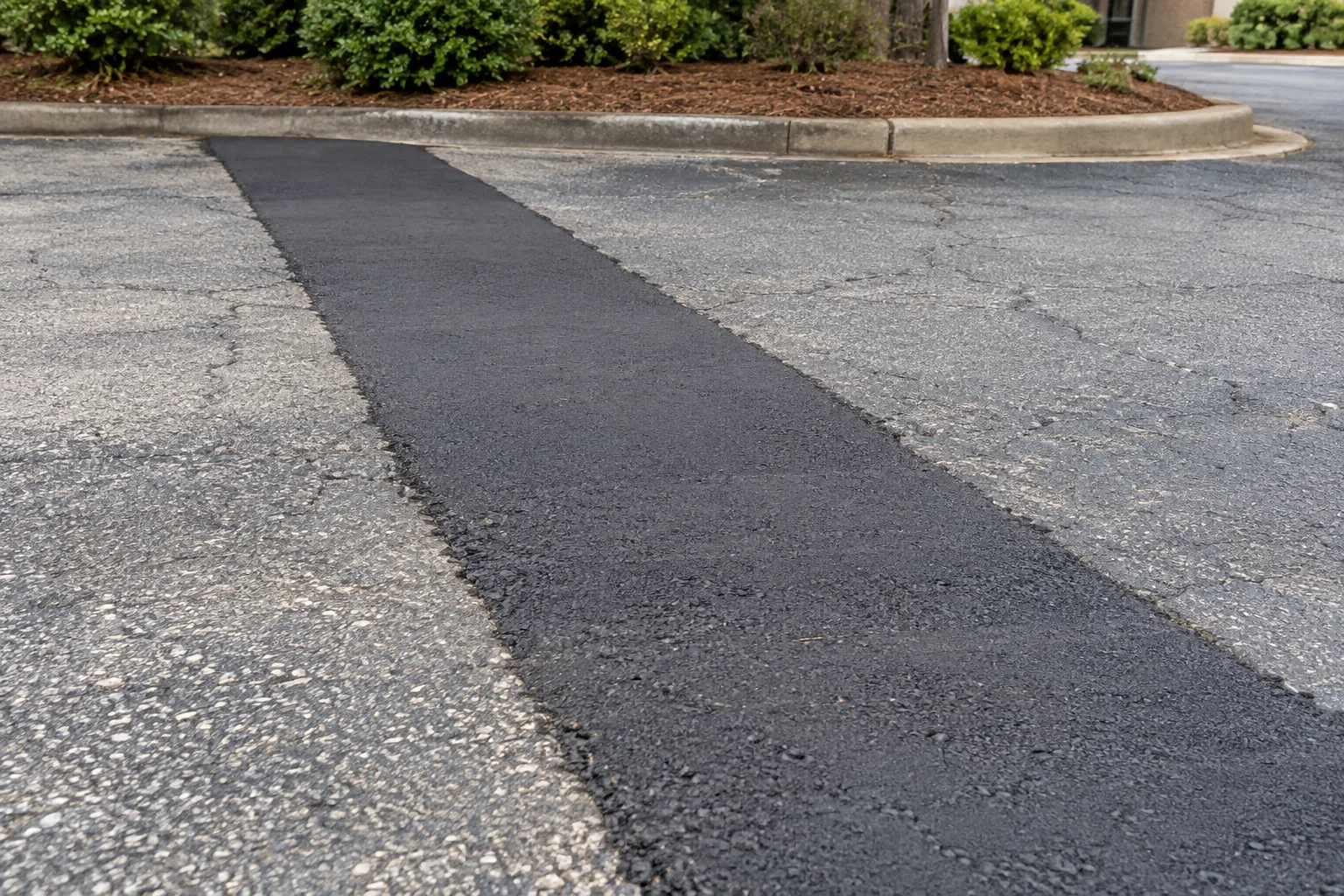
The educational image shows a restored strip as a way to recognize the term. It does not establish what was installed beneath it, whether a particular utility was repaired or whether any inspection occurred. A darker rectangle in a photograph is not proof of a complete restoration history. Use actual records and a property-specific evaluation to discuss the work needed at your site.
Start with the work history and responsible contacts
Tell the pavement contractor what you know about the utility work, when it occurred and which area was affected. Provide the actual scope or completion information if available. If the opening has a temporary surface, say so rather than describing it as permanent restoration. An owner may not know every detail, but clearly identifying uncertainty helps the next contractor understand the basis of the request.
Keep the relevant utility-work contact available for coordination. The pavement contractor may need confirmation about the state of the opening or the responsibilities that remain with the other party. Do not assume that one contractor can verify another party's concealed work from the appearance of the surface. Ask what information is needed and who supplies it before final restoration is scheduled.
Where the work touches public property, shared access or another owner's area, clarify who confirms the applicable requirements and authorizations. This page does not set a local permit rule or restoration dimension. The responsible party needs to determine what applies to the actual location. Record that responsibility so a private property repair request does not accidentally omit an authority or ownership question.
Define the restoration boundary and retained pavement
Ask the proposal to identify the area being restored and the surrounding pavement that remains. The visible utility opening may not fully describe the final restoration boundary. The appropriate limit depends on the project condition and applicable requirements. An owner should request the rationale and written scope rather than prescribe a universal strip width from an unrelated example.
Point out broken edges, adjacent cracking or changes in level around the affected area. These observations may influence the evaluation, but they do not establish a cause or a construction detail. A close view should be paired with a wider photograph showing the opening in relation to entrances, parking and drains. The contractor can then explain which concerns are included and which need another review.
Connections deserve their own answer. Ask how the restored surface meets retained asphalt, concrete or another fixed feature. If water collection or an awkward crossing is part of the request, identify it specifically. A price for covering the utility cut should not be assumed to correct unrelated drainage or access issues. Keep those concerns distinct so the final agreement describes the intended outcome.
Clarify fill, support and unexpected conditions
Restoration can depend on work below the final surface. Ask who is responsible for the fill and support condition and what information the pavement contractor is relying on. Do not interpret a neat temporary patch as confirmation of everything beneath it. The project needs a clear handoff between the party completing the underground work and the party restoring the pavement.
If further preparation is needed, ask what the offer includes and what assumptions remain. A contractor may need to review conditions exposed during preparation before finalizing a response. Agree on how findings are documented and how a revised scope is approved. That process is more useful than an undefined allowance that leaves the owner unsure which party handles additional work.
Avoid attempting to probe, reopen or adjust the affected area yourself. Describe the visible concern and arrange the appropriate review. Known utilities and site constraints need to be communicated to the responsible parties. The owner's role in the discussion is to provide information and confirm responsibilities, not to declare the opening or concealed service suitable for a construction activity based on memory.
Plan temporary use and final reopening
An affected utility area may be crossed by vehicles or pedestrians before permanent restoration is complete. Ask the responsible party what restrictions apply and how the temporary condition is managed. Do not assume that a surface is ready for unrestricted use because it has been covered. Temporary and permanent work should be identified clearly in the records and instructions given to occupants.
Tell the contractor about deliveries, entrances and the normal route through the area. A narrow cut can cross an essential access even when its total surface area is small. If staging or an alternate arrangement is proposed, clarify who evaluates it and who informs staff, tenants or household members. Coordinate with the utility-work contact so separate instructions do not conflict.
For final reopening, obtain project-specific release instructions from the responsible party. Ask whether related work, inspection or another handoff must occur first. Keep any continuing limitation with the property record. A crew's departure, a new surface color or the removal of one control item should not be treated as an independent authorization to reopen every activity at the site.
Compare restoration offers using the same handoff
Imagine two restoration offers for a strip across a parking entrance. One assumes the utility contractor has completed the fill and prepared the area for surfacing. Another includes defined additional preparation. Ask both to identify their assumptions and compare the same responsibilities before comparing totals. The difference may be a scope handoff rather than a disagreement about the cost of identical work.
Next ask whether each offer addresses damaged retained edges and the connection at the entrance. If the owner also reports recurring water there, obtain a separate answer about whether that issue is evaluated or excluded. A comprehensive-looking restoration title cannot substitute for those location-specific details. Keep the accepted scope, approved changes and completion information together for future maintenance.
To discuss utility-cut restoration with Asphalt Solutions, call or text the actual job-site address, photographs and available utility-work records. Explain which party completed the underground work and what the current temporary condition is. Most work is performed at customer properties. Visits to the Slidell contact location are by appointment, and listed phone availability is separate from construction scheduling. Ask for clear boundaries, preparation and handoff responsibilities in the project-specific offer.
Close the handoff with a location record
After the agreed restoration, record the affected location and completion date with the accepted scope. If any item remains temporary or outside the paving work, identify it plainly and name the responsible contact. Future maintenance should not have to infer the status of the underground work from a surface photograph.
Where several parties were involved, keep the relevant handoff information together rather than assuming each contractor holds the complete project record. The owner may need that information when a later concern appears at the restored strip. A location record does not establish a cause or guarantee future performance; it gives the next evaluator an accurate history and a way to contact the party responsible for an unresolved question.
Questions about utility cut
Meaning in plain language
A utility cut is an opening made in pavement for underground utility work. Restoration must account for the cut, fill and surrounding surface.
A practical example
Identify the trench route and restoration history. Distress following a utility cut may need a different conversation from unrelated surface wear.
Use the term in your project discussion
Record the utility work history when damage follows an old trench.
Details that matter
- Trench alignment
- Settlement
- Restoration history
A mistake to avoid
The asphalt cap is only one part of restoring a utility opening.
Continue with the right next step
Property conditions determine the final scope. These planning notes do not replace a site evaluation. How to use our pavement guidance