
Review the corner as part of the actual route
A damaged asphalt corner used by heavy vehicles needs a review of the operation and pavement together. Show how vehicles approach, turn and leave the area, using confirmed information from the property operator or relevant provider. The corner is part of a route, not just an isolated piece of broken pavement.
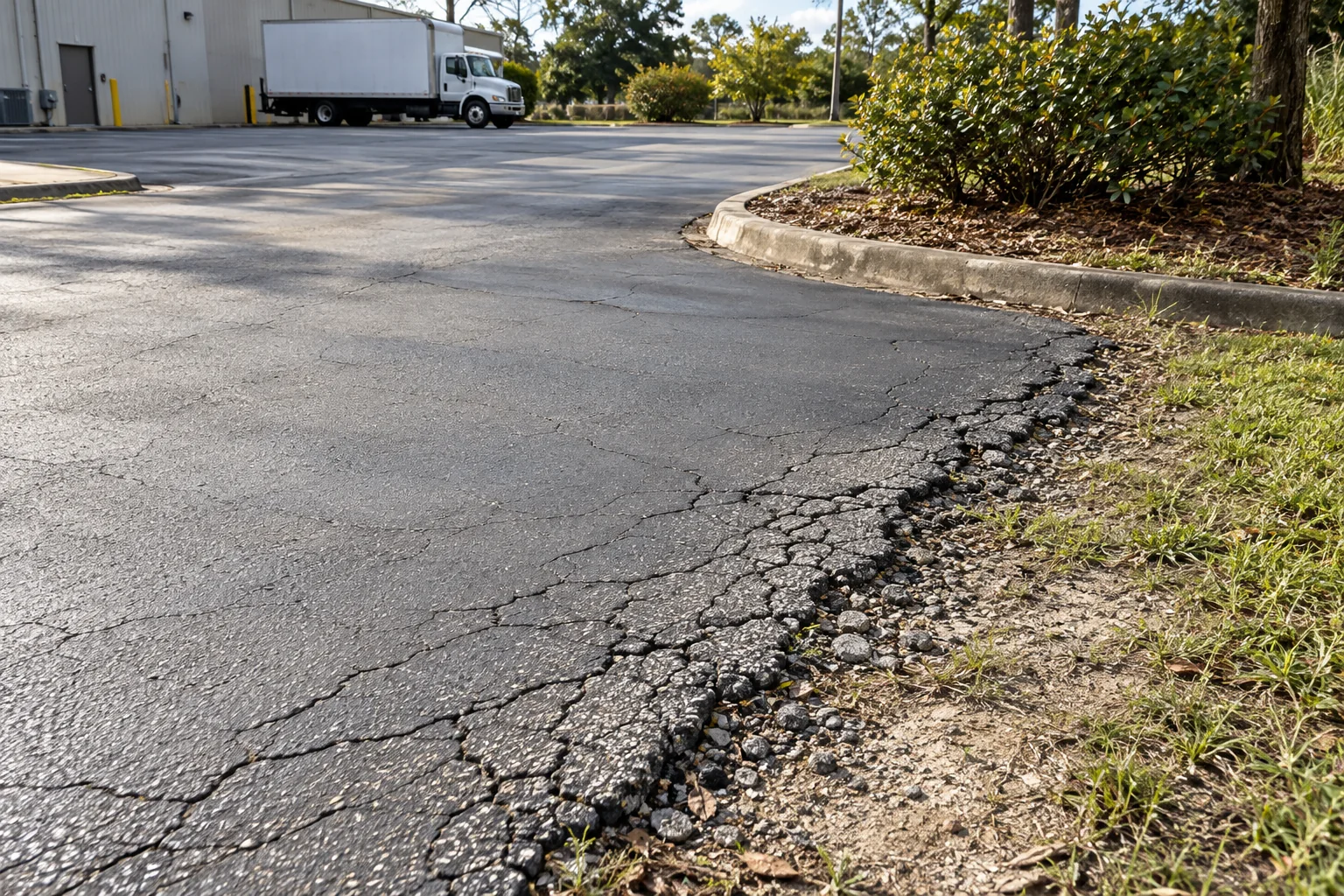
Describe the visible condition: edge breakup, cracks, loose material, a depression or another change. Identify whether the concern is concentrated beside the turn, along an approach or farther into the travel area. Do not assume the visible boundary establishes the full repair width or that every nearby mark has the same cause.
State what the property needs the area to do after the work. A route for regular collection or deliveries deserves an explicit operational discussion. Ask how the proposed scope relates to the actual vehicle use rather than assume that matching an ordinary parking area provides the right basis for the corner. The site review should explain the recommendation and its limits.
Gather confirmed vehicle and maneuver information
Ask the responsible operator for the vehicle types, route, frequency and standing or turning locations they can confirm. Include planned changes to deliveries, collection or site layout. Keep unknown information identified as unknown. A contractor should not have to infer the complete heavy-vehicle operation from a few tire marks during a visit.
A marked property photograph or available plan can show the route and constrained corner without arranging a live maneuver demonstration. Do not stand beside a moving truck, enter a reversing area or ask a driver to repeat a damaging movement for a photo. If additional operational observation is needed, coordinate a safe method with the responsible parties.
Identify gates, buildings, curbs, parked vehicles and other fixed or operational constraints near the turn. The surface decision may need to be considered alongside route or layout questions. Share known constraints before the work boundary is finalized so the proposal is evaluated against the intended operation rather than a path that vehicles do not actually use.
Show the edge and surrounding pavement clearly
Take an overall photograph identifying the corner within the property and its connection to the approach. Add safe close views of representative damage and the transition to surrounding pavement. Include adjoining soil, curb or other edge features. The evaluator needs to see the context around the damaged material, not only a cropped view of a broken fragment.
Describe whether vehicles are observed crossing beyond the paved edge and whether the route has changed. Those observations can inform the review but do not independently establish the cause or hidden support condition. Show apparently sound areas nearby and known earlier repair boundaries where useful.
Do not excavate beside the corner or remove loose material as an improvised strength test. Ask what examination or investigation is needed for the actual recommendation. A photograph cannot determine pavement thickness, reinforcement, retained layers or the full condition beneath the turning area. Keep the initial record accurate and undisturbed so the evaluator can explain the next information needed.
Include water and adjoining-ground questions
Record safely observed water collection or flow near the corner with its location and approximate timing. Show adjacent ground and visible drainage features. An edge concern can share space with water or erosion, but proximity alone does not establish a complete explanation. The relevant relationship needs to be evaluated for the property.
Ask which part of the proposed work concerns pavement and which concerns adjoining ground or drainage. These scopes may need coordination without being automatically included together. Identify the intended finished edge and which provider supplies it. A paving crew should not be left assuming another party will complete an unspecified support or landscape task.
Where shared or public connections are involved, confirm ownership and any required coordination. Do not assume that a route can be widened or water redirected beyond the property simply because the corner is damaged. The actual design and authority questions must be resolved by the appropriate responsible parties before the proposed change is approved.
Connect the proposed assembly to the intended use
Ask the contractor to explain how confirmed vehicle operations and actual findings inform the proposal. The estimate should identify removal boundaries, retained pavement and the resulting connections. A general statement that the corner will be stronger is less useful than an understandable scope tied to the operation and condition being addressed.
This guide does not prescribe a universal pavement thickness, material assembly or load capacity. Those decisions require appropriate property-specific evaluation. If further investigation or design information is needed, ask what question it answers and how it affects the recommendation. A limited test location should not be treated as complete knowledge of every part of the vehicle route.
Compare alternatives by function and limits. A localized repair, a broader reconstruction or a layout-dependent option can address different objectives. Ask what each leaves in place, what must be coordinated and what uncertainty remains. Different prices may reflect different boundaries and assumptions rather than identical work performed more or less expensively.
Coordinate the closure with the people using the route
Tell the contractor which heavy-vehicle movements must continue and whether another route is available. Coordinate with delivery, collection or other providers before setting the closure. Do not assume a truck can use a temporary path simply because a passenger car fits through it. The actual operator and responsible parties need to understand the arrangement.
Include employee parking, walking access and other operations near the corner. Agree how the work area will be isolated and how users will be told about changes. A route habit can bring a vehicle back toward a closed corner unless the site communication is clear. Identify who manages that communication during every stage.
Obtain reopening instructions for the actual work and intended vehicles. A release for ordinary traffic should not be assumed to answer every question about turning or standing by heavy equipment. Clarify who communicates the return to service to the operators. Keep those instructions with the project scope so the repaired area is used according to the agreed plan.
An example of checking a route-dependent repair
Imagine a damaged corner beside a delivery entrance where the operator confirms that trucks turn around a parked-vehicle row. Ask whether the proposal assumes that parking arrangement remains or depends on a layout change. If the operating route is about to change, share that information before the repair boundary is settled. One estimate may address the present broken edge while another considers more of the approach and its connections. Clarify the purpose, retained conditions and technical information supporting each. Also confirm the temporary route with the actual operator rather than infer suitability from passenger-car access. The resulting decision relates the pavement work to a documented operation without claiming that one surface photograph proves load capacity or that every future vehicle maneuver will fit the same corner.
Keep the completed boundary and operating record together
At closeout, review the corner and its retained connections against the scope and approved changes. Use genuine photographs showing the complete work area and relevant route context. Record any layout, drainage or adjoining-ground task that remains outside the work. A new surface image should not imply a universal load guarantee or completion of an excluded provider activity.
If a later concern develops, identify its location and timing and describe any known change in vehicle operations. Keep the information factual rather than assign cause from a tire mark or crack alone. The original operating record, scope and completion photos give the provider a clearer basis for follow-up.
Contact Asphalt Solutions with the actual project address, safe corner photographs and confirmed vehicle-route details. Most work is handled at customer job sites. Visits to the Slidell contact location are by appointment only, and the listed hours mainly concern phone availability. Call or text to discuss the site review and any coordination needed before the corner repair can be planned.
Questions about heavy trucks damaging an asphalt corner
The direct answer
Truck turning and loads can stress a corner differently from straight travel. Edge support and the proposed pavement section should match the actual use.
What to discuss before choosing a repair
Ask whether geometry, support and material section are all included in the evaluation.
What to observe and record
- Identify truck types
- Show turning paths
- Record edge breakup
A mistake to avoid
Repeating a residential repair detail may not fit a commercial turning area.
Continue with the right next step
Property conditions determine the final scope. These planning notes do not replace a site evaluation. How to use our pavement guidance