
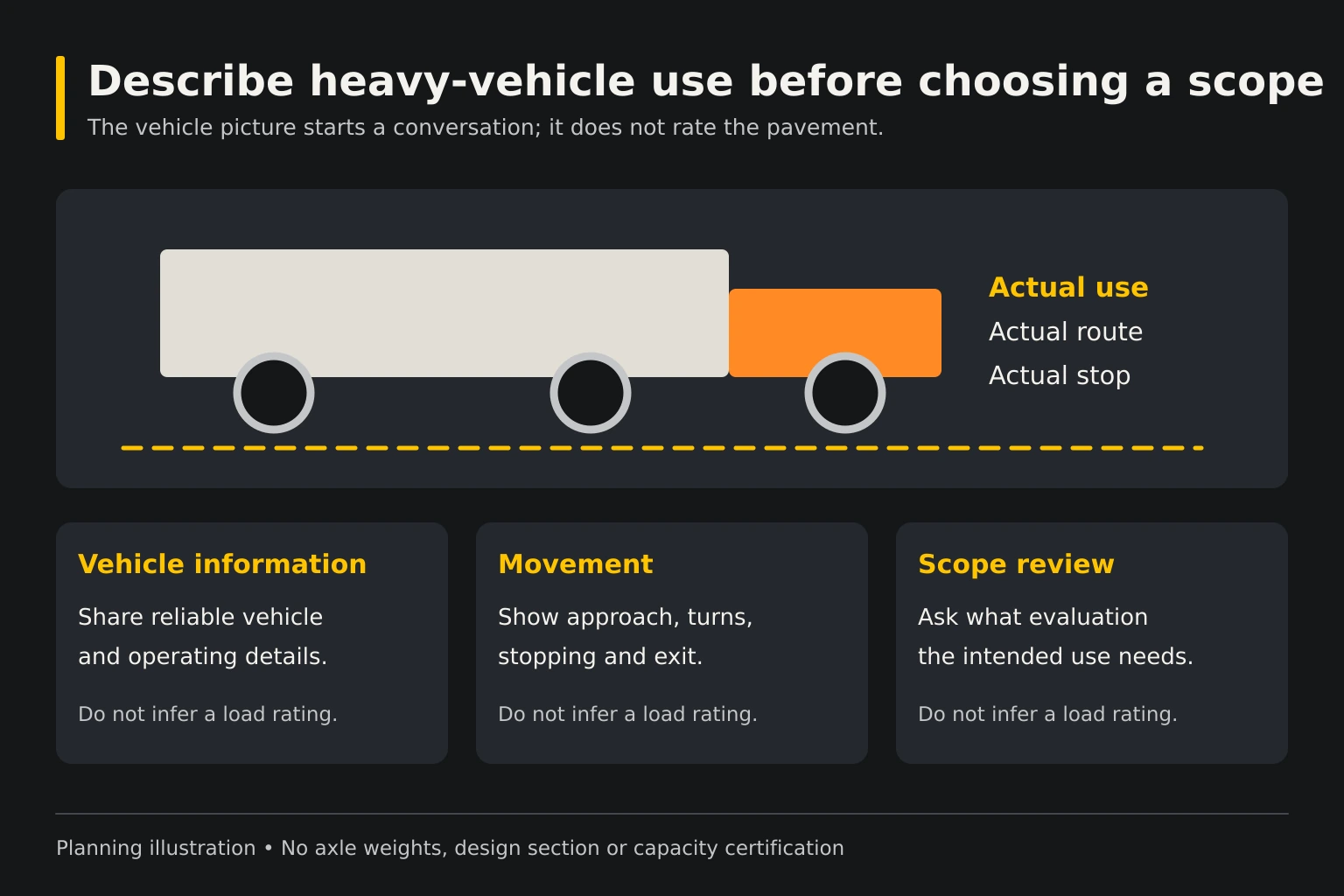
Identify the actual vehicles using the area
Begin with a list of the vehicles that use the pavement regularly and occasionally. Include delivery trucks, waste collection, work trailers, service equipment and stored vehicles where relevant. A property described simply as commercial or residential can hide important differences in use. Share confirmed information from the vehicle operator or service provider when it is available. Do not estimate a design load from the appearance of a vehicle in a photograph.
Explain whether use is expected to change. A new tenant, different collection provider or more frequent deliveries can affect the discussion even if the current pavement looks unchanged. The contractor needs the intended operation, not just a picture of the existing surface. Keep confirmed vehicle information separate from assumptions. Where the owner does not know the equipment details, identify the provider who can help answer the question.
Map the travel and stopping patterns
Show where vehicles enter, turn, stop, unload and leave. Mark those movements on a simple property sketch with entrances and retained features. The pavement supporting a turning movement may face different operational questions from a parking area used mainly by passenger cars. Do not treat every part of the property as having the same use simply because it has the same surface material.
Include locations where vehicles cross an edge, brake, reverse or remain parked. Explain any tight turn or restricted approach. A photograph of wheel marks can help locate a path, but it does not establish construction details. Ask the operator to review the intended movement where the layout is uncertain. A paving plan should fit an operation the property and provider can actually carry out rather than assume that drivers will avoid a difficult connection.
Document the existing concern in context
Photograph visible holes, ruts, broken edges or other distress together with the route used by the vehicles. Give each location a simple reference and describe how it affects the operation. Do not diagnose every damaged area as a load problem. Water, connections, existing condition and other factors may require review. The value of the record is to connect a visible concern with an actual use pattern.
Note whether the condition changes after deliveries, rain or other events. Keep dated observations when available, without implying that timing proves the cause. A close-up alone cannot establish what lies beneath the surface or how the pavement was built. Ask what information the contractor needs to review the concern. Where further investigation or professional design is necessary, clarify that responsibility before selecting the construction scope.
Discuss support and design responsibilities
Ask who is responsible for specifying the construction appropriate to the intended use. Do not choose a thickness or material from another property's job and assume it applies to yours. The actual vehicles, ground conditions, existing pavement and proposed work all belong in the discussion. A quote should explain what is included while identifying questions that need more review.
If the project requires professional design input, confirm who will arrange it and how the resulting information reaches the contractor. Do not interpret a sales description as a complete engineering assessment. Likewise, an estimate that acknowledges uncertainty should explain the process for resolving it. The owner needs an understandable route from the known operation to the approved scope rather than a collection of isolated specifications with no assigned responsibility.
Review edges, transitions and drainage
Show the places where the vehicle route meets streets, concrete pads, curbs, drain inlets or retained pavement. Include the approach to loading areas and dumpster pads. A concern at an edge or connection may need a different scope from a problem in the center of a broad paved area. Ask how the proposal handles those transitions and what surrounding surface will remain.
Record visible water paths or ponding without assuming the cause. Ask whether water-related work is included, excluded or pending additional review. A new surface alone should not be treated as an answer to every recurring wet-area problem. Keep the drainage and vehicle-use discussions connected because the route may cross the area of concern. Where another party controls an adjoining feature, identify the coordination before the quote is approved.
Plan access for construction and continued operations
Tell the contractor which vehicle operations must continue while work occurs and which can be moved or delayed. Contact providers about temporary routes or stopping locations before promising that service will remain available. A passenger-car detour may not work for a collection truck or delivery vehicle. The provider should confirm the arrangement for its actual equipment.
Ask what work-zone and staging space the construction needs. Keep temporary parking and stored equipment out of the agreed approach. If work is phased, identify how each stage affects the heavy-vehicle route and what must be ready before the next closure. The phase plan should cover more than the finished surface boundaries. Record who communicates updates to providers and who can authorize a revised access arrangement if conditions change.
Read the repair proposal for the actual operation
Compare estimates for work limits, preparation, proposed construction, retained transitions and drainage responsibilities. Ask what vehicle-use information each proposal assumes. Two estimates may cover the same visible damage while making different assumptions about future loads or movement. Do not compare only the price or one construction detail without understanding the full scope.
Clarify concealed-condition procedures, optional areas and any work outside the proposal. Identify who can authorize an addition if removal exposes a different condition. Keep the intended operation and the accepted work limits together in the project record. If the property changes the vehicle type or use after approval, notify the contractor before construction and ask whether the scope needs review. The accepted proposal should remain connected to the use it was intended to address.
Confirm reopening for each relevant vehicle
Ask for instructions that distinguish ordinary passenger vehicles from the heavier or concentrated use relevant to the property. A surface can appear finished before it is ready for every operation. Follow the contractor's project-specific guidance rather than a waiting period borrowed from another job. Give that guidance to the provider and the property staff responsible for allowing access.
If a truck arrives before its route is reopened, have a contact who can direct it to the agreed alternative. Do not let a driver decide that the surface looks ready. Keep any barriers and instructions current as phases change. The reopening handoff should explain what is permitted, what remains restricted and who confirms the next change. Record it with the final scope so the property can refer to the actual instructions later.
Maintain an operation and pavement record
After completion, keep the accepted proposal, approved changes, final photos and reopening guidance. Record the vehicle information and operating pattern used in the planning discussion. If a provider or tenant changes, review the new use rather than assuming the original scope covers every future operation. A maintenance record is more useful when it includes how the property is used, not only when it was paved.
To begin a discussion with Asphalt Solutions, send the exact address, the main pavement concern, overview photos and confirmed information about the vehicles. Include the schedule and any operation that must continue during work. The company serves Greater New Orleans and the Northshore, and the Slidell contact location is by appointment only. Call or text before arranging a visit. Clear facts help identify the next step without pretending that a photograph can finalize a design. Ask the authorized property representative to confirm the intended operation before the proposal is accepted. Where several tenants use the same approach, gather their relevant vehicle and schedule information in one current record. Keep unconfirmed assumptions marked as open questions. This helps the contractor distinguish the operation being planned from one tenant's informal description of how the entire property works. Confirm those operational details again if scheduling occurs substantially later than the original visit.
Questions before you request the estimate
Turn the property facts into a clear next step
Explore the asphalt repair service guide, project planning checklists and photo gallery. Bring the actual property address, useful photographs and access needs to the quote discussion.