
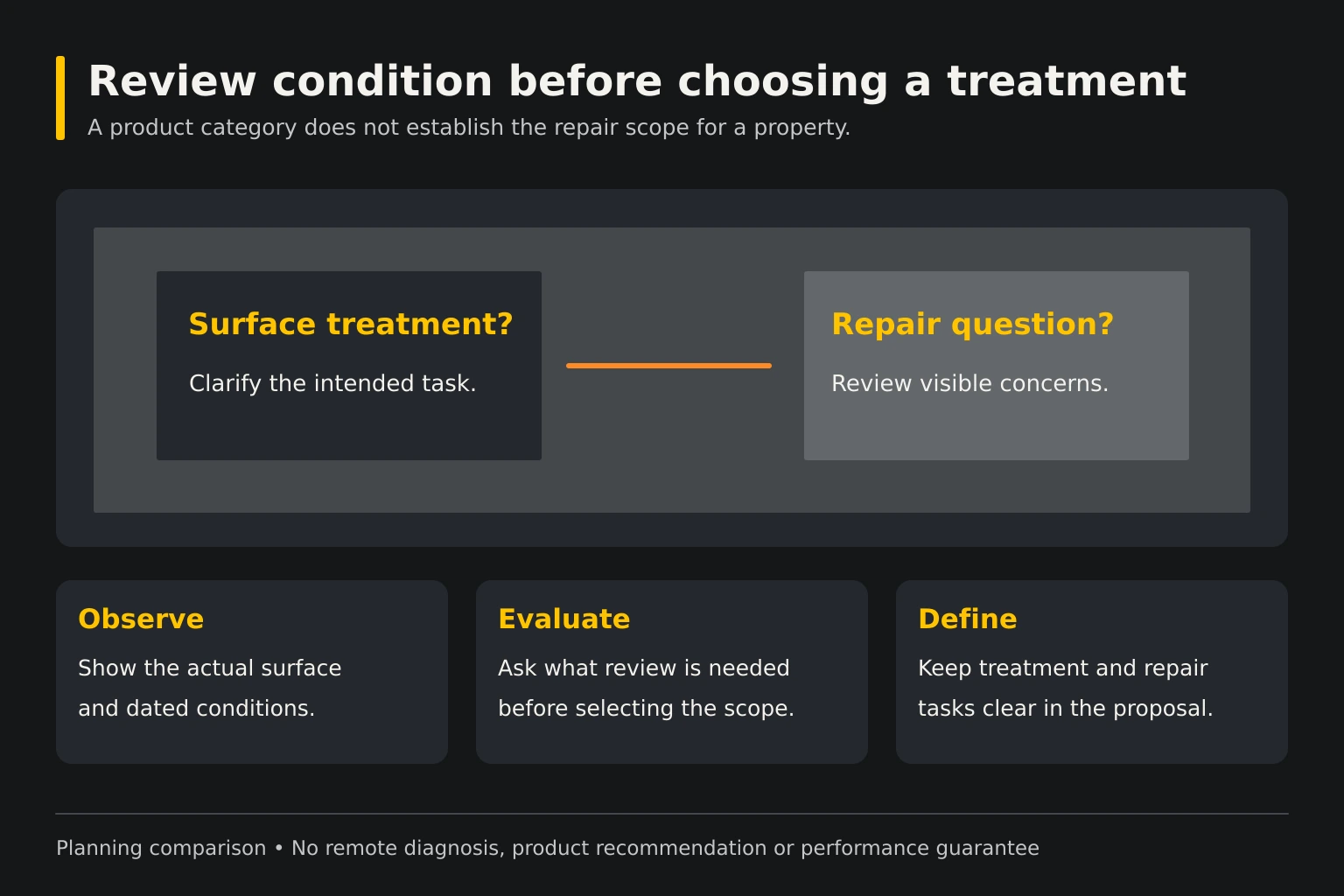
A fresh dark finish can make asphalt look renewed, but appearance and structure are different questions. Sealcoating is a surface treatment for suitable pavement. Holes, moving areas and an interconnected crack network deserve a repair conversation before a coating conversation.
Put the site details to work
Walk the property and label defects in a simple sketch. Separate isolated openings from widespread breakup. Ask which repairs are included before surface preparation and whether any areas are excluded from the treatment. An estimate that only names a coating leaves important questions unanswered.
Turn the observations into a clearer scope
Write down your highest-priority concern, the areas affected and the access you need during construction. Keep those notes with your photos so the conversation starts with the same property facts. Ask which observations can be confirmed during a visit and which require additional investigation. Material choices, dimensions, timing and prices depend on the actual site and the work proposed.
Make two lists before naming a treatment
Separate appearance concerns from problems affecting use. A faded surface belongs on a different line from a recurring hole, a broken entrance edge or water at the garage. Mark where each occurs. This lets the estimate discussion distinguish maintenance of a usable surface from repairs or changes needed elsewhere.
Do not assume a single driveway condition label describes every area. A stable main travel area and a distressed corner may need separate decisions. Ask whether the recommended treatment applies to the whole surface or follows repairs within a defined boundary. Keep the proposed sequence with the quote.
Ask about the preparation, rather than only the finish
For a maintenance proposal, ask which cleaning, repairs or other preparation is included and what existing conditions will remain. If a repair is recommended first, request its location and scope. The title sealcoating alone does not explain every step or establish that the pavement is suitable.
If the contractor recommends a different approach, ask which observations support it. You can compare options without treating them as equivalent. Surface maintenance, localized repair, resurfacing and replacement may have different objectives, exclusions and operating requirements. A lower total is meaningful only after the proposed result is understood.
Use a hypothetical corner to test your understanding
Imagine a driveway that looks worn across its area, with a broken corner beside a roof outlet. The owner can ask three distinct questions: what explains the corner concern, what related work needs review, and whether the remaining surface is suitable for maintenance. The example does not establish a diagnosis or describe a completed company job.
If the proposal addresses only the worn appearance, the owner should understand that the corner remains a separate concern. If the proposal includes repair, its boundary and any water-related coordination should be identified. The useful comparison is between written outcomes, rather than between two labels on otherwise unexplained estimates.
Keep the return-to-use instructions with the selected option
Ask what access restrictions the actual materials and sequence require. Plan vehicle parking, shared-driveway access and deliveries before confirming work. Do not apply the waiting time from a neighbor’s unrelated project. Request instructions for the proposed work and clarify who communicates a weather-related change.
After completion, save the scope, care guidance and any approved repair changes together. This gives a future assessment the right history. A maintenance record is useful, but it is not proof of a fixed lifespan or a warranty term. Ask for the applicable written terms rather than inferring them from a general description of the treatment.
Your next step
Ready to discuss the property? Share the address, photos and your project goal through our quote form. An inquiry starts a conversation; it does not confirm pricing or a construction date.
Call (985) 788-0493
Use a condition list before asking for one treatment
Make a separate entry for each visible concern instead of describing the whole property as needing sealcoating. Record faded appearance, loose material, holes, broken edges, low areas and recurring damage in their actual locations. Connect the list to a simple map and overview photographs. An attractive dark finish is a different goal from restoring a damaged section, and the estimate should not blur those decisions into one line.
Ask which areas are being considered for maintenance and which require a repair discussion first. Keep uncertain causes marked as uncertain. If the property has different uses, describe them beside the relevant areas. A quiet passenger-parking section and an active collection route may raise different questions even if both surfaces look faded. The owner should provide those facts before accepting a proposal that assumes one operation fits everywhere.
Separate preparation, repair and maintenance responsibilities
When reading the quote, identify the work proposed before the maintenance treatment, the repair areas and the retained pavement. Ask whether removal, cleaning, preparation, marking changes or another task is included. Do not assume that a maintenance line item rebuilds a failed section or corrects a drainage connection. The contractor should explain how each included task relates to the observed condition.
If additional work depends on a finding during preparation, agree how that condition will be documented and approved. Name the owner or representative who can authorize a change. Keep optional repairs separate from the accepted scope rather than allow them to appear as settled work. A clear process helps the property understand what is included in the initial price and what remains a decision.
Plan access for the actual treatment sequence
Give the contractor the normal use of the areas being considered, including parking, deliveries, collection and pedestrian entrances. Ask what can remain open and what must close during preparation and application. A maintenance project can still affect essential access, especially where the property relies on one entrance. Do not promise tenants or household members that all routes remain available before the sequence is reviewed.
Coordinate provider arrangements and assign who moves parked vehicles. Ask for project-specific reopening guidance for the relevant users and loads. A surface that appears finished should not automatically be treated as ready for every operation. Keep the instructions with the property team and update notices if the sequence changes. The maintenance plan should describe practical responsibilities as clearly as the material being applied.
Keep the decision useful for the next project
After the work, retain the accepted areas, repair limits, approved changes and reopening guidance. Photograph the result with the original location references. Record work deliberately deferred and any issue outside the maintenance scope. A dark finished surface should not erase the history of a recurring concern or be used as proof of concealed supporting conditions.
If another quote is requested later, provide the contractor with that record and the current observation. Explain which maintenance and repair tasks were actually performed rather than rely on a general statement that the lot was sealed. This helps the next conversation distinguish a new concern from a question about the accepted work. Keep any offered follow-up terms in their written form and contact the company with a specific location and useful images.
Make the inquiry specific enough to guide review
Send the exact work-site address, the condition list, useful overview photos and the operations that affect timing. Explain whether the goal is appearance, preventive maintenance, a damaged-area repair or several separate decisions. If the preferred method is unknown, say so. An owner does not need to select the treatment before providing a useful request.
Keep the same location references as the quote develops and identify the accepted proposal version before scheduling. The result should be a scope that someone else can understand, not an assumption that one maintenance word covers every surface concern.
Sort the conditions before asking for a darker finish
Make three lists: areas that appear generally sound, isolated defects and areas with recurring or interconnected damage. Mark each list on a sketch. This avoids treating every square foot as if it has the same condition. Ask the proposed contractor what must be repaired before any coating and what remains outside the maintenance scope.
Compare proposals that cover the same repairs and preparation. One price may include only coating while another includes patching and cleaning. Those are different scopes. Ask about application conditions, access restrictions and written reopening instructions without expecting one calendar rule to suit every product or property.
Questions before the project
Reviewed October 14, 2026. This is planning guidance, not a project-specific specification. Read our guidance and image-source policy.