
The decision in plain language
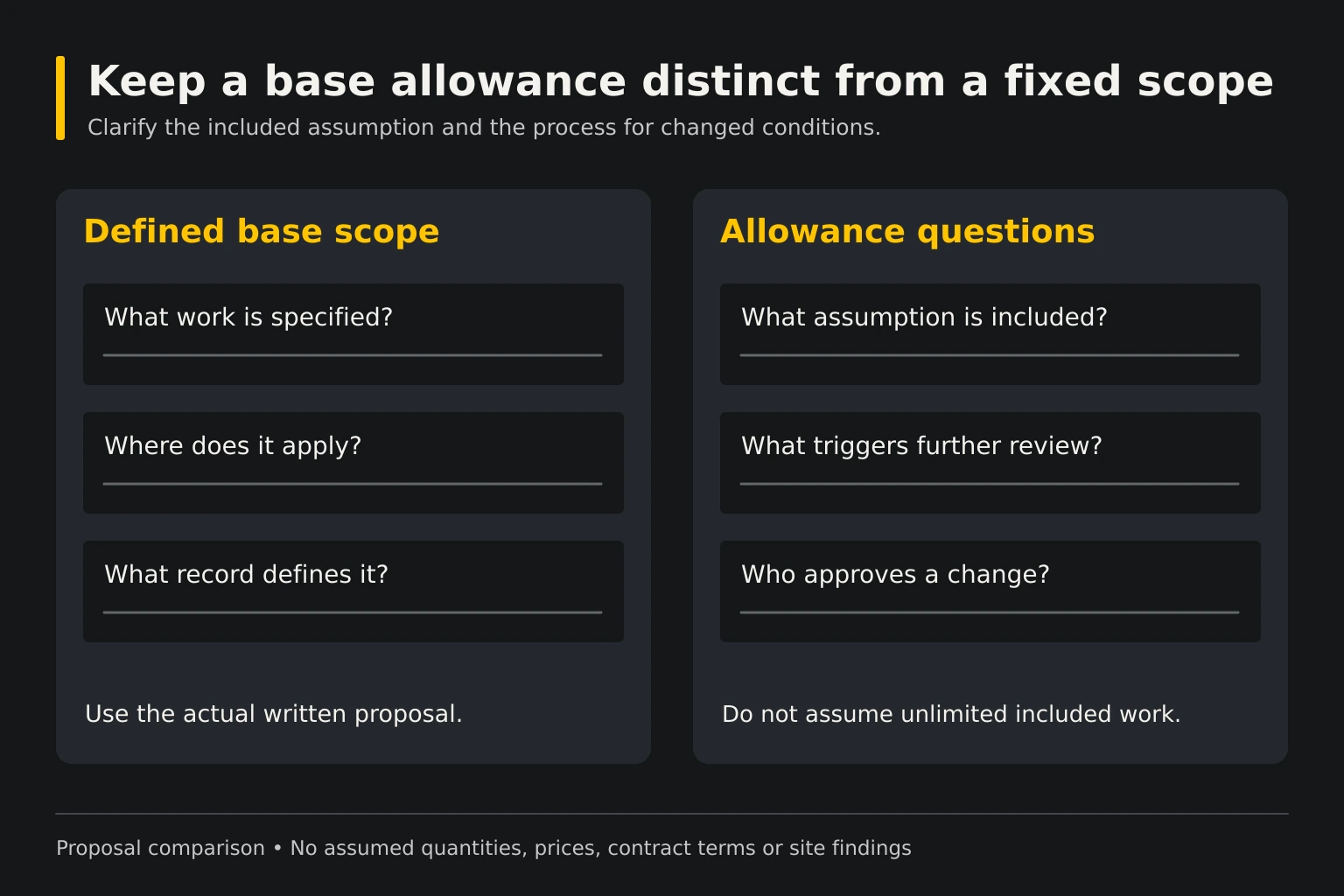
An allowance describes uncertain work differently from a fixed included quantity.
The situation to discuss
Ask what conditions trigger extra base work, how quantities are measured and who approves changes. Keep those rules with the proposal.
Your five-point decision sheet
Use these headings on a simple sketch or in your project notes. Under each one, write the actual property observation, the question you still need answered and the person responsible for the decision. Leave an unknown item marked as a question instead of assuming it is included.
- What supporting work is expressly included before the allowance?
- Which task and uncertain extent does the allowance describe?
- What units, quantity and stated price basis apply?
- How will differing approved work be measured and reflected?
- Who approves a documented revision before the work changes?
What not to assume
An allowance should not be read as unlimited included repair.
Turn the discussion into a clear work boundary
Keep a copy of the marked site sketch with the estimate. Identify the area being authorized and any adjoining feature that must remain protected or available. If the contractor recommends an investigation or a separate trade, record that next step before treating the proposal as a final solution. A planning guide helps you ask questions; it cannot establish hidden conditions from photographs.
When a decision changes the work, request an updated description showing what was added, removed or deferred. Confirm how any additional quantity will be measured and approved. Make sure the person giving the approval has authority for that part of the property. This prevents a useful site conversation from becoming a different job than the one the owner expected.
Bring the right information to the visit
Send your address, the overall project goal and photos showing this specific connection or operating area. Include a wide view for context and a closer view of the detail under discussion. Describe any timing or access constraint that affects the decision. Avoid placing yourself in traffic or entering inaccessible structures to collect information.
Find the uncertain item in the proposal
Read the estimate for language identifying work that is included and work whose extent remains uncertain. Ask the contractor to explain any base allowance in terms of the actual property and accepted boundary. An owner needs to know what the line describes before treating it as a complete preparation scope or comparing it with another price.
Keep that explanation with the proposal. A term used in a site conversation may not have the same meaning in every estimate. Request the quantity, amount, area or other basis the contractor is using, along with the task it covers. Do not infer those details from the word allowance alone.
Distinguish included work from possible additional work
Ask what preparation is expressly included before any allowance or revision is considered. Identify removal, retained surfaces and the accepted construction area. A short paving description can leave the owner uncertain whether the proposed support work is a stated included task or a later decision prompted by exposed conditions.
Keep optional owner-requested areas separate from uncertainty within the accepted boundary. Widening the driveway and responding to a condition discovered beneath the old pavement are different reasons for changing the work. The written record should explain which decision is being made rather than combine both under a general additional-work label.
Ask why the extent is uncertain
Discuss what could be assessed during the visit and which conditions may only become visible after removal or other preparation. Ask the contractor what information supports the current estimate and what remains unknown. Owner photographs and recollections can help the discussion, but they do not establish hidden support conditions by themselves.
If a review or separate provider is recommended before the scope can be settled, record that next step. Do not describe an unresolved condition as confirmed or assume that an allowance is a diagnosis. Its purpose in this discussion is to make uncertainty and the approval process understandable, not to replace a property-specific assessment.
Define the basis for quantity and price
Ask how the proposed work is described and measured, and which stated rate or amount applies where the proposal uses one. Keep the units and covered task together. A quantity for one activity should not be compared with a different quantity describing another activity simply because both appear beside preparation language.
Request an understandable example using the proposal's own terms if the calculation is unclear. Have the contractor explain how an approved increase or decrease would be reflected. The owner should be able to follow the stated basis without inventing a conversion, assumed area or hidden quantity that was never part of the accepted quote.
Clarify the allowance's treatment
Ask what happens when actual approved work differs from the basis described in the estimate. Keep the answer in the written proposal or revision process. Do not assume that every allowance uses the same treatment, that an unused amount is automatically handled one way, or that a larger quantity is already authorized.
Identify any limit, separate approval or additional pricing step the contractor describes. The planning goal is to understand the offered arrangement, not to decide the legal meaning of a contract term. Where an agreement needs interpretation beyond the construction explanation, obtain the appropriate advice rather than rely on a generic website worksheet.
Name the authorized decision maker
Identify who may approve changes and how the contractor should contact that person. If several owners or property managers are involved, agree how a revision reaches the required decision makers. Being present when a condition is exposed is not a substitute for an established approval arrangement.
Record what information should accompany the request: location, described condition, proposed work, revised quantity or amount and effect on sequence. Ask how the contractor handles work pending a decision. The owner should understand the next action without assuming the crew will proceed beyond the accepted scope while approval remains unresolved.
Keep evidence tied to a location
Request appropriate photographs or a marked sketch when a revision concerns a particular section. A wide view helps locate the area; a closer view can support the contractor's explanation. Keep those records with the current proposal rather than a disconnected image that does not show which boundary or activity is being discussed.
Distinguish the contractor's finding from the owner's interpretation. If a separate review is needed, record its source and status. The project file should make it possible to understand why work changed without presenting a photograph as a complete engineering assessment or assuming that every visible condition calls for the same preparation task.
Compare proposals using matched assumptions
List the included preparation, allowance basis, pending conditions, measurement method and approval process for each estimate. Ask the contractors about material differences before comparing totals. A larger allowance or a fixed line item can reflect different assumptions and should not be treated as a direct price comparison until the actual scopes are understood.
Keep exclusions and separate-provider tasks visible too. If one proposal includes a review or connection omitted from another, ask how that affects the work. The comparison should explain the difference in what is offered rather than rank estimates from a single number whose covered activities remain uncertain.
Update scope and schedule together
When a revision is approved, keep the current work description, quantity or amount and sequence in the same record. A preparation change may affect closure or another provider's handoff. Tell affected users about revised access instructions through the agreed contact rather than assume the original schedule still describes the property.
If an owner adds an area at the same time, record that request separately. The final scope should explain each change and its accepted treatment. Keep the earlier version as history, but identify the current version used for construction so the crew and owner are working from the same authorized boundary and task list.
Retain a clear final account of the work
At closeout, keep the original proposal, approved revisions, final quantity or amount records where applicable, and photographs of the completed area. Ask about any unresolved allowance item or separate task before treating the project record as complete. The owner should be able to trace the accepted work without reconstructing several verbal conversations.
Use the record for later maintenance or review of the same location. Keep construction observations and confirmed work history distinct from recollection. A clear file explains what preparation was included, what changed, who approved the revision and which task remains pending, without making an unsupported claim about hidden conditions throughout the property.
Questions before you approve the work
Discuss the actual property and work limits
Send the property address, current photographs, intended use and access needs. Keep planning with these related decisions.
- Driveway paving with limited equipment access
- Reviewing pavement thickness language in a proposal
- Asphalt project decisions
General background: FTC guidance on written estimates and contractor agreements.
Reviewed October 14, 2026. Owner preparation guidance; the accepted proposal defines the actual work.