
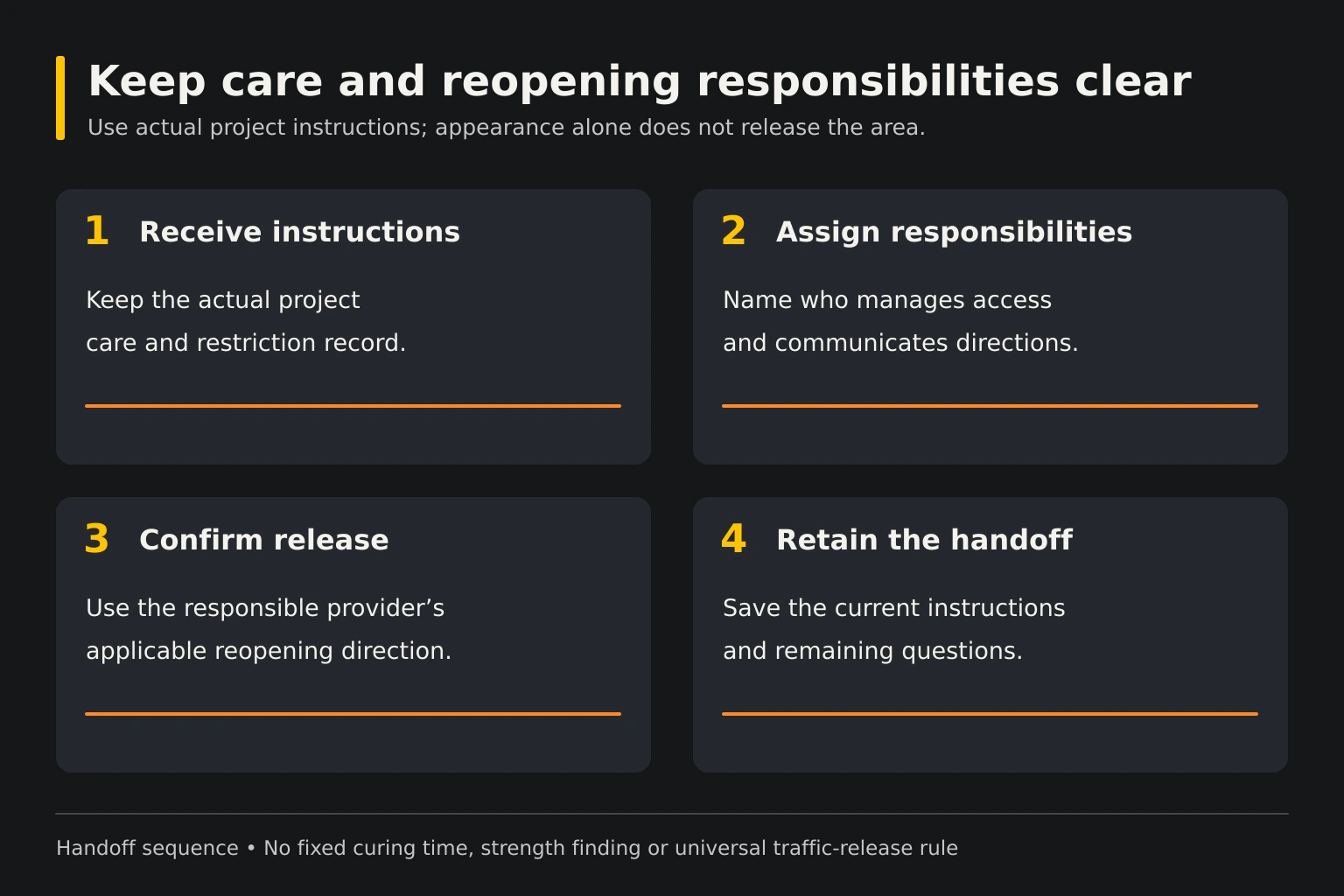
The decision in plain language
Reopening instructions need to come from the actual placement conditions and intended loads.
The situation to discuss
Request separate guidance for people, cars and heavier vehicles. Assign someone to keep barriers in place until the stated conditions are met.
Your five-point decision sheet
Use these headings on a simple sketch or in your project notes. Under each one, write the actual property observation, the question you still need answered and the person responsible for the decision. Leave an unknown item marked as a question instead of assuming it is included.
- What curing and protection tasks are included and assigned?
- Which walking, vehicle, storage and provider activities must the guidance cover?
- Who issues and distributes the current dated instructions?
- What temporary routes and changed-condition process are agreed?
- Which separate treatments and final care records remain distinguishable?
What not to assume
A surface that looks dry is not a reliable reopening decision by itself.
Turn the discussion into a clear work boundary
Keep a copy of the marked site sketch with the estimate. Identify the area being authorized and any adjoining feature that must remain protected or available. If the contractor recommends an investigation or a separate trade, record that next step before treating the proposal as a final solution. A planning guide helps you ask questions; it cannot establish hidden conditions from photographs.
When a decision changes the work, request an updated description showing what was added, removed or deferred. Confirm how any additional quantity will be measured and approved. Make sure the person giving the approval has authority for that part of the property. This prevents a useful site conversation from becoming a different job than the one the owner expected.
Bring the right information to the visit
Send your address, the overall project goal and photos showing this specific connection or operating area. Include a wide view for context and a closer view of the detail under discussion. Describe any timing or access constraint that affects the decision. Avoid placing yourself in traffic or entering inaccessible structures to collect information.
Discuss care while reviewing the scope
Ask which curing and protection tasks are included in the proposal and who handles them. Keep those responsibilities with the accepted concrete area and construction sequence. Care planning should begin before the closure is agreed, rather than become an owner assumption based on when a surface looks finished.
Explain the household or business activities affected by the work and any provider movements expected afterward. The contractor needs the actual intended use to give project-specific guidance. Do not borrow a waiting period from a different property's driveway and treat it as permission for every activity on this job.
Understand curing as part of the concrete work
NRMCA describes curing as maintaining suitable moisture and temperature conditions so newly placed concrete can develop its intended properties. That general explanation does not supply a universal reopening instruction for every project. Ask what method and responsibilities are included in the actual offer and which guidance the contractor will provide.
Keep owner tasks distinguishable from work performed by the contractor or another provider. If a particular care activity is assigned to the owner, request understandable instructions and the contact for questions. Avoid improvising a different treatment based on a generic article or assume a separate product replaces the agreed curing arrangement.
Separate completion from permission to use
Ask how the contractor communicates completion of construction tasks and release for the intended activities. A crew leaving the site, a visible finish or a dry-looking surface should not be treated as an instruction to reopen. The owner needs the actual guidance for the work and use being discussed.
Record the source and date of the current instruction. Keep pedestrian use, household vehicles and later construction or delivery activity distinguishable where the guidance does. Permission for one movement should not silently become permission for another load or operation simply because both would cross the same concrete section.
Identify all expected activities
List parking, turning, walking, furniture placement, storage and provider movements relevant to the included area. Describe confirmed vehicles or equipment where available, without choosing a construction or reopening rule from a name alone. The contractor should understand what the owner plans to return to the surface.
Keep occasional activities visible too. A later collection or renovation delivery may differ from ordinary daily use. Tell the contractor about that event during planning and request the relevant guidance before it is scheduled. The current access record should reflect the actual activities, not only the first household vehicle expected to return.
Assign protection and communication
Ask which protection measures and responsibilities are included and who keeps current route instructions available. Identify the owner contact responsible for telling residents, tenants, guests and providers. Users who were not at the estimate discussion still need the same current instructions when the concrete area is restricted.
Keep contractor tasks separate from owner notices or operating arrangements. If another provider must visit during protection of the surface, coordinate its activity before arrival. Do not assume an ordinary appointment can use the normal route simply because that provider has visited the property before construction.
Make temporary access workable
Explain essential entrances and vehicle needs before approving the closure. Ask whether a practical phase arrangement exists for the actual property or whether temporary parking and another reviewed route are needed. Retaining a nearby slab does not automatically preserve a usable route through preparation and newly placed concrete.
Assign vehicle movement, stored-item access and notices before the crew arrives. If a phase or restriction changes, request updated guidance rather than rely on an earlier completion assumption. Keep one dated current instruction record so the property contact and affected users can identify which route is actually available.
Ask about changes in project conditions
Have the contractor explain how the current construction and care sequence handles changed conditions or a delayed provider task. Keep the responsible contact visible. A general timeline from another job should not override the instruction given for this project's actual placement and intended use.
If the owner changes an activity or vehicle after estimating, communicate it before reopening for that use. Request a current review rather than treat the earlier guidance as a blanket permission. The purpose is to keep the accepted care and access arrangement aligned with what will actually happen on the completed surface.
Keep treatments and later maintenance distinct
Ask whether any separate product, sealer or later treatment is expressly included, with its timing and responsible provider. Do not infer those tasks from the word curing or from an appearance preference discussed during estimating. The accepted proposal should make the offered construction care and any separate task understandable.
Where a product-related instruction is supplied, keep it sourced and current alongside the contractor's guidance. Ask the appropriate provider before applying an unreviewed treatment. A generic website suggestion should not quietly replace the project's accepted care arrangement or imply that every later maintenance service is part of the completed concrete quote.
Compare proposals with care included
Read estimates for matched work limits, construction sequence, curing responsibilities, owner tasks and reopening communication. A shorter description can leave responsibilities unresolved rather than offer the same completed project at a smaller price. Ask about material differences before comparing totals or agreeing a closure your property cannot accommodate.
Keep exclusions, pending decisions and separate-provider tasks with the accepted layout. If the sequence changes, request a current record of care and access responsibilities. The owner should know who gives the next instruction and which task remains open instead of reconstructing several verbal updates after the crew leaves.
Keep instructions connected to the actual activity
Label the care record with the included area and activity it concerns, alongside its source and date. If another provider asks to return, give the responsible contractor the current movement information before arranging it. A useful record preserves the instruction that was actually issued without turning one permission into a blanket release for every later property task.
Retain the final guidance and observations
Save the accepted scope, approved changes and current care and reopening instructions. Include their source, date and the actual activities they concern. Keep final location photographs and pending provider tasks in the same project folder without presenting a surface image as proof of every hidden construction condition or permitted use.
For later observations, identify the location, timing and actual activity and contact the appropriate provider. Avoid diagnosing a condition or change the care method from a single image. A clear handoff record explains what was completed, which instructions were provided and who is responsible for the next question about the concrete area.
Questions before you approve the work
Discuss the actual property and work limits
Send the property address, current photographs, intended use and access needs. Keep planning with these related decisions.
- Concrete delivery access on an occupied property
- Concrete color variation at a repair boundary
- Concrete project decisions
General background: NRMCA CIP11: Curing In-Place Concrete. Follow instructions for the actual project rather than a universal reopening period.
Reviewed October 14, 2026. Owner preparation guidance; the accepted proposal defines the actual work.