
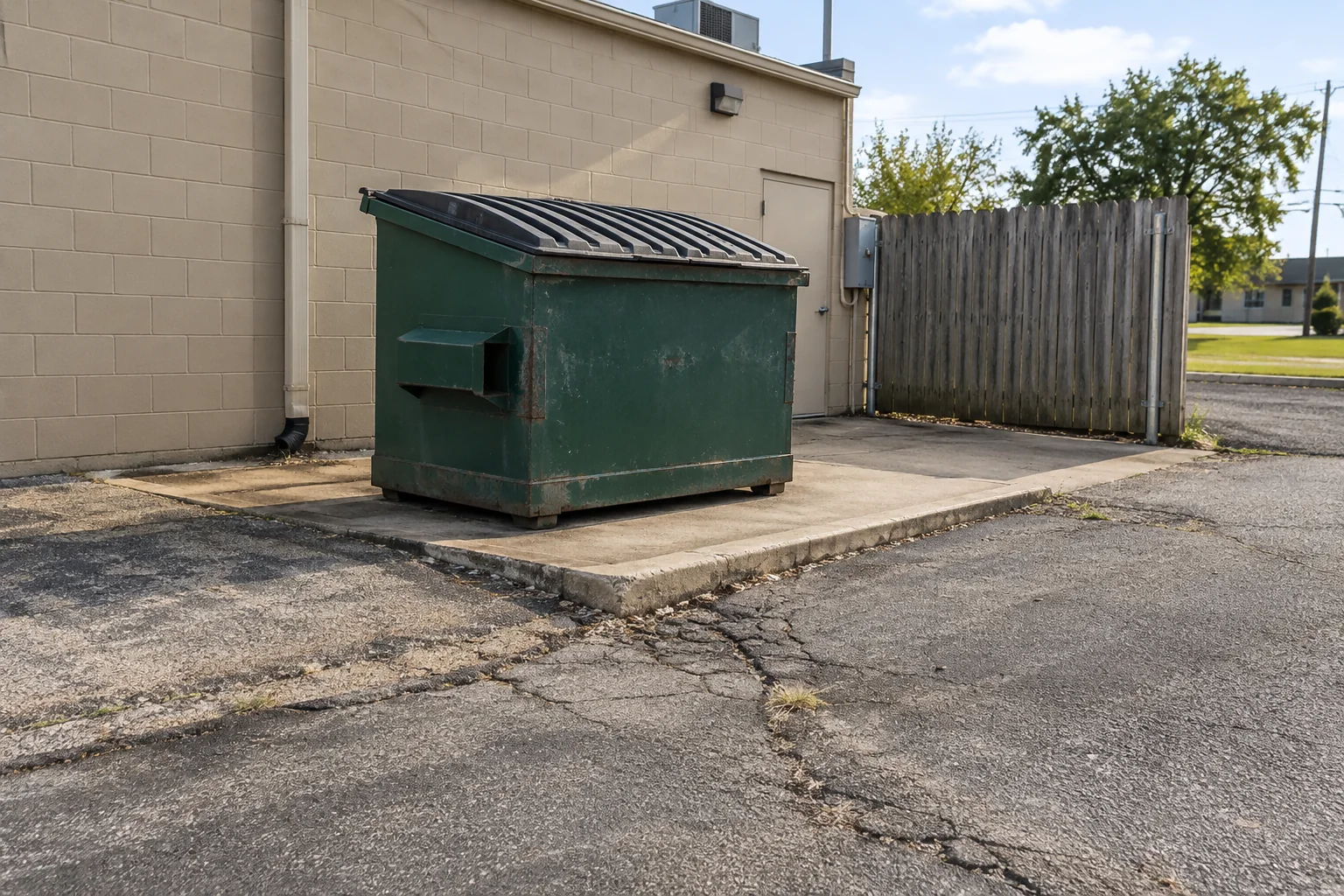
Look beyond the container footprint
Repeated damage around a dumpster area calls for a review of the operation as well as the visible pad. The container footprint is only one part of the site. Show the collection truck's approach, turning area and standing position, using available operational information rather than guessing from tire marks alone. The concern may extend into pavement that lies outside the concrete pad.
Describe exactly where damage returns. It may be at the pad edge, in an approach lane, beside an enclosure gate or at a turning location. Identify previous repair boundaries if they are known. A patch that looks similar to an earlier patch does not prove why either one deteriorated, but the location and history help the evaluator ask better questions.
State the operational problem you need to solve: repeated closures, loose edges, water collection, difficult collection access or a damaged connection. This gives the site review a practical goal. A useful proposal connects the work to that goal and explains which parts of the collection area are included instead of assuming the container slab alone defines the project.
Gather collection details from the responsible parties
Ask the site manager or collection provider for the information they can confirm about the vehicles and collection method. Useful context includes the approach route, frequency, standing location, turning needs and any planned operational change. Keep confirmed information separate from assumptions. A paving contractor should not have to infer every collection detail from an empty area during a brief visit.
Photographs and a marked property plan can identify the route without arranging an unsafe live demonstration. Do not enter a truck's working area or stand beside lifting equipment to obtain a better picture. If further operational observation is needed, the responsible parties should agree on a safe way to obtain it. The initial request can rely on existing records and views taken when the area is clear.
Explain whether the dumpster location or provider may change. A repair designed around an operation that is about to move deserves a different planning discussion. Resolve known layout decisions before finalizing the pavement boundary so the proposed work can be evaluated against the actual intended use of the area.
Document the pad, edges and approach separately
Begin with an overall photograph showing the container, pad, enclosure and access route. Add closer views of damaged edges, cracks, depressions or loose pavement when the area is safe and clear. Identify the locations on a copy of the overall photograph. This makes it easier to distinguish damage under the container from concerns where collection vehicles stand or turn.
Include apparently sound pavement around the damaged area. The transition helps explain where the concern begins and what might be retained. Show nearby drainage features, gates, building entrances and fixed obstacles. These features can affect the work sequence and the usable route even when they are not themselves damaged or included in the proposed repair.
Provide actual records of previous repairs when available: dates, boundaries, scope and any relevant instructions. Avoid assigning an unseen pavement thickness, material specification or support condition from appearance. If the earlier work is undocumented, say so. The evaluator can then explain what information is needed before comparing a repeat surface activity with a more extensive reconstruction approach.
Discuss support and drainage as project questions
The surface pattern can help locate a concern but does not verify the condition below the pad or approach. Ask what review is needed before the contractor recommends a repair depth or assembly. If investigation is proposed, clarify its purpose, location and limits. Information obtained at one point should not be treated as a complete record of every part of the collection route.
Describe water behavior around the pad and enclosure. Show standing water or sediment from a safe position and note when the observation was made. Clarify whether nearby inlets or drainage connections are part of the work. The proposal should explain any dependency on another provider rather than imply that pavement repair automatically corrects the full drainage system.
Keep loading and water questions in the same scope discussion without declaring one universal cause. The collection operation, retained pavement and site conditions should inform the recommendation. Ask the contractor to explain which findings support the proposed work and which uncertainties remain. That is a more useful basis for approval than a general promise to use stronger material everywhere.
Define the repair boundary and retained connections
Ask the estimate to show the pad and approach areas included in the work. Identify the connection to retained asphalt, concrete, enclosure foundations and gates. If the proposal includes only one part of the collection area, understand what concern that part addresses and why other damaged or heavily used locations remain outside the scope.
Compare alternatives by their intended function and boundaries. A surface repair, localized removal and larger reconstruction are not interchangeable simply because each price is called dumpster-pad repair. Ask what preparation, removal, restoration and coordination each includes. The actual site review should determine the proposed assembly; this guide does not prescribe a universal thickness or reinforcement detail.
Agree on the process for unexpected conditions after authorized removal. The site manager should know who receives findings, how an added scope is priced and who can approve a change. Include responsibility for adjacent restoration and any separate container or enclosure work. A clear division helps prevent a paving crew and collection provider from assuming the other has arranged the same task.
Keep collection and site access workable
Coordinate the closure with the collection provider and the people operating the property. Discuss whether the container must be moved, who arranges that move and how collection will continue during the work. A temporary location may need its own review for access and suitability. Do not assume an empty parking space is automatically an acceptable substitute for the dumpster area.
Tell the contractor about deliveries, employee parking, emergency access and walking routes that share the approach. Agree on how the work area will be isolated and how changes in the sequence will be communicated. The plan should account for vehicles that might return out of habit as well as the scheduled collection truck.
Obtain reopening instructions for the actual work and intended collection operation. A general vehicle release may not answer every question about container placement or collection equipment. Confirm who tells the provider when the area is ready. Keep the instructions with the site record and communicate them to the people who schedule pickups so the completed work is used as planned.
An example of checking the proposed boundary
Suppose earlier repairs repeatedly addressed the asphalt directly beside a concrete dumpster pad, while the collection provider confirms that the truck stands and turns farther out in the approach lane. That information does not prove the cause of the repeated damage, but it changes the review boundary worth discussing. Ask the contractor to show how the proposed work relates to both the damaged edge and the confirmed vehicle operation. If the approach remains outside the estimate, understand why and what concern the included work is intended to resolve. Also confirm whether a planned container relocation would change the route before construction begins. A useful decision connects documented operations with the proposed area of work rather than assume that replacing the same small patch again addresses the complete collection activity.
Review completion against the whole operation
At closeout, compare the completed area with the agreed boundary and any approved changes. Record the pad edges and approach with genuine photographs. Confirm what remains outside the work and how future concerns should be reported. A useful completion record relates the visible result to the collection operation rather than present an empty pad photograph as proof of a universal load capacity.
Contact Asphalt Solutions with the project address, damage locations and available collection details. Most projects are handled at customer job sites. Visits to the Slidell contact location are by appointment only, and the listed hours mainly concern phone availability. Call or text to arrange the review and explain any operational deadline before assuming a collection closure or work date can be accommodated.
Questions about repeated damage at a dumpster pad
The direct answer
Waste collection vehicles and stationary loading can concentrate stress at a dumpster area. The pad, approach and turning movements all affect the scope.
What to discuss before choosing a repair
Ask whether the pad and its approach are designed for the actual service movements.
What to observe and record
- Describe collection vehicles
- Show tire paths
- Record pad-edge damage
A mistake to avoid
Improving the pad alone may leave a weak access route untouched.
Continue with the right next step
Property conditions determine the final scope. These planning notes do not replace a site evaluation. How to use our pavement guidance