
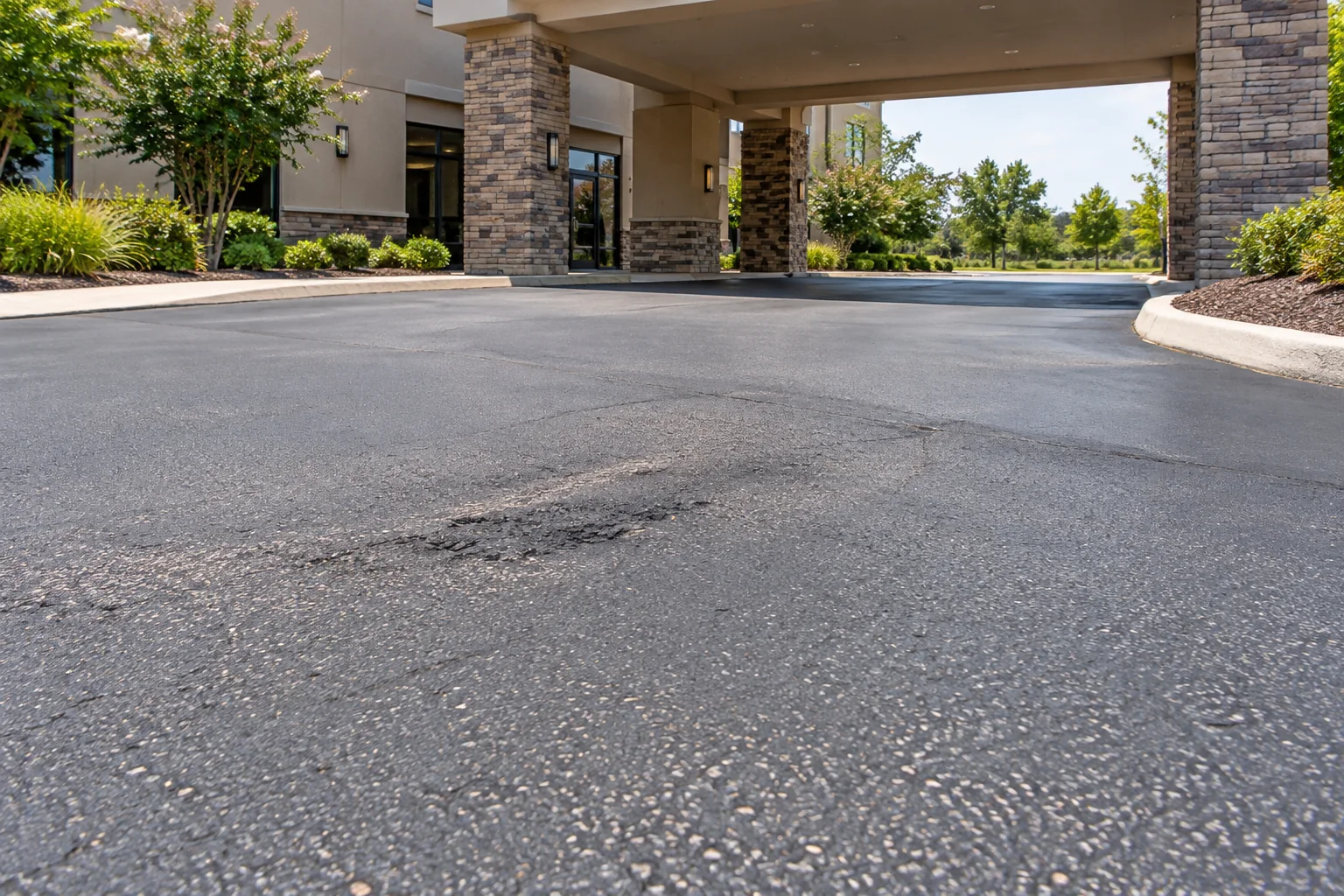
Locate the damage within the actual stopping route
A pavement concern where vehicles brake should be reviewed with the route and operation that use it. Show the approach, normal stopping location and surrounding surface. The fact that damage is near a stop does not alone establish its cause. It does identify a useful relationship for the evaluator to examine before recommending work.
Describe the condition rather than rely on a general failure label. Cracks, scuffs, loose material, ridges and a visible depression are different observations. Identify each location and practical consequence. A close photograph cannot establish affected depth, supporting condition or whether every mark belongs to the same concern. Keep the account factual enough for the site review to distinguish those questions.
Explain what the owner needs the route to do after work. A regular delivery entrance, customer approach and infrequently used parking aisle can have different planning constraints. The contractor needs confirmed use information and present findings before the scope is treated as appropriate. A repair should be compared by its intended function, not selected solely because it can make the stopping area look more uniform.
Provide confirmed vehicle and operating information
Identify the vehicles that use the route and how often they arrive, stop, turn or stand, using information the operator can confirm. Include planned changes in operations. Do not estimate a vehicle load or complete pavement demand from tire marks. If a detail is unknown, say so and identify who may be able to supply it.
Show gate, door, crossing or loading constraints that affect the stopping point. A route can be shaped by equipment and site operations as well as the paved surface. Ask whether those constraints must be settled before the boundary or approach is chosen. The owner should not have to infer that the contractor has reviewed a related system merely because it appears in a photo.
Do not ask a driver to brake sharply or repeat a damaging maneuver for evidence. Existing records, safe static views and normal-use observations can begin the review. If further operational observation is necessary, coordinate a safe method with the responsible parties. The quote process should not depend on recreating a concern or putting someone beside active traffic.
Show the affected surface and retained surroundings
Take an overall image locating the damaged stopping area in the property. Add safe representative close views and show where the condition changes to surrounding pavement. Include apparently unaffected areas nearby. The complete view helps the evaluator understand extent and avoids treating the worst small spot as proof of identical conditions across an entire lane.
Mark separate concerns on a copy of the overall photograph. Show earlier patch boundaries and relevant fixed connections if visible. Describe any difference in level without inventing measurements. A surface image can locate a ridge or low-looking area, but it does not replace the examination or measurements required for a property-specific recommendation.
Leave material undisturbed for the initial request. Do not cut, scrape or excavate the area as an improvised strength test. Ask which uncertainty further investigation would address and how its limits will be explained. A useful owner record preserves the current condition and confirmed history rather than changes the surface to make a diagnosis seem possible.
Include history and actual water observations
Provide records of paving, resurfacing, patching or surface treatment where known. Identify dates and work boundaries. If the assembly or repair history is undocumented, state that clearly. Present appearance does not establish the original materials or thickness, and an assumed construction account should not silently become the basis of the repair scope.
Describe safely observed water collection or flow with location and approximate timing. Include nearby drainage features without declaring one blocked or defective. Water near a stopping area can be relevant context without proving a complete explanation for the damage. Clarify whether a drainage question needs separate review before the pavement activity is selected.
Keep known changes in use and nearby work separate from conclusions about responsibility. Timing can help prepare the assessment, but it does not alone establish fault or warranty coverage. Retain earlier agreements and contact the responsible provider about recent work where appropriate. The current recommendation should follow actual findings and documented history rather than a guessed explanation for recurring marks.
Compare the proposed work by purpose and boundary
Ask the contractor to identify what is removed, retained and restored and explain why that boundary fits the concern. A localized surface activity, a repair involving removal and a broader route project can represent different objectives. They should not be treated as identical corrections simply because each estimate refers to the same stopping location.
Clarify what confirmed vehicle use and actual findings support the approach. This page does not prescribe a universal pavement section, material or load capacity. If more information is required, ask the question it answers and how it affects the recommendation. A limited finding should not be treated as complete knowledge of every part of the route.
Identify exclusions, allowances and related-provider dependencies before comparing totals. Agree who receives unexpected findings during authorized work and who approves changes and pricing. A clear process lets the owner evaluate new information without an active crew improvising a layout, equipment or drainage decision outside its scope. Keep the updated boundary attached to the actual project record.
Plan the closure around real arrivals and access
Discuss whether the stopping area can close and which operations need an alternate arrangement. Include deliveries, collection, customer access and walking connections as relevant. A route empty during the visit may still have scheduled use. The work plan should account for that operation rather than assume the owner can stop every arrival without coordination.
Confirm temporary arrangements with actual operators and responsible site parties. A path suitable for a car may not suit delivery equipment. Identify who reviews the route, communicates changes and controls the work area during each phase. Users need clear instructions before they arrive at their usual stopping point and find it unavailable.
Follow actual provider instructions for reopening and use, including any separate turning, standing or parking restriction. A fresh-looking surface does not independently release the route for every vehicle operation. Clarify who communicates the complete handoff where related tasks remain. A useful completion includes an understandable operational release as well as the installed material.
An example of a route-specific comparison
Suppose a damaged stopping area serves regular deliveries and also connects to a customer entrance. One proposal may address a limited damaged section, while another includes more of the approach. Ask which concern and confirmed operation each is intended to address. Mark the retained boundaries and identify any equipment or drainage dependency before comparing totals. The owner should understand whether the options have the same objective or leave different conditions in place. Include the temporary route needed during closure and have the responsible parties confirm its suitability for the actual vehicles and walking connection. A price labeled entrance repair should not silently promise unrestricted delivery access throughout construction or universal future load performance. Keep confirmed use, present findings and approved changes in the same record. At closeout, identify what was completed and what remains so later surface observations can be discussed against the actual scope instead of treat every tire mark or crack near the stop as proof that the same mechanism has returned.
Keep the work and later use record together
Retain genuine overall completion photographs, the scope and approved changes. Identify retained pavement and any deferred task. The record should explain the activity provided without imply every hidden condition or future operating change is covered by the new surface. Expectations and any warranty terms belong to the actual agreement.
If another concern appears later, report its location and timing with actual observations. Describe confirmed changes in vehicle use or nearby work separately. Do not repeat braking events to prove an explanation. The before-work account and documented operation help the provider understand the follow-up against the actual scope instead of assume every surface mark represents the same recurrence.
Contact Asphalt Solutions with the project address, safe views and confirmed stopping-route details. Most jobs are handled at customer sites. Slidell contact-location visits are by appointment only; listed hours mainly concern phone availability. Call or text to discuss the site review and operational constraints before choosing a pavement activity for the braking area.
Questions about surface damage where vehicles brake
The direct answer
Braking areas can have different stresses from ordinary straight travel. The defect pattern and vehicle use help determine the investigation.
What to discuss before choosing a repair
Ask whether the pavement mixture, support and traffic pattern warrant a different repair scope.
What to observe and record
- Identify stop locations
- Show ridges or scuffing
- Describe heavy vehicles
A mistake to avoid
A cosmetic treatment does not correct every displaced or unstable area.
Continue with the right next step
Property conditions determine the final scope. These planning notes do not replace a site evaluation. How to use our pavement guidance