
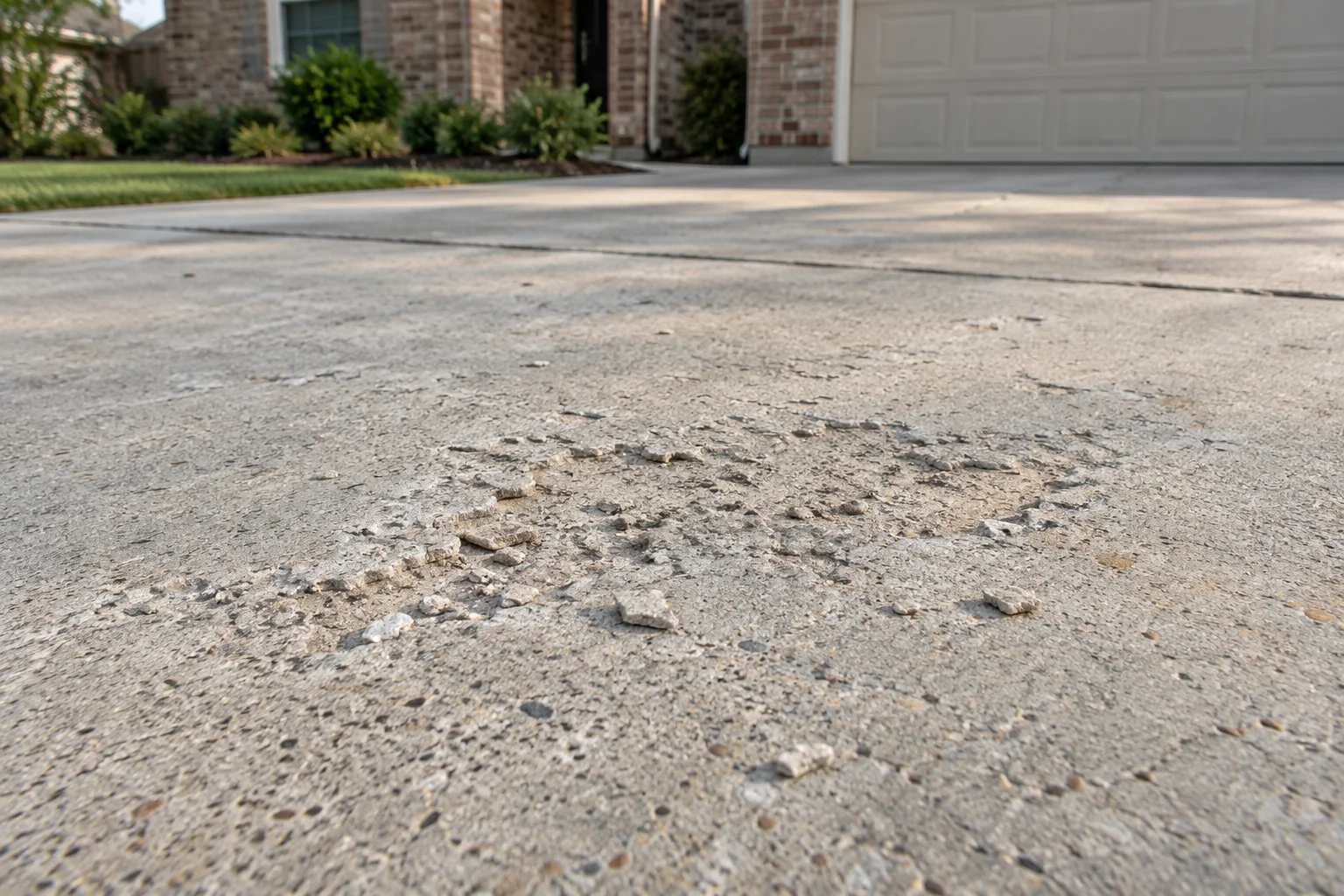
Describe surface loss before choosing a repair label
Flaking concrete is a visible surface-loss concern that should be described with its location and extent. Start by showing the affected area and the surrounding concrete. A shallow-looking rough patch and a broken or displaced panel are different observations. Neither photograph alone establishes the appropriate work or the condition beneath the surface.
NRMCA's scaling guidance explains local flaking and peeling in the context of concrete exposure and surface condition, and notes that peeling can also occur outside freezing conditions. That background helps an owner avoid assigning every flaking surface to the same cause. It does not diagnose a Louisiana driveway or establish a project-specific repair.
Tell the contractor what prompted the request. The concern may be growing surface loss, loose material, appearance, a walking area or a change after recent work. State the practical effect and what you have observed. The evaluator can then explain what information is needed and whether the next step concerns a surface activity, repair, replacement or further review.
Show the affected area and the remaining surface
Take a wider photograph identifying the driveway section, walkway or other concrete area. Add close views of the flaking and exposed texture from safe positions. Show the transition between affected and apparently sound areas where possible. The surrounding surface helps the evaluator understand the extent rather than infer a whole-property condition from one close image.
Describe whether the loose material appears to be increasing and whether the affected areas are merging or spreading. If genuine earlier photographs are available, retain their dates and context. Avoid inventing a loss depth or a structural conclusion from the picture. Ask what measurements or examination are needed to define the condition and proposed boundary.
Do not chip, scrape or pressure-clean the area as an improvised test before discussing the concern. Those activities can change what the evaluator sees and are not a substitute for review. If recent work has instructions or restrictions, follow them and contact the responsible provider. An honest record of the existing condition is a useful starting point.
Include exposure and known construction history
Tell the contractor what is known about the concrete's age, previous treatments, repairs and recent work. Provide actual records where available. If the history is uncertain, say so rather than infer a mixture, finishing method or curing practice from appearance. The evaluator needs to know which facts are documented and which remain assumptions.
Describe relevant exposure observations without deciding the cause. Water collection, known products applied to the area or a reported change after an activity can be useful context. State what happened and when, with the limits of your knowledge. The technical background explains possible considerations; it should not be converted into a claim that one factor caused your specific surface condition.
Also identify how the area is used. A driveway approach, a walkway and a less-used edge can raise different practical questions about access and the intended result. The contractor should understand the use before recommending an activity. If the use will change, make that part of the project discussion rather than assume a cosmetic improvement addresses the future need.
Separate a surface activity from removal of damaged material
A coating or cosmetic treatment and a repair involving deteriorated concrete are different scopes. Ask what the proposed activity is intended to accomplish and why the existing surface is considered suitable for it. A uniform-looking finish should not be treated as proof that the underlying condition was evaluated or corrected.
If the recommendation includes preparation or removal, ask how the boundary is selected and which retained surface is assumed to remain suitable. The owner should not choose a repair depth from an online example. A useful proposal connects the evaluated condition with the actual work and identifies limitations that remain.
If more deterioration may be found during preparation, agree on how the finding is documented and how a changed response is approved. A preliminary allowance is not a guarantee that every concealed condition is already known. Keep the relevant assumption beside the affected location so the owner understands what requires confirmation before additional work proceeds.
Compare local repair and a broader panel question
The existing short FAQ distinguishes surface loss from a full-panel condition. Preserve that distinction when reviewing offers. Ask whether the concern is limited to the surface or whether another issue needs evaluation. A photograph of flakes should not automatically become a recommendation to replace the entire driveway, and a narrow treatment should not imply that every panel question is settled.
Identify joints, edges, garage aprons and neighboring panels that affect the proposed work. Ask how the retained features are handled and which restoration is included beside the repair. The final boundary should be understandable in relation to the property rather than described only as a quantity of material or a general preparation line.
Where movement or water is also reported, ask for a separate answer about those concerns. A contractor may recommend another evaluation or a different scope based on the findings. Keep that next step visible. It is more useful to document an unresolved question than to treat an early surface proposal as a comprehensive assessment of the concrete.
Plan the work and retain the actual result
Tell the contractor about vehicles, doors and walking approaches affected by the work. A limited flaking area may still lie on an essential route. Ask which area is unavailable during preparation and repair, who communicates changes and what owner actions are needed before the start. If another trade is involved, identify the relevant handoff.
Follow project-specific reopening and use instructions. A changed surface appearance or the completion of one activity does not independently release the area for every use. Ask who authorizes availability and whether any limitation continues. Keep the instruction with the scope so household members, staff or tenants receive the same information.
At completion, retain the actual work boundary, date and supporting documents. If part of the concrete remained outside the agreement or a recommendation was deferred, record that plainly. A future photograph of a treated area does not establish that every flaking location was addressed. The record should describe what was actually done and which questions remain open.
Prepare a useful flaking-concrete request
Send the job-site address, wide and close photographs, observed change and known work or exposure history. Explain how the area is used and what outcome you want reviewed. Ask what the next evaluation would establish before selecting a cosmetic treatment, repair or broader replacement. Keep the request tied to the actual area instead of seeking a guaranteed answer from one photograph.
Call or text Asphalt Solutions to discuss the property. Most projects take place at customer job sites. Visits to the Slidell contact location are by appointment, and listed phone availability is separate from construction scheduling.
A practical way to compare two surface-loss descriptions
Imagine an owner receives one offer for a cosmetic surface activity and another that describes preparation of a defined flaking area. Ask both providers to identify the same location and explain why the remaining surface is suitable for their proposed work. The price comparison should retain that difference instead of treating every mention of concrete repair as an identical task.
Next ask whether the reported concern extends beyond the visible patch. If the owner has also observed movement or a water issue, keep those questions separate and obtain a response for each. A proposal may be appropriate for one condition while another requires more information. Record that boundary and any recommendation before accepting the work. At completion, the location record should show what was actually addressed without implying that all panels or concealed conditions were evaluated.
Questions about concrete surface flaking
The direct answer
Flaking concrete requires a review of depth, loose material and exposure conditions. A cosmetic surface treatment and removal of deteriorated concrete are different approaches.
What to discuss before choosing a repair
Ask what preparation, bond and finish can be expected from a repair.
What to observe and record
- Show flaking depth
- Mark the affected area
- Describe when the condition appeared
A mistake to avoid
A thin cover should not be assumed suitable over unsound material.
Continue with the right next step
Property conditions determine the final scope. These planning notes do not replace a site evaluation. How to use our pavement guidance
Background reading: NRMCA CIP 2 on concrete scaling. General guidance does not replace evaluation of the actual property.