
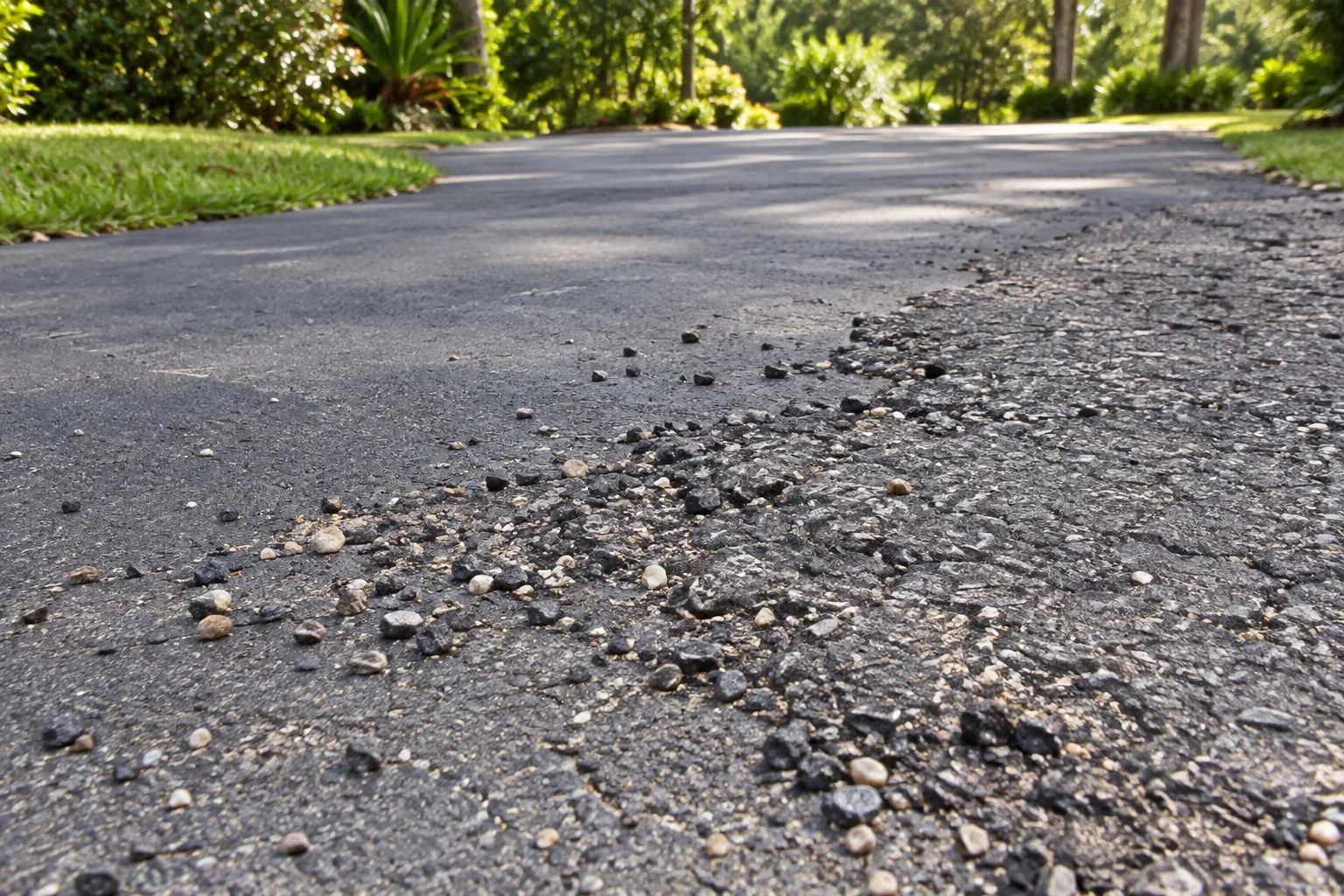
Loose material is an observation, not a complete diagnosis
Loose stones on an asphalt surface can prompt questions about the material's source and the condition of the pavement beneath it. Start by recording where you see the particles and how the surrounding surface looks. A few isolated stones, material carried from elsewhere and an area losing surface texture are not identical descriptions. The evaluator needs that context before selecting a response.
Raveling is a technical term for pavement surface loss involving dislodged aggregate and binder. The FHWA distress manual describes it as a surface condition, but the presence of loose particles in a photograph does not by itself establish that diagnosis. Ask whether the material is residual debris, associated with surface deterioration or part of a different condition at the property.
The useful first request explains the extent, change over time and practical concern. You may be noticing an increasing amount of material, a rough area where people walk or a condition after recent work. Say which question matters to you. A contractor can then explain what can be assessed and whether the next step is cleaning, maintenance, repair or further evaluation.
Photograph both the particles and the surrounding pavement
Begin with a wider image showing the affected driveway section, parking row or entrance. Then add close views of the loose material and nearby surface texture when safe. The wider view helps the contractor see whether the concern is isolated, follows a traffic route or lies beside another source of material. A close image alone can make a small feature look like a whole-property condition.
Describe whether the loose material appears to be increasing and whether the surface looks different from earlier photographs. If you have genuine dated images, keep their context clear. Avoid staging a dramatic pile or moving material simply to make the problem appear larger. An honest record of what was observed is more useful than an image arranged to support a diagnosis.
If the area is under active work or subject to instructions from a recent project, follow those directions and contact the responsible provider. Do not sweep, scrape or otherwise alter a restricted area as an improvised test. Ask what observations are useful and whether the contractor wants to review the condition before further activity changes it.
Record where material may be coming from
Tell the evaluator about adjacent gravel, landscaping, recent construction or another potential source you know about. That information does not prove where every particle originated, but it helps define the question. Distinguish material lying on top of a surface from visible texture loss in the pavement when describing what you can observe safely.
Also describe traffic and use. Concentrated turning, parking or delivery activity may be relevant to a local rough area. A walkway concern may have a different practical effect from particles along an unused edge. The contractor should understand where people and vehicles encounter the condition rather than only see a close image of aggregate.
Known treatment or repair history belongs with the location. Provide actual records if available, including whether nearby work was temporary or complete. Do not guess a prior material or construction date from color. If the history is incomplete, identify that uncertainty. The evaluator can explain whether further information is needed before the appropriate scope can be prepared.
Ask what the remaining surface condition means for the scope
The source and extent of loose material are important, but the remaining pavement also needs consideration. Ask what the contractor can evaluate about the affected area and how that influences the recommendation. A cleaning activity and a repair addressing deteriorated material have different purposes. The proposal should make clear which question it answers.
Do not assume that loose stones automatically require replacing the entire driveway or lot. The existing short FAQ correctly points owners toward identifying extent and source first. Equally, do not assume that removing visible debris resolves a surface condition that continues to produce material. Ask the evaluator to distinguish the observation, the proposed activity and any remaining limitation.
If additional preparation findings could affect the scope, agree on the process for documenting them and approving changes. A preliminary price may rely on an assumption that needs confirmation at the property. Keep that assumption visible rather than treating the quote as proof that every underlying concern has already been evaluated.
Compare cleaning, maintenance and repair as different responses
A contractor may recommend different next steps depending on the actual condition. Ask what each proposed activity is intended to accomplish and what it does not address. A service description should connect to the observed property, not only promise a more uniform appearance. The owner needs to understand whether the recommendation concerns material on the surface, the surface itself or another question.
When comparing offers, give providers the same location record and known history. One offer may cover cleaning only, another may include localized repair and a third may depend on additional evaluation. Those are not automatically like-for-like prices. Ask for preparation, boundaries, disposal or cleanup responsibilities and limitations to be shown clearly.
If a surface treatment is proposed, ask why the pavement is considered suitable and whether repairs are needed first. Do not choose a treatment solely because another property received it. Product and project instructions should guide the actual work. A useful quote explains the relevant assumptions and any condition that would cause the recommendation to change.
Plan access and keep the completion information
Loose material may occur at an entrance or walking approach, so explain how the affected location is used. Ask the responsible party for any interim access instructions appropriate to the observed condition. Do not redirect people through an unfamiliar area based only on a photograph or assume that a visible alternate path is suitable for everyone.
For planned work, identify vehicle moves, deliveries and pedestrian needs before scheduling. Ask how the work area is managed and who communicates changes. Follow the project-specific reopening instructions rather than infer release from appearance or the crew leaving. If different areas have different status, retain that distinction when informing occupants.
After work or evaluation, keep the actual scope, date, location and instructions with the property record. If the recommendation was further review or a concern remained outside the work, record that plainly. A later observer should not assume every loose-material question was resolved simply because another maintenance activity occurred nearby.
Prepare a useful request about loose aggregate
Send the job-site address, wide context views, close texture photographs and a description of whether material is increasing. Include known adjacent sources, vehicle activity and available work history. State whether your concern is recurring material, roughness, recent work or another practical effect. Ask what the next evaluation would establish before selecting a service.
Call or text Asphalt Solutions to discuss the actual property. Most projects occur at customer job sites. Visits to the Slidell contact location are by appointment, and listed phone availability is separate from construction scheduling.
Keep the source question open until it is reviewed
An owner may notice loose particles after nearby work and reasonably ask whether they came from that activity. Record the timing and location without treating the sequence as proof. Ask the responsible parties what can be checked and which information would help. If the proposed action is cleaning, clarify whether a later observation is needed to understand if material continues to appear. The point is to preserve an honest question and the agreed next step, rather than label every particle as pavement failure or assume that removing it establishes the condition of the remaining surface.
Questions about loose stones on an asphalt surface
The direct answer
Loose aggregate can be a sign of raveling or another surface condition. The extent, rate of change and condition of the remaining pavement influence the next step.
What to discuss before choosing a repair
Discuss whether cleaning, a suitable maintenance treatment or more extensive renewal is appropriate.
What to observe and record
- Photograph close and wide views
- Describe whether loose material is increasing
- Note concentrated traffic areas
A mistake to avoid
Sweeping loose stones does not by itself stop continuing material loss.
Continue with the right next step
Property conditions determine the final scope. These planning notes do not replace a site evaluation. How to use our pavement guidance
Terminology reference: FHWA asphalt pavement distress descriptions. Technical terminology does not diagnose a private property from a photograph.