
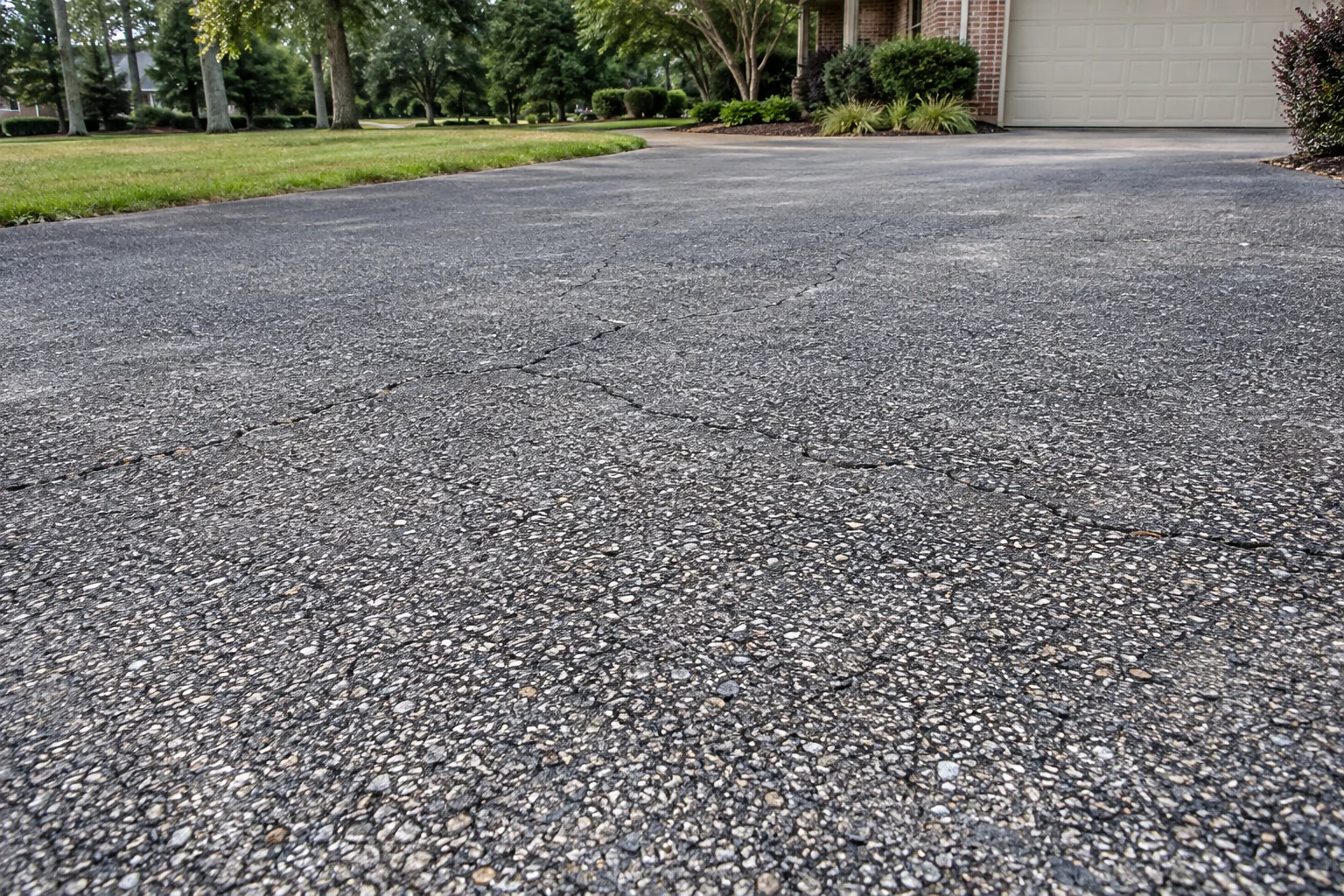
Describe the cracks and the absence of visible movement
An asphalt surface can show cracks without an obvious depression or raised edge. That is a useful observation, but it does not establish the condition beneath the pavement or prove the cracks can be ignored. Show the pattern and surrounding surface and describe what has changed, if anything. The site review can then address the appropriate next step.
Avoid turning a visual impression of level pavement into a technical finding. A photograph may not reveal small changes in elevation, crack depth or the behavior of retained layers. Say that no settlement is visibly apparent to you rather than claim that supporting conditions have been verified. Accurate language leaves room for the evaluator to explain what needs checking.
The practical decision may concern maintenance, a localized repair or further review before choosing either. Ask what findings support the recommendation and what it is intended to accomplish. The absence of a visible depression should not be the only reason for selecting work, just as the presence of a crack does not automatically establish that a whole driveway or lot needs replacement.
Show the complete pattern before focusing on width
Take an overall view identifying the cracked driveway or parking section. Add safe closer views that show the line and its surrounding texture. If cracks connect, change direction or follow an earlier repair boundary, show that context. A single close image does not describe the extent of a pattern across the property.
Mark separate locations on a copy of the overall photograph so each close view remains identifiable. A scale reference can sometimes help communicate appearance when it can be positioned safely without entering traffic or disturbing the opening. It is not a substitute for the measurements or examination the evaluator may need for a recommendation.
Show apparently unaffected pavement nearby where useful and identify any visible loose material or edge damage separately. Do not widen a crack, dig below it or perform an improvised test before the review. Ask what information is needed and how it will inform the proposed activity. The initial record should preserve the condition rather than change it to make a diagnosis seem possible.
Keep time and weather observations factual
Genuine earlier photographs can help show whether the same location has changed. Retain their dates and context rather than compare unrelated close-ups. Describe when you first noticed the crack and whether an actual change has been observed. If you do not know its age, say so. A weathered appearance does not establish a reliable installation or crack date.
Record water collection or flow observations only when safely available. Note approximate timing after rain and identify the location. Do not conclude that a dry opening proves there is no water-related concern or that one wet photograph establishes the full cause. The evaluator can explain whether the water context needs additional review.
Include known work or use changes around the area. Earlier patching, utility work, resurfacing or a different vehicle route may provide context, but timing and proximity alone do not prove causation. Keep documented facts separate from assumptions so the recommendation can be discussed against an honest history rather than a story built from the crack's appearance.
Ask what makes a maintenance activity appropriate
If crack maintenance is proposed, ask why the actual opening and surrounding pavement are considered suitable for that activity. The provider should explain the purpose, preparation and limits in terms the owner can understand. A product name by itself does not show how the recommendation relates to the observed condition.
Distinguish addressing an appropriate opening from repairing pavement that needs removal. Those activities can have different objectives and boundaries. Ask which concern each proposed item addresses and what remains in place. A surface treatment should not be understood as proof that every hidden condition has been investigated or that future movement is impossible.
This guide does not prescribe a crack-width threshold, treatment material or repair depth for an unseen property. The actual evaluation should determine those decisions. The owner can prepare by showing the full pattern, providing known history and asking for a clear explanation of what the selected activity is expected to accomplish and what it cannot establish.
Define investigation questions before authorizing them
Sometimes a recommendation needs more information than the surface view can provide. Ask which uncertainty an investigation is intended to resolve and how its result will affect the decision. A defined question is more useful than a general instruction to test the pavement without explaining what the owner will learn.
Clarify the location, extent and limits of any proposed examination. Information obtained at one point should not be presented as a complete record of every part of a driveway or parking lot. Ask what restoration or follow-up decision is included and whether the investigation is a separate scope from the later repair.
If removal during authorized work reveals a condition different from the initial review, use an agreed communication and approval process. Identify who receives the findings, who can approve a change and how it is priced. An understandable allowance or exclusion gives the owner a reviewable decision without treating the original surface appearance as a guarantee of what will be found.
Set priorities using actual property use
Identify which cracks lie in entrances, walking connections, parking positions and vehicle routes. The location and consequences can affect the owner's priorities even when two cracks look similar. Explain the concern that matters to the property and any operational deadline. Do not assume that visual prominence alone establishes the order in which all work should be done.
Discuss closures and temporary access for the activity selected. A maintenance project and a removal-and-replacement project can have different operational needs. Tell the contractor whether the route can close and who must be informed. Keep household access, business deliveries and walking routes visible in the planning conversation.
Follow the provider's actual reopening and care instructions. Appearance is not a universal release for vehicles, and a waiting period from another project may not apply. Agree who communicates the release and how restrictions reach the people using the surface. A clear operational plan supports the work regardless of whether the selected scope is maintenance or a larger repair.
An example of comparing two apparently level areas
Suppose an owner notices a long line near an older repair and a separate connected pattern in a parking position, with no obvious depression in either place. Present the two locations separately and include known history. Ask whether the evaluator sees different questions or suitable activities for them. If maintenance is proposed at one location and further review at the other, request an explanation tied to the actual findings. The absence of visible settlement is shared context, not proof that the two areas have identical hidden conditions. A marked overall photograph and clear scope make the comparison understandable. Keep any investigation purpose, work boundary and excluded concern in the record so the owner can evaluate the decision without trying to establish depth or support condition from the surface line alone.
Keep a record for the next condition review
At closeout, retain the scope, approved changes and genuine photographs identifying the treated or repaired locations. Record any areas excluded or deferred for later review. The completion record should explain what was done rather than rely on the absence of a visible crack in one image as proof of every underlying condition.
If a concern changes later, report the location, timing and actual observation. Distinguish a reopened line, new loose material, water collection and visible movement rather than label all of them the same recurrence. The earlier record helps the provider understand the follow-up and discuss it against the actual agreement.
Contact Asphalt Solutions with the project address, safe overall and close photographs and known history. Most work is handled at customer job sites. Visits to the Slidell contact location are by appointment only; the listed hours mainly describe phone availability. Call or text to discuss the appropriate property review before assuming that no visible settlement means no further decision is needed.
Questions about surface cracks without visible settlement
The direct answer
An isolated crack without obvious movement may be suitable for maintenance, but condition and behavior still need review. Its appearance should be recorded over time.
What to discuss before choosing a repair
Ask how crack condition affects treatment choice and monitoring.
What to observe and record
- Photograph with a scale reference
- Note water entry
- Record changes after weather
A mistake to avoid
No visible settlement does not prove every supporting layer is sound.
Continue with the right next step
Property conditions determine the final scope. These planning notes do not replace a site evaluation. How to use our pavement guidance