
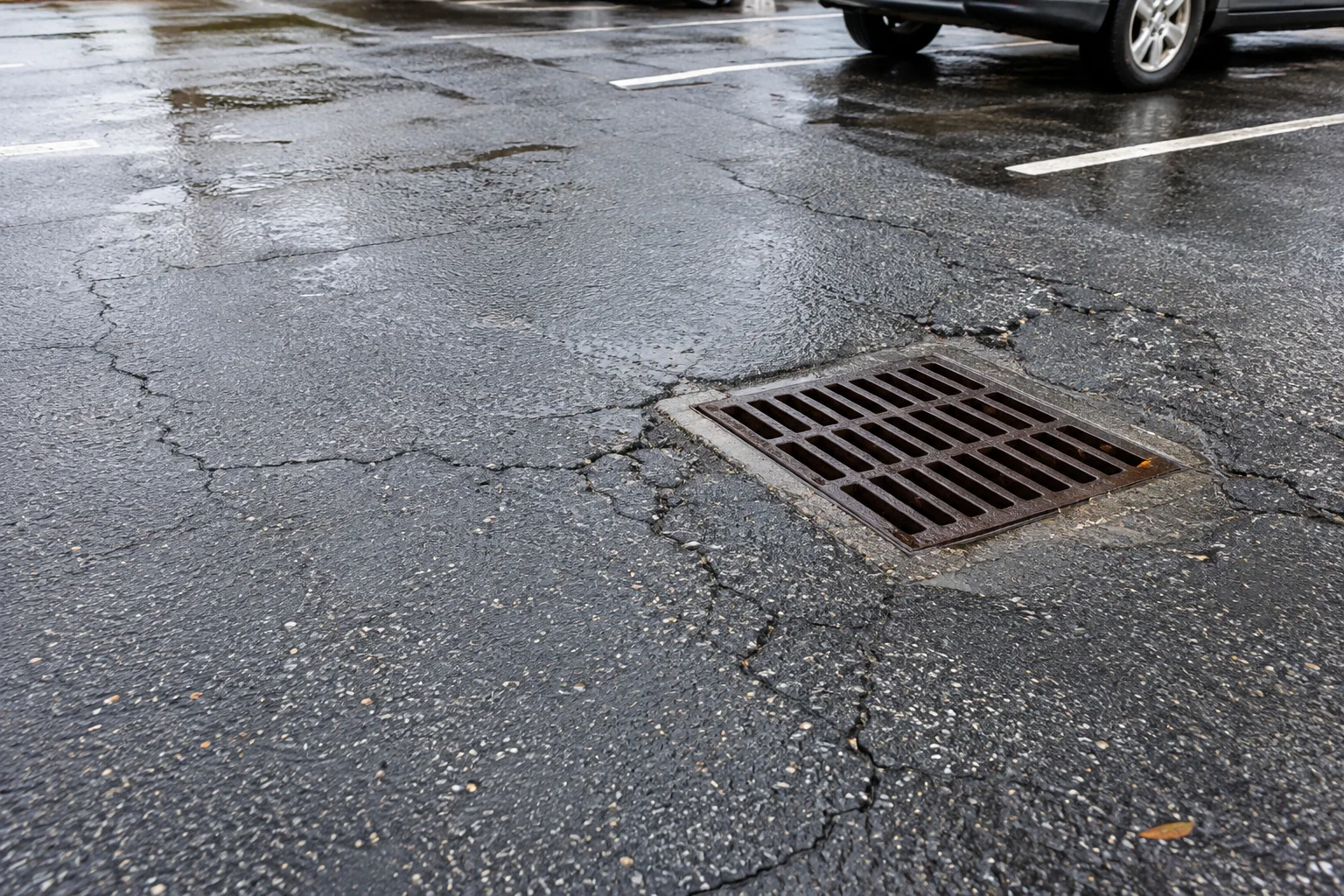
A location-based example for a drain-area comparison
Imagine a manager receives one offer for asphalt patching around an inlet and another that also describes a review of the retained connection. Ask each contractor to identify the same boundary, preparation and responsibility for the drain-related features. A surface repair price should not be interpreted as including work inside the drainage structure unless the actual agreement says so. Keep that distinction beside the named inlet rather than in a general note about the entire lot.
Next identify the observed water path and the traffic using that location. If the manager reports water after rain, request a clear answer about whether the proposed work evaluates that concern or addresses cracking only. The inlet's appearance alone does not establish the condition of the connected system. A qualified review may need more information, and that next step should remain visible instead of being converted into an unsupported promise that patching will solve every water issue.
Finally, compare the access assumptions. Work around an inlet can affect a parking row, delivery approach or pedestrian connection even when the repair area is modest. Ask who moves vehicles, who communicates restrictions and who releases the location for use. Keep those instructions with the accepted scope so staff do not infer reopening simply because the patch looks finished.
Keep the drain-area record useful after the project
Retain the actual work boundary, approved changes and completion information with the inlet location. If the project addressed the surrounding asphalt while another drain-system question remained open, state that plainly. A future manager should not have to infer the entire scope from a photograph of a darker patch. The record can show completed pavement work without claiming that concealed drainage features were inspected or repaired.
Use the same location name in future photographs and observations. If cracking or water appears again, link the new observation to the earlier scope without assigning a cause from timing alone. That history helps the next evaluator understand the question and identify the appropriate next step. It does not replace a site review or establish hidden structural conditions.
Locate the cracks relative to the drain
Cracking around a parking drain can involve several connected features: asphalt, a concrete collar, the inlet frame and the surrounding travel surface. Start by showing which part is damaged and how it meets the others. A close-up of one crack is useful, but a wider view should also show parking stalls, traffic direction and the position of the inlet within the lot.
Describe whether the cracking circles the structure, extends away from it, lies at a material transition or overlaps an earlier patch. Note any visible change in level without guessing what moved beneath the surface. If the concern appeared after another repair or drain adjustment, include that history. These observations help distinguish assessment questions that a generic “fill cracks” request can miss.
Take photos from a stable position outside moving traffic. Do not remove grates or enter a drain to investigate it yourself. Show the accessible surface and explain known concerns. The property manager should identify the appropriate responsible party for structural, outlet or other drain work if those tasks extend beyond the asphalt scope being discussed.
Observe where water reaches and leaves the inlet
A parking drain works within a larger surface-water path. Report where water approaches it, whether it passes across the cracked area and whether a puddle remains nearby after rain. A drain being present does not establish that the surrounding surface directs water to it or that its connection and destination are suitable. Separate the visible observations from assumptions about underground operation.
Include safe rainfall observations where available and dry-weather photos of the surrounding lot. Identify nearby curbs, islands and fixed surfaces that could affect the path. If the problem is seasonal or appears only during stronger events, say so. The inquiry should explain the circumstances honestly rather than claim a particular drain failure that has not been assessed.
Ask which drainage-related investigation is included in the paving proposal. Asphalt work can address an assessed surface connection, while inlet, pipe or outlet work may require a separate scope. Confirm responsibilities and sequence before approval. Changing one surface elevation without reviewing the adjacent structure can leave an interface that does not perform as intended.
Distinguish crack treatment from rebuilding an interface
A limited crack treatment, a localized asphalt repair and reconstruction around an inlet are different operations. Ask why the recommended approach fits the observed condition and what it retains. If the surrounding area has movement or repeated damage, merely treating the visible crack should not be assumed to resolve the complete concern. The assessment should explain the repair boundaries and relevant limitations.
Where asphalt meets a retained frame or concrete collar, ask how the finished transition is handled. Clarify which materials are removed and whether the structure itself is adjusted or repaired. A description that includes “repair around drain” can still omit the drain assembly. Compare defined operations rather than infer inclusion from a broad phrase in the estimate.
An overlay changes the surrounding surface height, so the inlet connection needs attention before resurfacing is selected. Ask how the finished paving meets the retained drain and how water reaches it. Do not assume that another layer automatically improves collection. Sealcoating also has a maintenance purpose and should not be used as a substitute for correcting an assessed damaged interface.
Include the traffic pattern near the drain
Drains can be located in parking stalls, circulation lanes, tight turns or delivery routes. Show the actual movements and vehicle types at the affected location. Explain occasional service traffic as well as daily passenger use. This helps the assessment relate pavement conditions to intended use without guessing that every part of a parking lot receives the same demand.
Identify whether drivers repeatedly cross the repair boundary or turn near the inlet. A route sketch is often more useful than a list of vehicle types alone. Include standing locations if they affect the area. The estimator should discuss the intended use with the property facts in hand; a web page cannot provide the final construction detail for a particular inlet or traffic demand.
Plan how vehicles and pedestrians will avoid the work zone. The inlet may lie on a route that serves several entrances, so even a small repair can affect a larger operating area. Show available alternatives and have the responsible property team review their suitability. Confirm which routes remain open during preparation and placement rather than assuming the finished repair footprint defines every closure.
Coordinate ownership, access and related tasks
Before scheduling, identify who owns or maintains the drain and who can authorize work on it. Shared properties can have responsibilities different from the person requesting an asphalt quote. Obtain the actual scope boundary and responsible contact instead of assuming the paving contractor has authority over every connected drainage feature. Keep the coordination practical and tied to the operations proposed.
Ask whether preparation requires temporary protection or other measures around the inlet and who handles them. Confirm the sequence with any separate drain or concrete work. Related operations should connect deliberately; one contractor finishing a surface does not necessarily mean another part of the drain project is complete. Record the handoff and the person who approves the final interface.
Keep tenants, staff and service providers informed about the agreed closure. State the affected route and construction boundary clearly. Use actual reopening instructions for the work performed rather than a promised time based on an early estimate. Ask separately about passenger traffic, turning and service vehicles where those uses differ at the location.
Review the proposal against the actual drain concern
Give each estimator the same defect photos, water observations, repair history and route sketch. Compare removal, preparation, repair limits, retained structures, elevation connections and related operations. Check exclusions for pipe, outlet, concrete or inlet work. A lower total may represent a narrower asphalt-only scope rather than an equivalent correction of the entire concern.
Identify how hidden conditions will be raised and who can approve a change. Ask what records the property should retain after completion, including the location and explanation of the work. Dated photos and a clear proposal help a later manager distinguish the completed repair from a new concern nearby. They also make the next maintenance discussion more useful than relying on a general recollection.
Begin a commercial inquiry with the address, drain location, observed cracks and the effect on property use. Include desired timing and the authorized contact. Asphalt Solutions discusses parking lot paving and asphalt repair across Greater New Orleans and the Northshore. Call or text (985) 788-0493 for the project discussion; the inquiry does not confirm drain diagnosis, construction scope or a scheduled workday.
Questions before you plan the work
Bring the property facts to the conversation
Parking lot paving, asphalt repair and pavement maintenance address different project questions. Compare the appropriate scope for your property.