
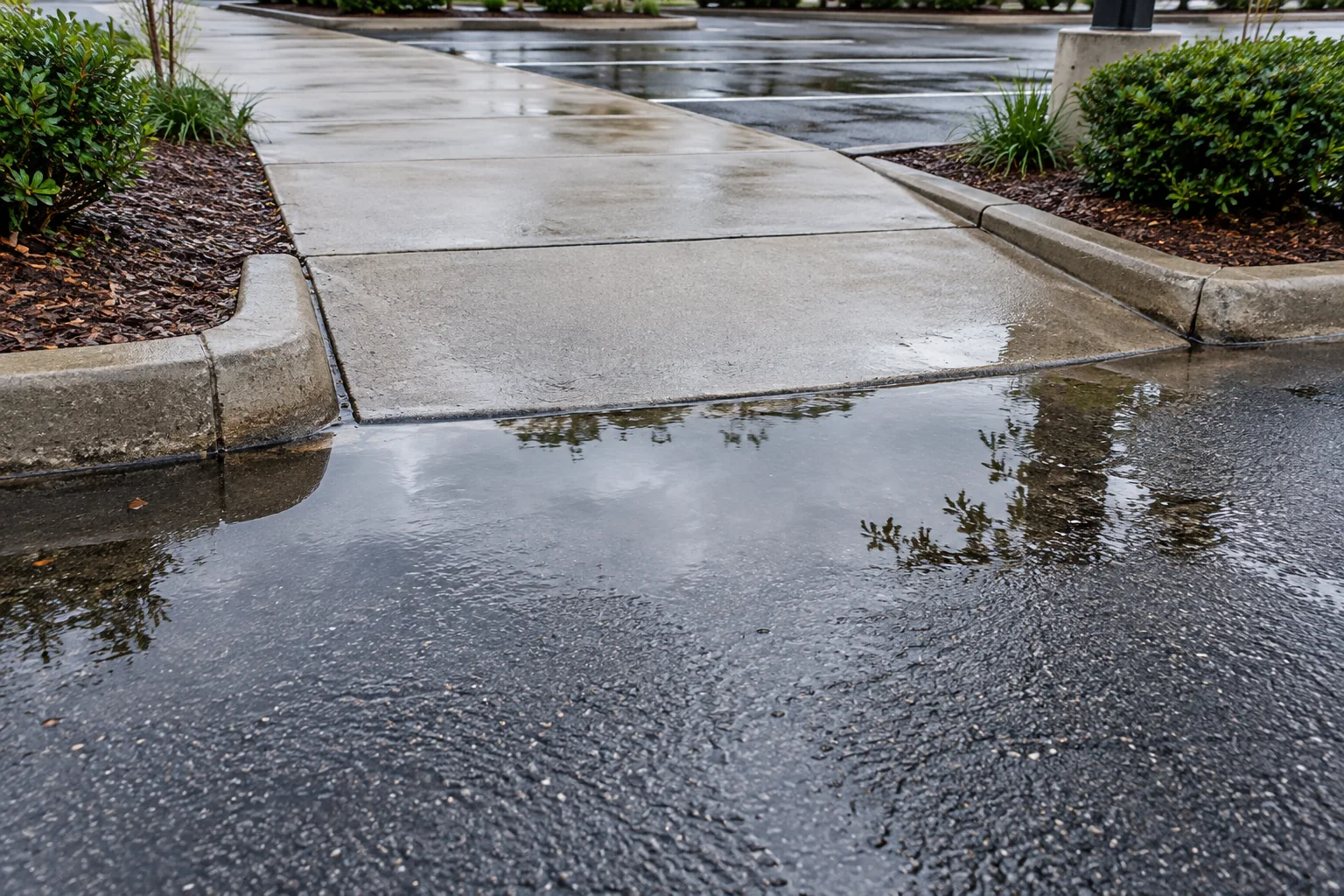
Show the crossing and the route it connects
Standing water at a sidewalk crossing is more than an isolated wet spot to photograph. Show the crossing, the pavement on either side and the route people use to reach the building or destination. The location and practical effect should guide the review alongside the water observation. A close image of a puddle alone does not explain the complete connection.
Identify whether the concern affects a driveway crossing, a parking-lot approach or another private-property connection. Describe where people normally walk and where the water is seen. Keep those facts separate from a technical finding about slope, drainage capacity or accessibility. The actual geometry and applicable requirements need the appropriate property-specific evaluation.
Paint or a warning notice does not change the surface elevations or correct drainage. If site management needs an interim access arrangement, discuss it with the responsible parties while a suitable correction is evaluated. The permanent work and temporary route are related planning questions, and neither should be assumed resolved merely because the concern has been marked.
Record water timing without entering the hazard
Use safe overall photographs to locate the water and its extent. Include the crossing edges, nearby curb, dry connected surfaces and any visible drainage feature. Note approximately when the image was taken after rain and what conditions you know. A single photograph does not establish total duration or performance during every weather event.
If several observations exist, retain their actual times and locations. A dry-weather photograph can show surface connections hidden by water, while an after-rain view can show collection. Describe each for what it demonstrates. Do not infer an unseen pipe condition or a complete drainage explanation from water at one crossing.
There is no need to walk through standing water, step into a traffic lane or recreate runoff for the quote. Property management can arrange a safe observation opportunity where needed. Ask what measurements or examination the evaluator needs instead of attempting a homeowner depth or flow test that may not answer the design question.
Consider connected elevations and retained surfaces
Ask how the proposed activity relates to the sidewalk, asphalt, curb and nearby fixed points. The low-looking spot may be part of a larger connection that needs to be understood before selecting work. Adding material at one location can affect adjacent surfaces, so the contractor should explain the intended finished relationship rather than only describe a patch thickness.
Include door approaches, parking connections and any other walking-route feature close enough to be affected. If specialized design or accessibility review applies, identify who will provide it for the property. A photograph or a general paving proposal should not be treated as certification that the complete route meets every applicable requirement.
Clarify which surfaces remain and which are proposed for removal or adjustment. A sidewalk task, pavement task and drainage-system task may be separate scopes even when they meet at the crossing. The owner should understand the division and sequence so each provider works toward the same intended connection.
Resolve drainage questions with the right provider
Show nearby inlets, channels, curb openings or other visible water features without assuming that one is blocked or correctly connected. Ask what review is included and what would require separate investigation. Pavement work at a crossing does not automatically include inspection or repair of every drainage component serving the property.
If another provider has already reviewed drainage, share the findings and identify what remains unresolved. The paving contractor needs to understand any dependency that affects the surface decision. A proposal should not imply that an unknown downstream condition has been verified merely because the visible crossing can be resurfaced.
Confirm ownership and required coordination where shared or public connections are involved. Do not assume water can be redirected toward adjoining land or that a crossing may be altered without the appropriate agreement. This guide prepares the discussion; it does not establish a drainage design, local approval requirement or permission to change another party's feature.
Define the intended correction and its limits
The written scope should locate the affected crossing and explain what condition the work is intended to address. Ask how the removal boundary, retained surfaces and finished connections support that purpose. A line item called drainage repair can be too vague if it does not show which surface or system activity is actually included.
Compare alternatives by their boundaries and assumptions. One proposal may concern a localized pavement connection, while another includes concrete or drainage work from additional providers. Understand what each option leaves unresolved and what information is needed before it can be finalized. Different totals may cover different objectives rather than identical corrections.
Agree how unexpected findings after authorized removal are communicated, priced and approved. Identify any allowances or exclusions clearly. A reviewable change process helps the owner respond to new information without treating the original surface view as proof of every hidden condition or accepting an undefined expansion of the project.
Plan a usable temporary route
Tell the contractor when the crossing is used and whether it serves an important or sole walking connection. Include business hours, resident needs, deliveries and any shared property operation. The route users need must be considered before the work area closes, rather than addressed informally when people arrive at a barrier.
Identify who reviews and communicates the temporary arrangement. An alternate path should be considered against actual use and any applicable requirements, not assumed suitable because there is room to walk around the puddle. Discuss how vehicles and pedestrians will be directed where their routes interact near the work.
Clarify reopening and handoff between providers. Follow instructions for the actual concrete, pavement or drainage activities and conditions. A finished-looking surface does not independently release the complete route for use. The responsible parties should know which task is complete, what remains and who communicates the return to the normal crossing.
An example of coordinating a crossing correction
Suppose water collects where asphalt meets a concrete sidewalk, and a proposed pavement patch stops at that connection. Ask how the retained concrete elevation and the intended water path affect the result. If a separate drainage review remains pending, identify it as a dependency before the surface work is finalized. If the crossing must close, agree on the complete temporary route and the party responsible for reviewing and communicating it. A different proposal may include concrete adjustment or another provider activity, so compare the actual objectives rather than only the totals. The useful plan identifies what is changing, what remains and who confirms that the whole walking connection can reopen. It should not rely on a warning sign or a new-looking patch as evidence that every drainage and route question has been resolved.
Review the finished connection and future observations
At closeout, compare the completed boundary and connections with the agreed scope and changes. Retain genuine photographs that show the whole crossing and any excluded or deferred task. A narrow image of new material should not imply that a separate drainage question or walking-route review was completed when it was outside the agreement.
If later rain prompts a concern, safely record the location, extent and approximate timing and report it to the provider. Keep observations factual rather than infer the complete cause from one image. The before-work record and written responsibilities make the follow-up more precise and help identify which party should address the question.
Contact Asphalt Solutions with the actual project address, safe views of the crossing and known water observations. Most jobs are handled at customer properties. Visits to the Slidell contact location are by appointment only, and the listed hours mainly concern phone availability. Call or text to discuss a site review and the access constraints that need to shape the plan.
Questions about standing water at a sidewalk crossing
The direct answer
A wet crossing should be reviewed with the walking route, curb details and nearby pavement elevations. Drainage changes need to preserve a usable path.
What to discuss before choosing a repair
Discuss pedestrian movement and water management together.
What to observe and record
- Show the entire crossing
- Identify low edges
- Record inlet locations
A mistake to avoid
Raising only the asphalt can alter the sidewalk or curb-ramp transition.
Continue with the right next step
Property conditions determine the final scope. These planning notes do not replace a site evaluation. How to use our pavement guidance
Background reading: U.S. Access Board accessible-route guidance. General guidance does not replace evaluation of the actual property.