
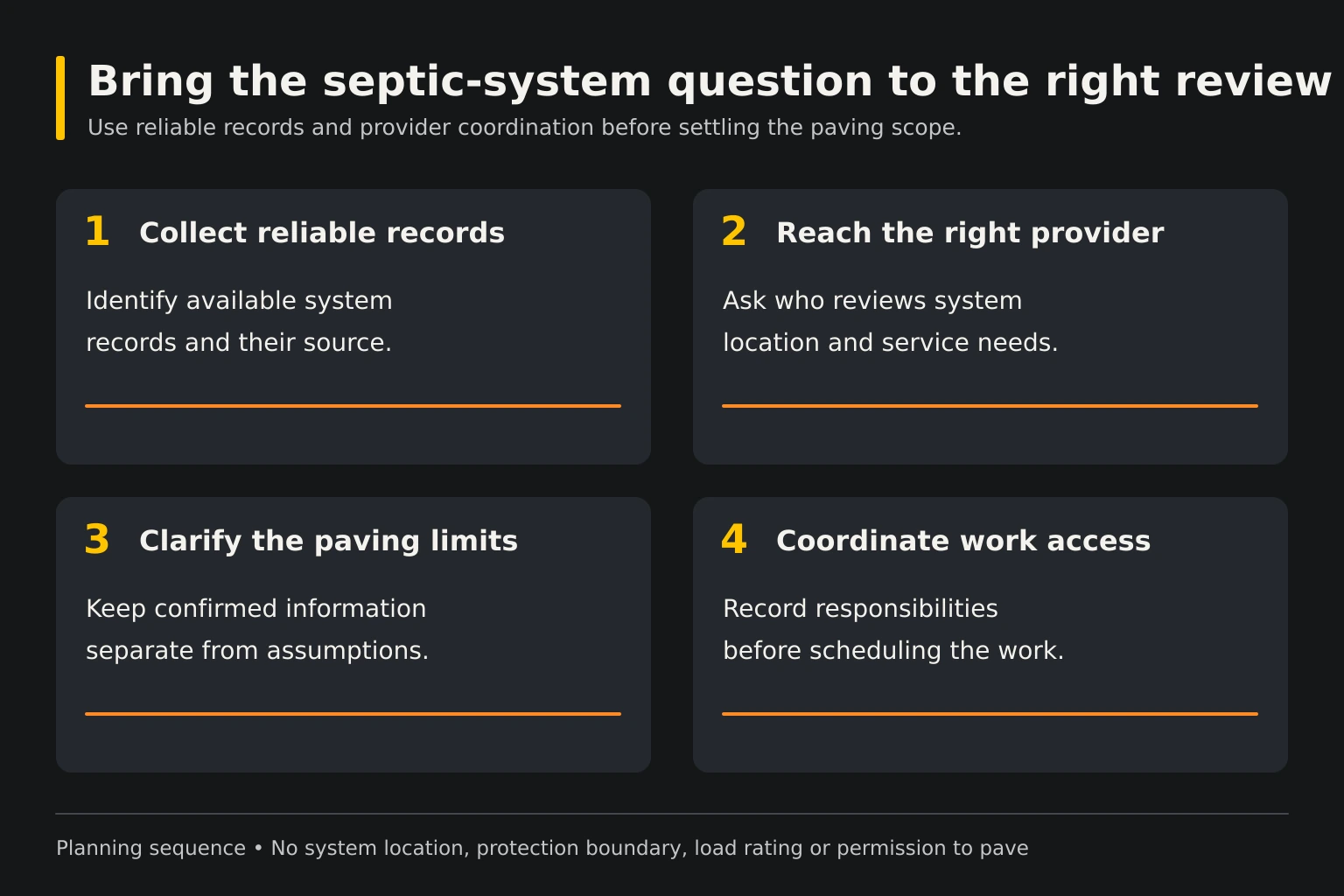
The decision in plain language
Buried systems and their service access must be identified before pavement work is defined.
The situation to discuss
Ask the owner or responsible system professional to locate protected areas and access points. Plan equipment travel separately from the area being paved.
Your five-point decision sheet
Use these headings on a simple sketch or in your project notes. Under each one, write the actual property observation, the question you still need answered and the person responsible for the decision. Leave an unknown item marked as a question instead of assuming it is included.
- Which current system plan and professional confirm the protected area?
- Which service access must remain available?
- Is the proposed pavement clear of the confirmed drainfield?
- Has the equipment route and staging been reviewed separately?
- Who resolves a system-related question before paving is scheduled?
What not to assume
A surface photograph cannot verify the location or suitability of a buried system.
Turn the discussion into a clear work boundary
Keep a copy of the marked site sketch with the estimate. Identify the area being authorized and any adjoining feature that must remain protected or available. If the contractor recommends an investigation or a separate trade, record that next step before treating the proposal as a final solution. A planning guide helps you ask questions; it cannot establish hidden conditions from photographs.
When a decision changes the work, request an updated description showing what was added, removed or deferred. Confirm how any additional quantity will be measured and approved. Make sure the person giving the approval has authority for that part of the property. This prevents a useful site conversation from becoming a different job than the one the owner expected.
Bring the right information to the visit
Send your address, the overall project goal and photos showing this specific connection or operating area. Include a wide view for context and a closer view of the detail under discussion. Describe any timing or access constraint that affects the decision. Avoid placing yourself in traffic or entering inaccessible structures to collect information.
Start with confirmed system information
Gather the available system plan, installation records and service-provider information. Identify what is confirmed and what remains unknown. A surface photograph or an owner's memory cannot establish the full buried arrangement. The paving discussion should begin with the system professional's current information rather than a parking sketch drawn over an assumed empty area.
Ask the responsible system professional which components, protected areas and access points need to be shown on the planning record. Keep that review separate from the paving quote. The owner should not expect an asphalt estimate to locate or assess a septic system or to replace a qualified provider's system-specific guidance.
Keep the drainfield out of a proposed parking area
EPA guidance advises owners not to drive or park on a drainfield and not to place asphalt or concrete over it. A drainfield should not be treated as available ground for a driveway extension simply because it appears open at the surface. Use the system professional's confirmed information to keep that area distinct from the paving discussion.
Do not move an informal boundary on a sketch to make a parking idea fit. If the proposed layout conflicts with the system area, pause that layout and involve the appropriate system professional or permitting authority. A contractor's paving proposal is not a determination that an existing septic-system area is suitable for new pavement.
Separate pavement limits from construction travel
Mark the proposed nearby pavement and the route crews would use to reach it as separate items. A project outside a protected system area can still have an equipment approach or staging idea that needs review. Show the complete route rather than only the final surface the owner hopes to construct.
Ask the system professional to identify the protected areas that affect travel and staging. Share the current information with the paving contractor before scheduling. Keep the accepted route distinguishable from an owner shortcut or an empty-looking lawn area. Construction planning should not quietly depend on using the drainfield as a temporary approach.
Make service access visible
Identify service access points from confirmed records and the responsible provider's review. Show them within the wider property layout, including how the service provider normally reaches the system. Do not assume that leaving a visible lid in place preserves every requirement for inspection, service or movement around the area.
Ask which access arrangement must remain available and who reviews any proposed nearby connection. Keep system access tasks separate from pavement work. If another provider must complete or approve a task, record the contact and status before the paving sequence relies on that arrangement as though it were already confirmed.
Use photographs as context rather than proof
Take wide photographs from accessible positions showing the proposed nearby work and retained property features. Label visible access points only where their identity is confirmed. Keep unidentified covers or surface features marked as questions. An image is useful for discussion, but it does not establish buried component limits or a system's condition.
Avoid opening covers or entering inaccessible structures to collect estimating information. Use records and the responsible provider for that review. If the paving contractor needs more information, keep the inquiry pending until the appropriate source confirms it rather than fill the gap with a guessed location or an assumed clearance.
Coordinate water observations with the system provider
Record visible water observations around the proposed pavement with location references and timing relative to rain. Tell the system professional about any proposed change affecting nearby runoff. Keep owner observations separate from a diagnosis of the system or a design for directing water around it.
Ask which water-related tasks belong to each provider and which remain unresolved. EPA guidance treats excess water reaching a drainfield as a concern for its operation. Do not make a proposed pavement outlet depend on the drainfield as an assumed destination. Bring that connection to the responsible provider's review before accepting the nearby paving scope.
Clarify provider responsibilities before approval
Name the system professional, paving contractor and any other provider involved in the connection. Identify who supplies confirmed location information, who reviews protected areas and who approves a required system-related task. A single owner project record can coordinate these roles without turning the paving contractor into the system designer or service provider.
Keep unresolved questions visible. If a provider's assessment changes the proposed layout, request a current paving review using that information. The accepted proposal should describe the nearby work that can actually proceed, with pending separate tasks distinguished from included construction rather than hidden in a general coordination phrase.
Review nearby preparation without guessing hidden conditions
Ask the paving contractor what preparation is included in the accepted nearby boundary and what information it needs before excavation. Confirm appropriate utility-location responsibilities as well as the separate septic-system review. Owner records can identify concerns but should not be treated as complete confirmation of every buried feature on the property.
Agree how a newly exposed condition or conflict will be documented and brought to the responsible providers. Name the authorized contact for the paving revision. Do not resolve an unexpected system-related issue by casually extending the work boundary or moving a service feature outside the agreed professional review and approval process.
Keep the arrival arrangement current
Before work, confirm that required provider reviews and assigned tasks have reached their agreed handoff. Check the current route, staging and protection information with the contractor. If a system visit or another property project changes the arrangement after estimating, send the revised information before the crew arrives.
Tell household members and visiting providers about the agreed restrictions and contact. A person arriving later should not treat an unused area as an alternative parking or delivery route. Keep one dated current plan so changes in access are communicated without replacing confirmed protected-area information with informal owner instructions.
Keep system records separate at closeout
Save the accepted paving boundary, route, approved changes and final photos of nearby retained connections. Keep the system professional's records and instructions with their own source and date. A completed pavement job should not be presented as confirmation of septic-system condition, compliance or future service needs.
For later observations, identify the location and timing and contact the appropriate provider for the issue. Avoid diagnosing a system concern from a pavement image. The useful owner record explains what nearby work was completed, what system information was used and which professional remains responsible for the next system-related question.
Questions before you approve the work
Discuss the actual property and work limits
Send the property address, current photographs, intended use and access needs. Keep planning with these related decisions.
- Asphalt extension for trailer parking
- Defining asphalt removal and disposal
- Asphalt project decisions
General background: EPA guidance on caring for a septic system. A responsible professional must review the actual system and nearby work.
Reviewed October 14, 2026. Owner preparation guidance; the accepted proposal defines the actual work.