
The decision in plain language
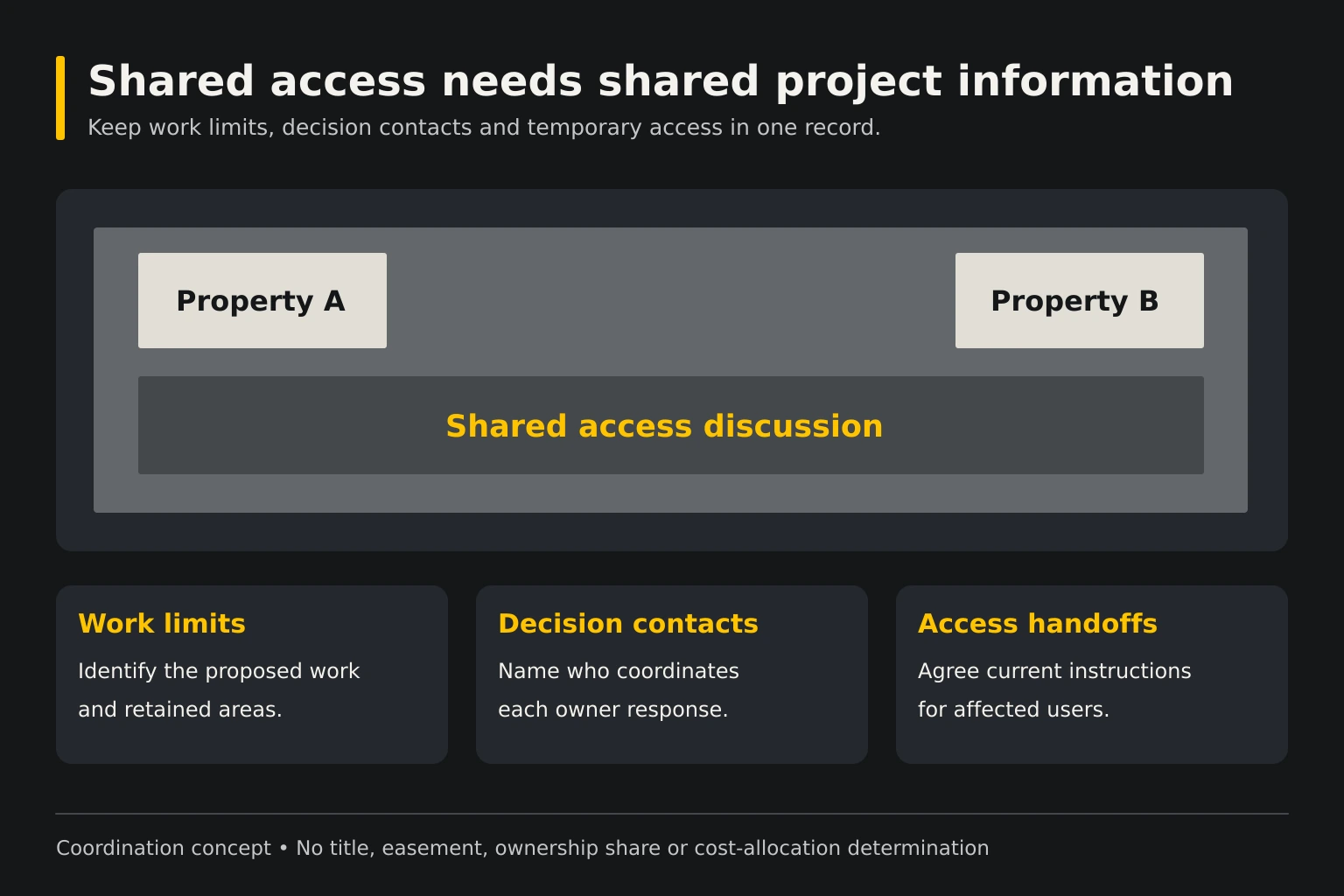
A shared drive needs agreement on work limits, payment responsibilities and access before construction is booked.
The situation to discuss
Keep each owner’s authorized area clear. Discuss parked vehicles, deliveries and the closure plan with everyone who uses the same entrance.
Your five-point decision sheet
Use these headings on a simple sketch or in your project notes. Under each one, write the actual property observation, the question you still need answered and the person responsible for the decision. Leave an unknown item marked as a question instead of assuming it is included.
- Authorized boundaries. Record the property detail and ask how the written proposal handles this item.
- Shared access. Record the property detail and ask how the written proposal handles this item.
- Parking relocation. Record the property detail and ask how the written proposal handles this item.
- Written approvals. Record the property detail and ask how the written proposal handles this item.
- Cost allocation. Record the property detail and ask how the written proposal handles this item.
What not to assume
One owner’s request does not establish permission to work on all shared property.
Turn the discussion into a clear work boundary
Keep a copy of the marked site sketch with the estimate. Identify the area being authorized and any adjoining feature that must remain protected or available. If the contractor recommends an investigation or a separate trade, record that next step before treating the proposal as a final solution. A planning guide helps you ask questions; it cannot establish hidden conditions from photographs.
When a decision changes the work, request an updated description showing what was added, removed or deferred. Confirm how any additional quantity will be measured and approved. Make sure the person giving the approval has authority for that part of the property. This prevents a useful site conversation from becoming a different job than the one the owner expected.
Bring the right information to the visit
Send your address, the overall project goal and photos showing this specific connection or operating area. Include a wide view for context and a closer view of the detail under discussion. Describe any timing or access constraint that affects the decision. Avoid placing yourself in traffic or entering inaccessible structures to collect information.
Identify the shared use accurately
Explain who uses the driveway and which routes serve each property. Show entrances, branches, parking and retained surfaces on a dated owner sketch. A paving contractor needs to understand the actual use without being asked to determine property rights from an informal description.
Gather the relevant owner records and identify questions that need the appropriate professional or authority. Do not assume long-standing use establishes permission to alter every adjoining feature. Keep unresolved ownership, access or approval questions visible before construction planning relies on a boundary that has not been confirmed.
Name the authorized project contact
Identify who may request the estimate, approve the scope and authorize revisions. If several owners are involved, agree how their instructions reach the contractor. A single communication contact can organize the discussion, but the record should still distinguish coordination from the authority to approve the work.
Record the accepted participants and pending approvals. Avoid treating one user's preference as an instruction for all users. The contractor should receive a current agreed scope and a clear decision process before scheduling, rather than a collection of separate verbal requests that conflict at the work boundary.
Define the paving boundary together
Mark the proposed shared section and any private branches included or excluded. Identify retained connections and optional work. A quote for one entrance, a shared travel route and every household's parking area can describe very different jobs even when all are called driveway paving.
Ask each participating owner to review the same dated plan before approval. Record why any recommended limit differs from the original request. Keep work outside the agreed shared section separate so its price, responsibility and access effects are understandable rather than hidden in a single undifferentiated total.
Describe use along the whole route
List daily vehicles, visitor patterns and delivery or collection movements. Show where vehicles stop, turn or remain parked. A narrow branch may serve one property while the common entrance carries every user. Explain the actual routine without prescribing construction details from a vehicle name alone.
Share confirmed information about occasional unusual use and keep future intentions distinct from current conditions. Ask which additional information the contractor needs. The accepted proposal should be reviewed against the described route and movements rather than assume every part of the shared driveway performs the same job.
Record water and retained connections
Photograph visible low areas, adjoining drainage features and transitions to private branches. Note observations with their timing relative to rain. Include wide views so each concern can be located on the common route. One owner's isolated photo may not show the connection affecting another user's entrance.
Ask which pavement and water-related work is included and who may authorize changes to a shared or adjoining feature. Separate tasks needing another provider or approval. Do not promise a connection on another property as part of the paving sequence until its responsibility and permission have been resolved.
Clarify preparation and possible changes
Discuss removal, support preparation and included material within the accepted boundary. Ask what can be evaluated during the visit and what might be found only once removal begins. Existing users can provide records of prior work, but label unconfirmed history as recollection rather than a known construction specification.
Agree how exposed conditions and proposed revisions will reach all required decision makers. Identify the authorized approver and how the current record will be shared. A change should state revised limits, price effects and sequence before work continues beyond the accepted scope, rather than rely on whoever happens to be present.
Make the closure plan serve every user
List access needs for each affected property, including deliveries, stored vehicles and scheduled providers. Ask whether the route closes as a whole or can be addressed in agreed phases. Do not assume a usable entrance to one branch keeps the rest of the shared driveway available.
Arrange temporary parking, vehicle movement and notices before the crew arrives. Name the person distributing current instructions to users who are not the contractor's main contact. Keep temporary restrictions visible so a resident or provider does not enter a closed route using outdated information from an earlier project discussion.
Coordinate utilities and surrounding work
Share known service, irrigation and adjacent-project information, then confirm the appropriate utility-location responsibilities before excavation. Keep fences, gates, landscaping and separate-provider tasks assigned to their responsible parties. A shared paving scope should not silently inherit every restoration task around the route.
If an adjoining owner or provider changes a retained feature after estimating, request a current review. Update the shared plan and communication record before scheduling. The crew should work from the arrangement that is actually approved and present, including any unresolved connection that could affect access or sequence.
Compare scope before discussing allocation
Read proposals for matched shared and private limits, preparation, retained connections, access arrangements and exclusions. Clarify differences before users discuss how to divide the cost. A paving estimate describes construction work; it does not by itself determine the users' ownership obligations or private cost-sharing arrangement.
Record the participants' accepted arrangement separately from the contractor's construction scope. Get appropriate advice where rights or obligations need interpretation. Keep optional work distinguishable so one user's request does not become an assumed shared charge or a changed common boundary without the required agreement.
Give absent users the same current instructions
Some users of a shared driveway may be away during estimating or construction. Identify how they will receive the accepted boundary, closure plan and reopening instructions. Include tenants or regular providers where the authorized owner is responsible for informing them. A decision known to the person meeting the crew may still be unknown to the person arriving later.
Keep one current instruction record with a named contact and an update date. When a phase or closure changes, replace the earlier instruction rather than rely on a chain of verbal messages. Record essential access needs before approval, and raise unresolved requirements with the contractor. This coordination helps every affected user understand the same route and restrictions without treating a communication notice as a determination of ownership rights or construction approval authority.
Leave a record all users can follow
Save the accepted scope, approval record, changes and final photographs of the common route and private connections. Include project-specific reopening and care guidance. Make the current instructions accessible to affected users, with a named contact for follow-up observations or pending separate work.
For later concerns, identify the section, actual use and observation timing. Retain consistent photo positions so users can discuss the same location. Avoid assigning a cause or responsibility from one image. The shared record should explain what was completed, what remained and which party handles the next action.
Questions before you approve the work
Discuss the actual property and work limits
Send the property address, current photographs, intended use and access needs. Keep planning with these related decisions.
Reviewed October 14, 2026. Owner preparation guidance; the accepted proposal defines the actual work.