
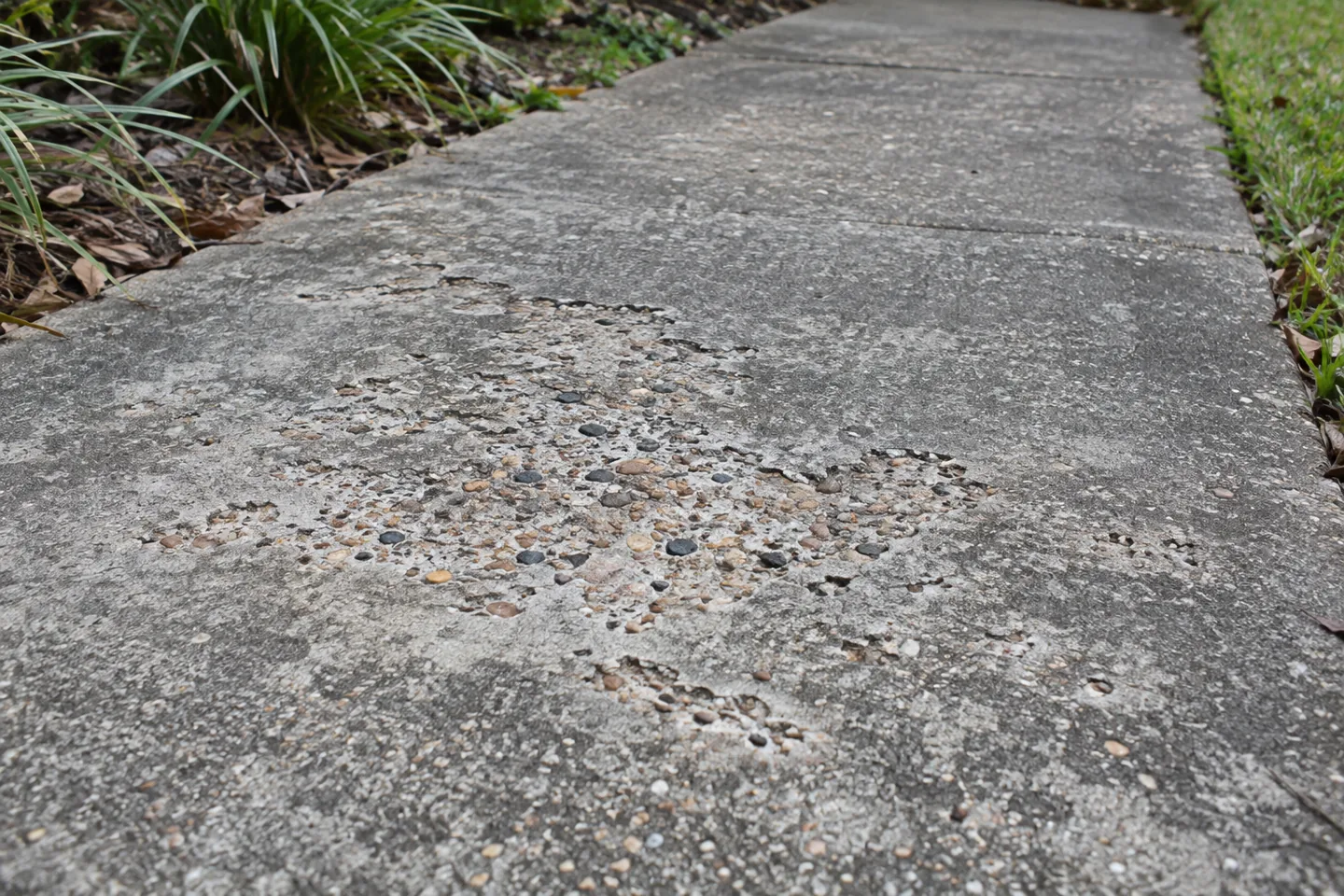
Begin with the visible surface loss
Scaling concerns local flaking or peeling of a hardened concrete surface. Owners may use the word for several rough-looking conditions, so the first task is to describe what is actually visible. Show the affected surface, the surrounding intact material and the location on the property. The name alone does not establish an appropriate treatment or prove why the surface changed.
Technical discussions of scaling often address environmental exposure, including freezing and thawing. That does not mean a rough Louisiana walkway can be diagnosed from the same label. Let the assessment establish which condition is present and what history matters. This page helps an owner prepare a useful surface-repair conversation without assigning a cause from a photograph or applying a generic repair recommendation to every textured slab.
Roughness, staining and missing material are different observations
A concrete surface can look uneven in color without having the same material loss as a flaking area. A broom texture, exposed aggregate finish or previous surface treatment may also affect appearance. If you do not know the original finish, say so. Avoid calling every variation scaling simply because the word appears in an online image search.
Describe whether thin pieces have come away, whether loose particles are present and whether the underlying surface is visible. Note damage at a joint or outer edge separately from changes across a panel. Those distinctions help keep the inquiry focused. The responsible reviewer can decide what additional examination is needed rather than starting from an owner-selected diagnosis that may not match the actual condition.
Map the affected area before discussing price
Take a wide photograph that includes the full panel, nearby joints and the route people or vehicles use. Add closer views of representative affected areas and a portion that appears intact. Use location labels so the images can be matched to the same property sketch. Avoid selecting only the most dramatic angle when the goal is to describe the repair extent accurately.
If several panels look different, record them separately. Ask whether the estimate addresses only the visible flaking, the full panel surface or another defined area. Approximate owner measurements can help initiate the discussion, but they should not be confused with confirmed repair quantities. The assessed limits and any uncertainty about preparation should be clear before two prices are treated as equivalent.
Surface appearance does not establish the remaining condition
A picture can document texture and color, but it does not establish the complete depth of affected material or the suitability of the concrete beneath it for a proposed treatment. Ask how the contractor will evaluate the surface and decide whether the stated approach is appropriate. Do not independently chip, grind or chemically treat the area to test a theory.
The owner can still provide useful context. Explain when the change was first noticed, whether loose material has continued to appear and how the surface is used. Keep observed facts separate from suggested explanations. If the original installation or finish is unknown, that uncertainty belongs in the record. A clear assessment question is more useful than an unsupported claim that the whole slab is either sound or beyond repair.
Compare resurfacing, localized repair and replacement carefully
Different proposals may describe surface preparation and a new surface treatment, a limited repair or more extensive removal and replacement. Ask which existing concrete will remain and what condition the proposed work is intended to address. A broad term such as resurface should be explained in relation to the actual area and material, rather than treated as a complete scope.
If a surface treatment is proposed, ask how its suitability, preparation and intended finish are established. If replacement is proposed, clarify panel boundaries and connections to retained surfaces. These are different project decisions, and the initial price should not be the only comparison. Request the reason for each approach without assuming that a cosmetic-looking option or a larger replacement is automatically right for the property.
Preparation and finish need separate descriptions
Ask the quote to identify the included preparation and the area to which it applies. The owner should understand what will be removed or retained and how changes discovered during preparation affect approval. This is a scope question, not a request for the owner to select equipment, product proportions or application instructions.
Discuss the expected finished texture and appearance separately. A repaired or treated area may differ from weathered neighboring concrete. Ask about the relationship at boundaries, existing joints and transitions to another pavement type. If an example photograph is used, identify it as a reference and clarify what it illustrates. Do not assume a product name guarantees an invisible repair or a specific surface performance on an unassessed site.
Share known history without inventing an exposure story
Bring dated photographs, installation records and invoices for previous surface work if available. Mention known cleaning, coatings, unusual use or environmental events accurately. Do not guess that a product, weather event or workmanship issue caused the surface loss simply because it occurred earlier. The timeline is useful evidence of sequence, not proof of cause.
If history is incomplete, ask which missing information matters to the assessment. Avoid reconstructing precise dates from memory or attributing another person's opinion to a verified professional finding. Mark approximate recollections as approximate. An honest record gives the contractor a clearer basis for questions and helps the owner compare recommendations without having to defend an unsupported explanation attached to the original inquiry.
Describe walking, cleaning and vehicle concerns
Explain the practical reason for requesting work. The concern may be loose surface particles, a rough pedestrian route, appearance at an entrance or another effect. Those priorities can influence what questions need to be resolved. A surface that looks unattractive in a close-up may raise different decisions from an area affecting ordinary movement through the property.
Ask how the proposed finish relates to the intended use and what care instructions will follow. Do not infer accessibility or slip performance from an image of a textured surface. If the route has a separate grade, transition or clearance concern, identify that too. A surface-loss treatment should not be assumed to resolve every other issue on the walking or driving route.
Keep joints and drainage observations in the comparison
Show whether flaking extends across joints, stops at a panel boundary or occurs near an inlet, wall or pavement transition. Ask which of those connections the proposal includes. An offer to treat a surface area may exclude joint materials, adjoining damaged edges or drainage work. Those exclusions need to remain visible when comparing the scope.
If water is observed, record when and where rather than diagnosing its role. Show surrounding surfaces so the reviewer can understand the location. Ask whether any separate elevation or drainage question needs assessment before selecting surface work. This keeps the inquiry broad enough to identify relevant concerns without turning a surface photograph into an assumed explanation for everything happening on the property.
A useful inquiry and a realistic completion discussion
Send the property address, the intended use, labeled photographs and any known surface-work history. State which outcome matters most and ask for the proposed area, preparation, finish, exclusions and access restrictions in writing. If the scope depends on conditions revealed later, clarify who approves the change and how it is documented before work begins.
After completion, keep the accepted surface boundaries, supplied care instructions and dated photographs from the original viewpoints. If another concern appears, explain whether it is inside the treated area, along a boundary or outside it. Discuss the actual agreement and available assessment rather than assuming every later rough patch proves the same cause. Specific records support a useful follow-up and avoid unpromised expectations about a repaired surface.
Questions about concrete scaling
Meaning in plain language
Scaling is loss of a concrete surface layer. It differs from a full slab breakup and should be evaluated for depth, extent and likely contributing conditions.
A practical example
Record flaking across the surface separately from damage at joints. These observations help keep unlike conditions out of one vague repair description.
Use the term in your project discussion
Ask how a proposed treatment will bond and what finish is realistic.
Details that matter
- Surface loss
- Loose material
- Exposure conditions
A mistake to avoid
A surface that looks rough may have several different causes.
Continue with the right next step
Property conditions determine the final scope. These planning notes do not replace a site evaluation. How to use our pavement guidance