
Preventive care is planned before a larger problem dictates the job
Preventive pavement maintenance is planned care intended to help sustain suitable pavement and address needs before more extensive intervention becomes the only practical response. The emphasis is on timing and suitability. It is not a promise that applying a maintenance product to any damaged surface prevents every future problem. The owner needs a clear explanation of why the proposed activity fits the current pavement.
The Federal Highway Administration describes preventive maintenance as a proactive approach to extending useful highway life. That is helpful terminology, but federal highway guidance is not a private driveway specification or a guarantee for a local property. For an owner, the practical discussion is which observed condition the proposed work addresses and what evaluation supports doing it now.
Start by stating the concern and the purpose of the request. You may be planning routine property care, asking about an emerging defect or reviewing a recurring maintenance expense. Those are related but different questions. Tell the contractor what prompted the conversation so a general request for maintenance does not hide a repair problem that deserves its own evaluation.
Suitability matters more than a service label
A pavement can have concerns that a proposed preventive activity does not address. Ask the contractor to explain what is suitable for the present condition and which findings would require another approach. If there is a recurring failed area, movement or water collection, identify it before accepting a broad treatment price. The proposal should not imply that the maintenance activity resolves every issue simply because it covers the same surface.
Ask what information is needed to make the suitability decision. That may begin with a site review and available work history. The owner can provide photographs, known repairs and a description of use without diagnosing the cause. If more investigation is recommended, ask which question it answers and how the result influences the scope. A testing method should have a purpose rather than be requested only because another project used it.
Keep the limits of the proposed work visible. A contractor may describe a maintenance activity for one part of the property while recommending separate repair elsewhere. Those responses should appear as distinct locations and responsibilities. The owner then knows what is being preserved, what is being repaired and which concern remains open instead of treating the project name as a complete condition report.
Use observations to discuss timing rather than guess an interval
A generic calendar interval does not establish the right date for every pavement activity. Ask what condition and operating factors the contractor considers when recommending timing for this property. Provide the known history, current use and recent observations. If a recommendation assumes another repair is completed first, record that dependency so the maintenance is not scheduled on an unsuitable surface.
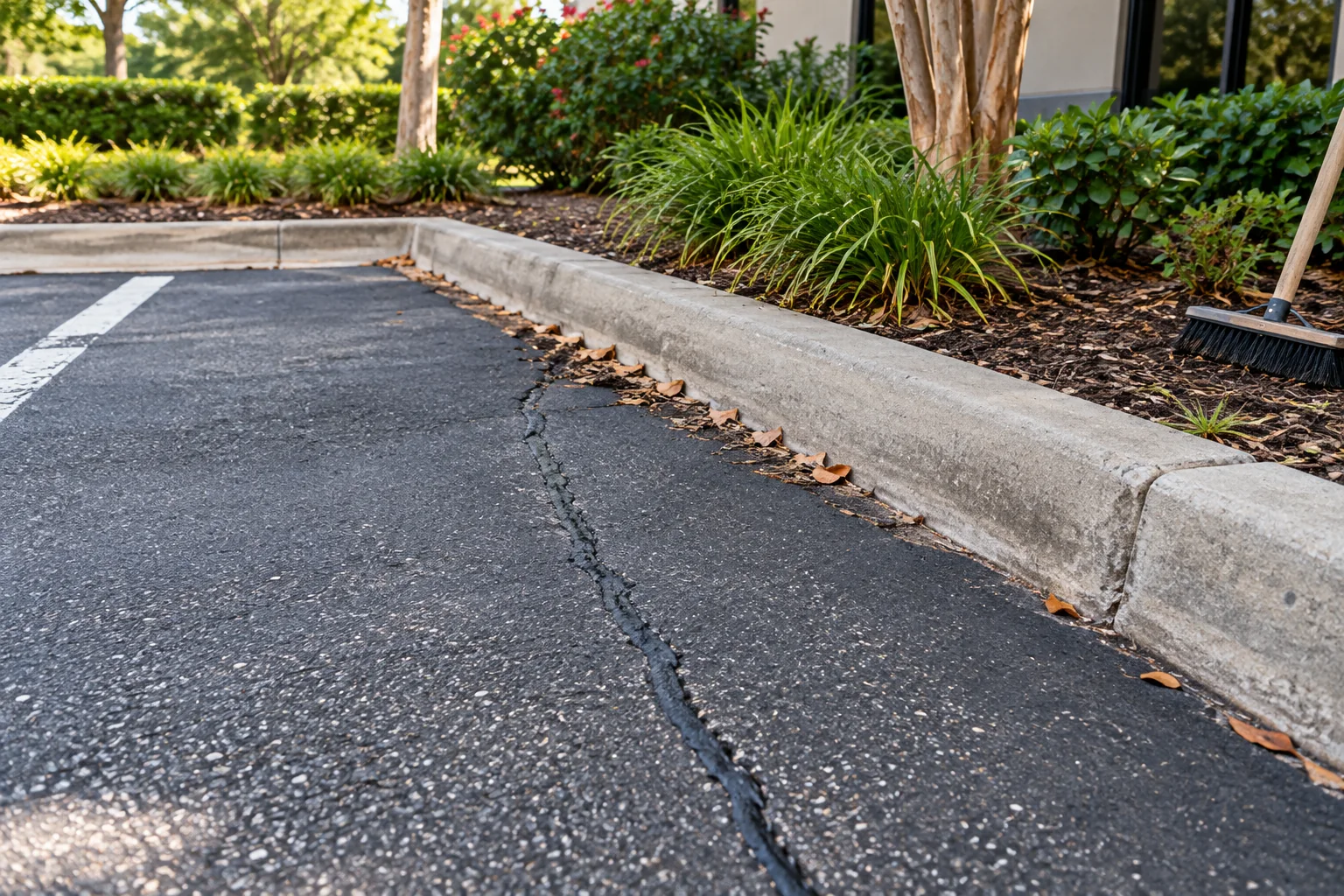
Photographs taken from consistent locations can help explain change over time. Record a new crack, developing surface concern or recurring water location without claiming to know the cause. A wide view shows the context; a close view helps describe the feature. Do not substitute unrelated reference images or an unrelated property's photograph for the actual condition. The evaluator needs an honest starting point.
Ask what should prompt another review after the work. A useful answer describes observations and limitations relevant to the proposed activity. It should not be interpreted as a guarantee that nothing else can happen until a future calendar date. Keep the instructions with the completion record so the next person managing the property knows what was recommended and what still requires attention.
Make preparation and excluded repairs clear in the quote
A preventive maintenance offer should identify its boundaries and the preparation included. Ask about cleaning, selected defect treatment and any other activity described as necessary before the main work. Do not assume that every visible crack, damaged edge or contaminated area receives the same response. The proposal needs to identify which conditions are included and which require another decision.
If localized repairs are recommended first, compare those items separately from the maintenance activity. One offer may assume a ready surface while another includes preparing damaged areas. The totals cannot be read as identical scopes until that difference is understood. Ask how additional findings during preparation are documented and how a change would be approved before added work proceeds.
Retained features and follow-up activities also matter. Parking accessories, markings, garage aprons and adjacent surfaces can affect the scope and sequence. Identify who handles related work and whether it is included. A preventive project can still need coordination with another trade. Keeping those details written down prevents the owner from assuming that a small maintenance job has no connection or restoration questions.
Plan the work around actual property activity
Tell the contractor how the area is used and what access needs consideration. A home driveway may require vehicle moves before the start; a business lot may need tenant notices, delivery changes or a staged sequence. The maintenance label does not remove those operating effects. Ask what area is unavailable, when the restriction applies and what owner actions must happen first.
If staging is proposed, identify who communicates the current stage and any change in the plan. Weather, preparation findings or an occupied area may affect the sequence. The property contact should know how updates reach tenants or household members. A notice that work is scheduled is less useful than clear instructions about the affected area, the required action and the contact for current information.
Follow the project-specific reopening instructions. A material that looks dry or a crew that has moved to another section does not by itself release the area for use. Ask who authorizes reopening and whether related repairs or marking work create additional restrictions. Keep any continuing limitation with the property record so someone arriving later does not receive an outdated instruction.
A practical example and the information to send
Imagine an owner asks for preventive maintenance across a lot but also reports a patch that repeatedly breaks down near a delivery route. Ask the contractor to separate the preventive work from the recurring repair question. The proposed maintenance may be suitable in some areas while the damaged location needs another evaluation. This example does not select a treatment; it shows why the full set of concerns belongs in the request.
Now compare two offers that use different service descriptions. Ask both to identify the same areas, preparation, defect work and limitations. If one recommends later review rather than immediate treatment, ask what observation supports that timing. A useful comparison considers the explanation and evaluated scope, not only whether the contractor can schedule an activity quickly.
For Asphalt Solutions, call or text the actual job-site address, current photographs and available maintenance records. Explain the purpose of the request, how the pavement is used and any access constraints. Most projects are handled at customer properties. Visits to the Slidell contact location are by appointment, and listed phone availability is separate from construction scheduling. Request a scope that identifies suitability assumptions, preparation, exclusions, reopening instructions and the next review questions.
Keep the recommendation separate from the sales description
Ask the contractor to connect the maintenance recommendation to the property rather than only describe the general benefits of a service. The useful answer explains the condition considered, the activity proposed and the limitation that remains. If the recommendation depends on preparation or another repair, place that dependency beside the work item. This helps the owner compare a condition-based proposal with a general product description without assuming that either a longer explanation or a more familiar service name proves suitability.
Questions about preventive maintenance
Meaning in plain language
Preventive maintenance is planned care intended to sustain a pavement before problems require more extensive intervention. Timing and pavement suitability are important.
A practical example
Keep treatment history alongside observations so maintenance can be timed around actual condition rather than a generic promise.
Use the term in your project discussion
Ask what condition triggers each proposed maintenance task.
Details that matter
- Crack changes
- Drain condition
- Surface deterioration
A mistake to avoid
Preventive work should not be used to conceal an already failed surface.
Continue with the right next step
Property conditions determine the final scope. These planning notes do not replace a site evaluation. How to use our pavement guidance
Terminology reference: FHWA preservation and maintenance guidance. Federal highway context does not replace a private-property evaluation.