
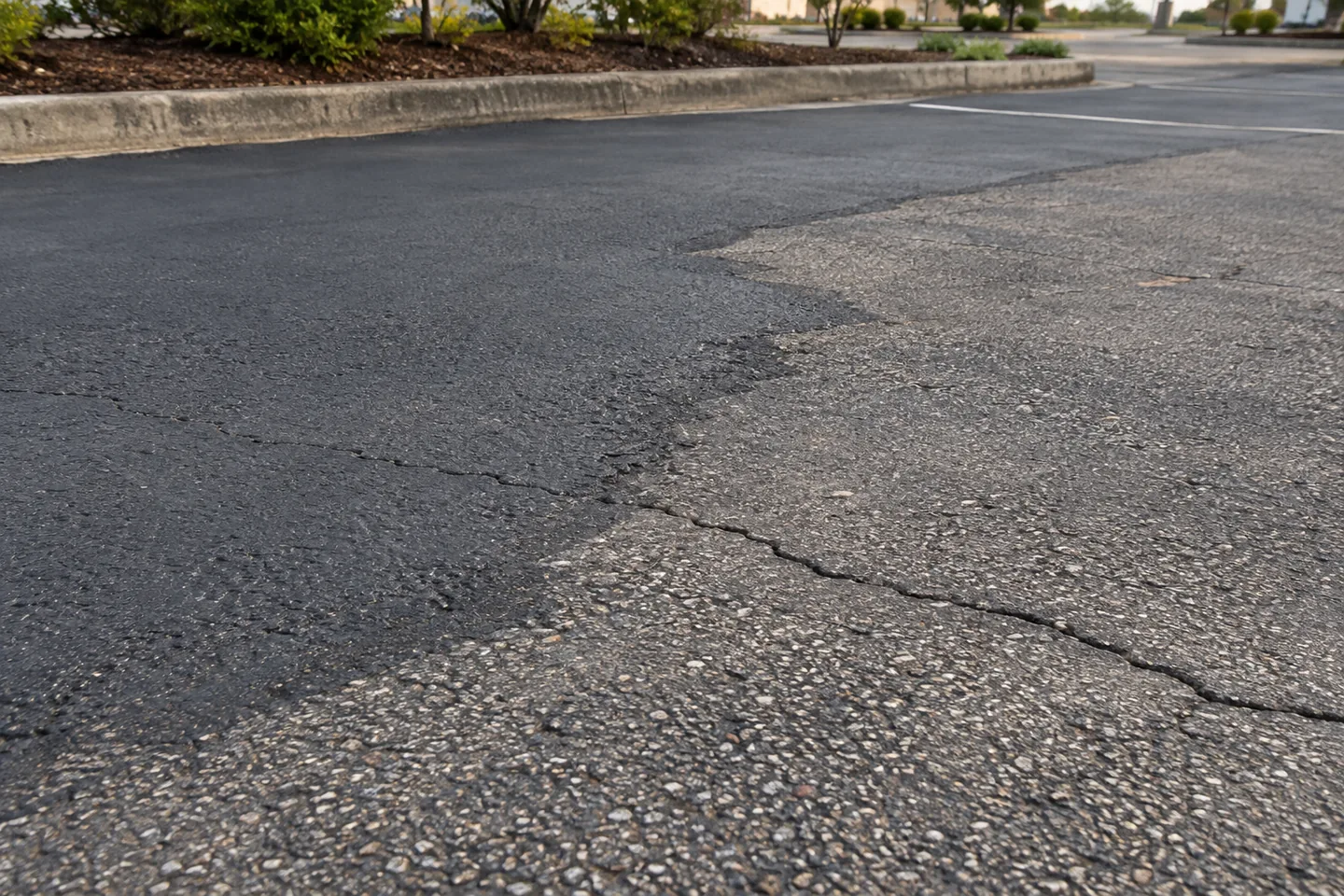
Reflection cracking describes a relationship between layers
Reflection cracking describes a crack appearing in a newer pavement layer above an existing crack or joint in retained pavement below. That definition concerns a relationship that an ordinary surface photograph cannot establish by itself. An owner may observe a line returning after an overlay, but the site discussion still needs history and assessment. Use the term as a question to review, rather than declaring that every crack in renewed pavement has the same concealed origin.
Distinguish the observation from the explanation. A dated photograph can show where a visible line appeared and how it relates to earlier photographs. A proposal or record may identify what pavement was retained during renewal. Those pieces of information can provide context, but do not replace evaluation of the actual section. Ask the contractor what is known, what remains uncertain and how that affects the recommended work instead of inferring a complete cause from the timing alone.
The orientation of a crack and its possible relationship to earlier pavement are different descriptions. A line can run across or along the surface while the reflection question concerns what exists below it. Keep both observations visible in the inquiry. This prevents a conversation about direction from silently becoming a diagnosis of the underlying layer, and helps the contractor explain why a particular assessment or repair recommendation is relevant to the property.
Assemble an honest before-and-after record
If earlier photographs exist, identify the same physical location using retained features such as a curb, garage apron or building corner. Keep original dates where known. Do not compare two different sections or imply that an example shows your actual property history. A useful paired record is about location and observation, not a promotional claim of a completed result. If the earlier viewpoint does not clearly match, label the uncertainty rather than treating the pair as proof.
Share the accepted scope for earlier surface work when available. It may explain removal, repairs, retained pavement and exclusions more accurately than recollection alone. If you know only that work occurred around a certain year, say that the date and operation are approximate. A dark or uniform appearance in an old photograph does not prove an overlay, and a rectangle does not reveal repair depth. The contractor needs verified history separated from appearance-based guesses.
Record the new line's full location and nearby visible conditions. Include branching cracks, earlier repair boundaries and retained connections in wider views. Note when you first observed the change rather than claiming that was necessarily when it began. If several lines appear, use a sketch to distinguish them. The record should make the site discussion more precise without attempting to measure hidden movement or establish responsibility from ordinary photographs.
Ask what an overlay proposal assumes about retained pavement
Before a new overlay or broader surface project, ask how existing cracks and joints affect suitability and preparation. The proposal should explain any repairs included before placement and identify conditions that remain outside the scope. Do not assume covering a visible line removes the relationship to retained pavement. The contractor's recommendation should address the actual property and explain the limits of the offered work rather than promise a crack-free outcome based only on a renewed appearance.
If an estimate includes treatment of existing cracks, ask what locations and operations are being priced. Keep that work distinct from the new surface layer. If the contractor recommends removal or replacement of selected areas, request their boundaries and the reason for the recommendation. These descriptions help compare proposals that may retain different amounts of existing pavement. A shared heading such as resurfacing can otherwise conceal significant differences in preparation and repair scope.
Clarify how discoveries affect the plan. Assessment or preparation may reveal information outside the initial scope. Agree how it is documented, what additional work is proposed and who approves price changes. This process is useful whether the owner is considering a new overlay or a localized repair to an already renewed section. It keeps uncertainty explicit instead of expecting a preliminary photograph to establish every condition through the pavement layers.
Review connections and use without assuming one cause
Show where the visible line approaches concrete, a utility feature, an old patch or the property edge. Ask how the proposed work relates to those retained items and which adjustments are included. If records identify earlier work by another party, share them without declaring that party responsible for the present concern. A location near a utility or joint is context for assessment. It does not give the owner a reliable diagnosis or permission to alter the retained feature.
Describe normal property use and any known changes since the earlier work. Include vehicle routes, turning areas and scheduled heavier visits where relevant. These details can help the contractor understand the section under discussion. Present changes as history rather than proven causes. The fact that a new delivery route and a visible crack appeared during the same period does not independently establish the relationship between them or define a structural repair specification.
Water observations should also remain factual. If a line is visible beside a wet area, show the wider runoff route and retained drainage structures from safe positions. Record dates and explain what you saw. Avoid claiming that the image proves water moving between layers or that crack treatment will correct a broader drainage concern. Ask which evaluation or additional work is included in the recommendation, keeping surface observations separate from concealed explanations.
Compare recommendations and retain a clear follow-up record
When reviewing proposals, compare the purpose of the work and the treatment of retained pavement. Check localized repairs, preparation, placement and exclusions. Ask why the recommended operation addresses the observed concern and what it does not promise. A maintenance item, localized repair and broader replacement may describe different responses. Their prices should not be treated as equivalent options merely because each proposal uses the phrase reflection cracking somewhere in its explanation.
Review access for the actual proposed work area. A line across the entrance may lead to a closure affecting the entire driveway, while repairs within a lot may require a phased route. Identify how users will be notified and who gives reopening instructions. This part of planning follows the marked scope, not the crack's technical name. The owner should know which surfaces remain usable during the work and where uncertain additional repairs could affect the route.
After work, keep accepted descriptions, approved changes, available photographs and care instructions together. If a line later reappears, record the same location and visible change without treating recurrence as proof of one cause or fault. For an Asphalt Solutions inquiry, provide the actual project address, current observations and verified earlier work records. Ask what assessment and work can be offered. The glossary helps frame the relationship question while keeping the final recommendation tied to the property.
Retained-layer history worksheet
Create separate columns for current observation, verified earlier work and questions still unresolved. Put the visible crack location and first observed date in the first column. Put accepted scope records, matching dated photographs and known retained features in the second. Do not turn an uncertain recollection into a verified overlay or joint record. In the third column, ask what assessment is needed to understand the relationship between the new surface and retained pavement.
Use the contractor's explanation to review the actual proposed operations, not to erase uncertainty in the historical record. Identify preparation and localized repairs separately from broader surface work. Note scope limits, additional-work approval and access instructions. At closeout, retain new records beside the old ones with clear dates. This worksheet helps track the question of reflection while avoiding an unsupported conclusion that every line after renewal proves the same cause or a particular party's responsibility.
Questions about reflection cracking
Meaning in plain language
Reflection cracking describes a crack appearing in a new layer above a joint or crack in the underlying pavement. Existing conditions can influence the new surface.
A practical example
Compare a new crack with the location of an old crack, joint or patch beneath the overlay if records are available.
Use the term in your project discussion
Include existing crack patterns and joint locations when evaluating an overlay.
Details that matter
- Underlying joints
- Prior crack maps
- Overlay history
A mistake to avoid
Fresh asphalt does not make every underlying discontinuity disappear.
Continue with the right next step
Property conditions determine the final scope. These planning notes do not replace a site evaluation. How to use our pavement guidance