
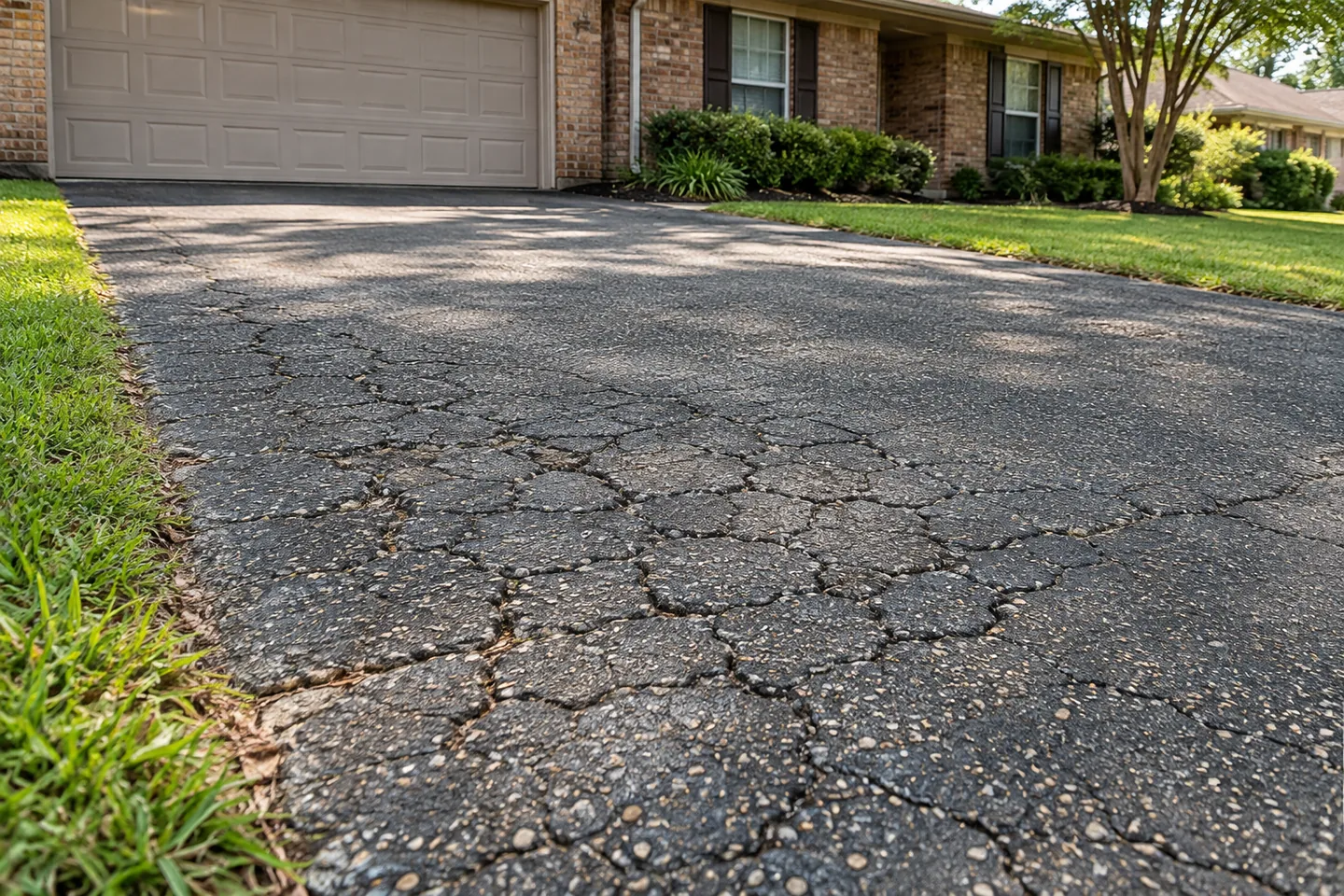
Recognize the interconnected pattern without guessing the cause
Alligator cracking describes a network of connected cracks that divides an asphalt surface into smaller pieces resembling scales. The FHWA distress manual uses the term fatigue cracking for this type of pattern. The visible network is useful information, but an owner should not treat the name as a complete diagnosis. The pavement, supporting conditions, traffic and repair history need assessment before selecting an appropriate response for a driveway or parking area.
Look at the pattern's extent rather than one individual line. A cluster concentrated in a vehicle route can tell a different visual story from isolated straight cracks elsewhere on the property. Record where the connected network begins and ends, and show its relationship to ordinary use. Do not infer a load capacity or a numerical severity rating from a photograph. The record should help identify the area to examine, not replace the contractor's property-specific evaluation.
Other crack patterns have their own terminology. Longitudinal cracks run generally along the pavement direction; transverse cracks cross it. Larger block-like networks may need a different description from a concentrated interconnected wheel-use pattern. An owner does not need to classify every crack perfectly before requesting help. If uncertain, describe connected cracks, show wide and close views and ask how the contractor characterizes the condition relevant to the proposed work.
Build a record of extent and location
Photograph the entire affected section from a safe place, including retained pavement beyond the network. A closer view can show connected pieces, while the wide view establishes where the concern sits. Include nearby concrete, curb edges, parking movements or a garage entrance as location references. The final repair boundary should be determined through assessment. A camera frame is simply a way to communicate the visible area and should not become an assumed construction limit.
Note whether the surface has missing pieces, displaced edges or visible changes since an earlier photograph. Use dates and consistent viewpoints if you already have a maintenance record. Do not drive over the section or lift material to test it for a quote. If the area appears unsafe, use the property's normal restriction process. The purpose of an owner record is to describe observations while leaving investigation and construction choices to the appropriate site assessment.
Record the property use around the pattern. Explain where vehicles routinely travel and whether deliveries or other heavier visits have changed. If the cracking appears concentrated where vehicles turn or stop, show that route. This context helps the contractor understand the area being discussed without proving that traffic is the sole cause. A change in use should be presented as known history, not as a substitute for information about the retained pavement and its support.
Ask why a coating or crack treatment is recommended
A maintenance coating does not rebuild failed supporting material. If an estimate proposes sealcoating around an interconnected crack network, ask what preparation or repair is included and what purpose the treatment is intended to serve. The owner should understand which concerns the work addresses and which it leaves. A new dark appearance must not be mistaken for proof that pavement structure has been restored or that every connected crack has been resolved.
Treating individual cracks and repairing a defined pavement area are different scope discussions. Ask how the contractor's recommendation responds to the network as a whole. The proposal may require more assessment before its limits are fixed. Keep that uncertainty visible rather than choosing a treatment solely because its label sounds economical or comprehensive. A useful explanation connects the observed section, proposed operation and retained material without assigning hidden conditions from a surface photograph.
If deeper repair is proposed, request clear removal limits, replacement description and supporting-material responsibilities. If a more limited treatment is proposed, ask about its intended purpose and exclusions. These alternatives should be compared on their actual work, not on the general phrase fix the cracks. The property-specific assessment matters because connected cracking is an observation, while the final recommendation must account for the conditions and use of the particular area.
Include edges, water observations and earlier work
Show the boundary between the cracked section and neighboring features. A network beside a grass edge, concrete slab or retained curb may raise connection questions that a central close-up misses. Ask what edge work or retained-feature coordination is included. Do not assume the patch outline covers landscaping or concrete renewal. The marked project scope should make it clear where pavement work ends and which surrounding items remain outside the contractor's offered work.
Wet-weather observations can add context. Record water present near the network and show nearby runoff routes or drainage structures from a safe position. Avoid saying that a puddle proves failed support or that one drain is responsible. The observations support assessment and questions about proposed drainage work. A repair to the cracked area and a change to the wider water route may require separate responsibilities, even when they are discussed during the same property visit.
Previous repair information should remain factual. If a connected network developed within or near an old patch, show both areas and share known scope records. Where the date or repair type is unknown, say so. A visible rectangular section does not reveal its depth, and a resurfaced appearance does not establish what occurred below it. Honest history is more useful than an assumed sequence of failures that may lead the discussion toward the wrong section or expectation.
Compare the scope and monitor observable changes
Compare proposals by their stated purpose, repair boundaries, preparation and retained-material assumptions. Check access arrangements, cleanup, any allowance and the procedure for approving work after discoveries. If estimates differ, ask each contractor to explain the recommendation. A low-cost surface treatment and a deeper repair can be different responses rather than equivalent prices. The owner should know what is being purchased before choosing based on the visual appeal of a new surface.
At an occupied property, review how the work affects the route through the cracked area. Identify customer approaches, vehicle turning and the only driveway entrance where relevant. Ask for closure and reopening instructions that correspond to the actual sequence. Do not assume users can cross a partly treated section because another area remains open. The operating plan and marked scope should communicate the same boundaries to the people using the property.
Keep accepted scope records and dated photographs after the work. A follow-up record can show whether a connected pattern has expanded, material has broken away or a different section has changed. Describe those observations without inferring concealed depth or assigning blame from appearance. When contacting Asphalt Solutions, provide the property address, photographs, known use history and the improvement you want reviewed. Ask for a site-specific discussion of options rather than a repair guarantee based on the crack name.
Connected-crack observation worksheet
Create a dated record of the whole connected pattern and nearby retained pavement. Note where the network sits relative to ordinary wheel routes, turning areas and edges. Add any known change in vehicle use or previous repair history, clearly separating verified details from uncertain recollection. Describe missing pieces or displacement only if visible; do not create a severity grade or support diagnosis from a photograph.
Ask each proposal to connect its recommended operation with the observed area and intended purpose. Record whether it includes a limited surface treatment, a defined repair or further assessment before final limits. Keep access instructions and exclusions beside that recommendation. Later photographs taken from similar viewpoints can show observable expansion or changes without pretending to measure hidden capacity. This record helps distinguish a new concern from an earlier one and supports follow-up based on the actual accepted work.
Questions about alligator cracking
Meaning in plain language
Alligator cracking is an interconnected crack pattern resembling small scales. It can indicate a pavement support or loading problem rather than a cosmetic surface issue.
A practical example
Photograph the extent of the interconnected pattern. Record whether it is concentrated in wheel paths, rather than treating every crack as an isolated opening.
Use the term in your project discussion
Discuss the extent and underlying conditions before choosing a maintenance coating.
Details that matter
- Crack network
- Wheel paths
- Softness or movement
A mistake to avoid
Sealcoating does not rebuild failed pavement support.
Continue with the right next step
Property conditions determine the final scope. These planning notes do not replace a site evaluation. How to use our pavement guidance