
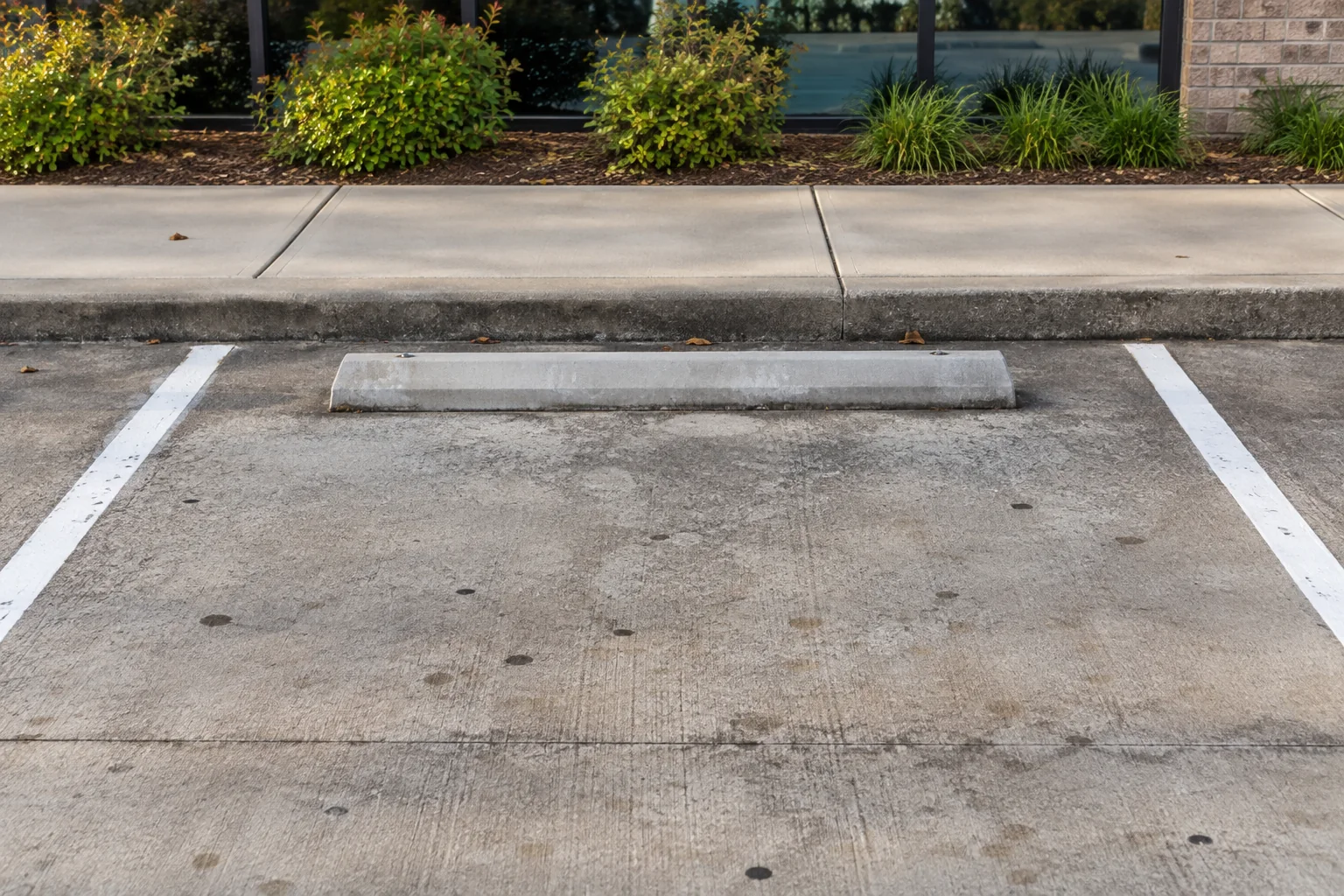
What a wheel stop is intended to do
A wheel stop is a low parking accessory intended to help position a vehicle within a parking space. You may also hear it called a parking stop or parking block. It is one part of the parking arrangement, alongside striping, curbs, circulation and walking routes. Its presence does not by itself establish that the space works well for the vehicles and people using the property. The important question is what the stop is supposed to accomplish at that location.
An owner may want to limit vehicle overhang near a sidewalk, keep vehicles away from landscaping or restore an existing parking arrangement after pavement work. Those are different starting points from simply replacing every old block in the same position. Identify the purpose before selecting a replacement. A clear description helps the contractor decide what needs examination and helps the owner understand whether the proposed work is a straightforward replacement or part of a broader layout review.
Wheel stops are not a substitute for evaluating pedestrian protection or vehicle impact risks. If the concern involves protecting a building entrance or controlling a serious vehicle hazard, describe that concern directly rather than assuming a parking accessory provides the needed protection. The appropriate response may involve a different professional or a separate scope.
Look at vehicle overhang and the route beyond it
The tires stop at the block, but the vehicle body continues beyond the tires. That overhang is why the position of a wheel stop cannot be judged only from the line at the front of a parking space. Look at the actual use of the adjacent area: a sidewalk, doorway approach, planting bed or another parking row. Describe any observed obstruction to the contractor and request review of the relationship between parked vehicles and the route people use.
Different vehicles can produce different conditions. A manager should explain whether the lot normally serves passenger cars, work vehicles, delivery activity or a mixture. A quick photograph of an empty space may not show the problem that appears when the space is occupied. When safe and appropriate, document the situation without including identifiable people or private license information. The purpose is to explain how the property functions, not to derive a universal stop position from one photograph.
Where accessible parking or an accessible route is involved, have the placement reviewed against the applicable requirements by the appropriate professional. The U.S. Access Board's parking guidance discusses keeping parked vehicles from intruding into required route clearance. That principle is useful context; a generic wheel-stop picture does not establish the dimensions or compliant arrangement for a particular property.
Inspect the block, anchors and pavement as a system
A loose or broken wheel stop can raise several separate repair questions. The block itself may be damaged, an anchoring component may be loose or exposed, and the supporting pavement may also be deteriorated. Replacing only the visible block does not explain what will happen to damaged material below it. Ask the contractor to describe each condition that is visible and which parts of the proposed repair address it.
Do not test a loose stop by driving into it or attempt to reset it while vehicles continue using the space. Identify the affected location and arrange an appropriate review. The property manager can discuss temporary parking restrictions with the contractor based on the observed condition. The right response depends on what is damaged and how the space is used. A remote description can start the conversation but cannot establish whether an anchor or supporting surface is sound.
If removal is proposed, ask what happens to old anchors and the holes or disturbed pavement left behind. If the stop is being relocated, request clarification about both the old position and the new one. The proposal should identify whether localized pavement repair, disposal and surface restoration are included. This makes the finished result easier to inspect than a line item that says only replace parking blocks.
Coordinate wheel stops with paving and striping
Parking accessories should be considered before resurfacing or restriping is finalized. Existing stops may need temporary removal for the planned work, or a revised parking arrangement may make their old positions unsuitable. Tell the contractor if a separate striping provider, property designer or maintenance company is involved. Someone needs to coordinate the intended layout so one trade does not reinstall an accessory where another trade expects a clear area.
Ask when the layout will be confirmed and who approves it before installation. An old stripe or anchor pattern is evidence of the previous arrangement, not automatic approval of the next one. This matters when parking use has changed, a sidewalk has been altered or the owner is correcting an access concern. Keep the approved plan or written location description attached to the relevant work order rather than relying on a verbal instruction passed between crews.
Discuss drainage observations as well. If water collects around a stop, describe when and where it happens. Removing or replacing a block may not resolve the underlying surface condition. Ask whether evaluating that water issue is part of the work or whether another assessment is needed. A useful quote distinguishes accessory work from drainage or pavement correction instead of promising that one small replacement will solve every concern nearby.
Compare replacement offers by responsibility
A wheel-stop quote should make it possible to understand what is being supplied and what is being done. Confirm the locations and quantities, the proposed product, removal of existing stops, anchoring responsibilities and the condition assumed for the pavement. Ask whether relocation is included or whether the offer covers replacement in an already reviewed position. The written scope should explain any dependencies on striping or other work.
Consider a property with several broken blocks and one loose block beside a walkway. An offer to replace the visibly broken pieces might leave the loose location and supporting pavement unaddressed. A second offer may include reviewing that location and repairing the affected surface. Request clarification before comparing the totals. This example does not establish the needed repair; it shows why counting blocks alone may not produce a like-for-like comparison.
Also identify who moves vehicles and who keeps the affected spaces unavailable during the work. Ask for project-specific reopening instructions, including any restriction associated with the installation method or nearby pavement work. Avoid promising tenants a universal turnaround time before the contractor has confirmed the sequence. The useful agreement states who communicates the release and how a delayed space will be identified.
Keep a location record for future maintenance
A simple maintenance record can link each concern to a numbered photograph or a named parking row. Note the date, visible movement or breakage, nearby surface damage and any reported interference with walking access. After the repair, retain the approved location description and the contractor's completion notes. These records help a future maintenance provider understand what was changed rather than assuming every block remains in its original position.
For a site discussion with Asphalt Solutions, send the property address and wide photographs showing the stops, stripes and adjacent pedestrian area. Include close views of visible damage without touching exposed anchoring components. Explain whether you need replacement, removal for paving, relocation review or help identifying the next step. Most work occurs at customer job sites. Call or text first; visits to the Slidell contact location are arranged by appointment.
For terminology about accessible parking and its relationship to walking routes, the U.S. Access Board provides official parking guidance. Use it to understand the questions that deserve attention, then have the actual layout and scope reviewed for the property. Product choice, placement and repair responsibilities should be settled from that evaluation rather than copied from the reference image on this page.
Questions about wheel stop
Meaning in plain language
A wheel stop helps control where a vehicle stops within a parking space. Placement must account for vehicle overhang and nearby pedestrian routes.
A practical example
Look at the vehicle parked against the stop. The bumper location and vehicle overhang both affect adjacent walking space.
Use the term in your project discussion
Evaluate placement with the parking layout and accessible-route clearances.
Details that matter
- Vehicle overhang
- Walking route
- Anchoring
A mistake to avoid
A wheel stop should not be used in a way that obstructs an access aisle.
Continue with the right next step
Property conditions determine the final scope. These planning notes do not replace a site evaluation. How to use our pavement guidance
Official reference: U.S. Access Board parking guidance.