
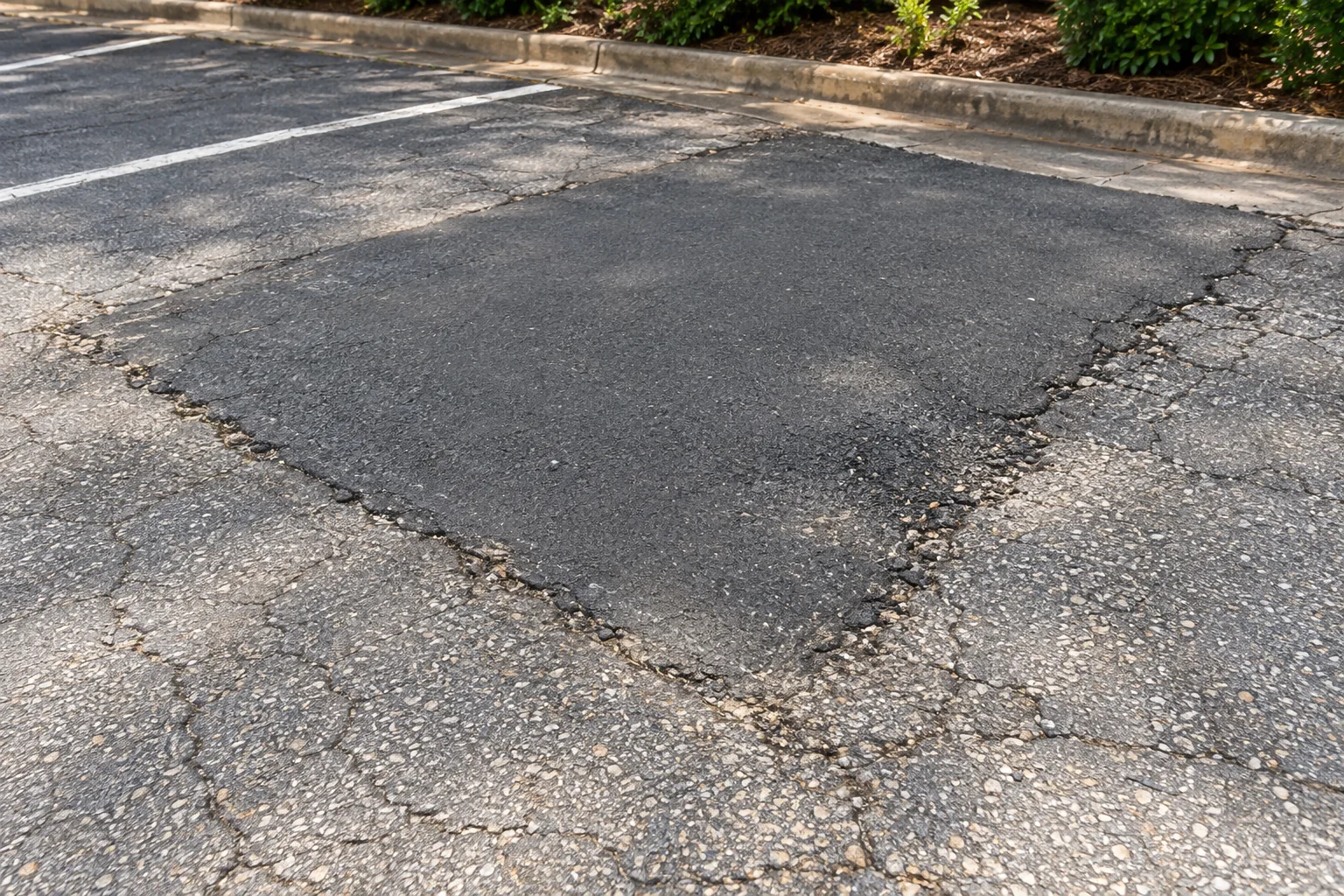
Show the whole patch and its retained surroundings
A repair patch with breaking edges should be reviewed as a connection between the patch and surrounding pavement. Show the entire repair, each affected boundary and the nearby surface. A close photograph of loose edge material can locate a concern but cannot establish whether the appropriate response is interface maintenance, pavement removal or further review.
Describe what is happening in plain terms. The concern may be cracking along one edge, material coming away at a corner, a visible depression or damage continuing into the retained pavement. These are different observations even when they occur around the same patch. Identify each location rather than assume the whole rectangle has one uniform condition.
Do not decide from the surface image that only resealing the perimeter is needed. Ask the evaluator to explain how the patch, interface, surrounding asphalt and any relevant supporting conditions inform the recommendation. The repair label and rectangular shape alone do not reveal its depth, original purpose or present suitability to retain.
Recover the repair history that can be confirmed
Share the earlier repair date, scope and boundary if those records exist. Useful information may include whether the work followed a utility activity, addressed a localized concern or formed part of a larger project. Keep that actual history separate from assumptions based on appearance. If the original purpose is unknown, say so.
Include genuine earlier photographs where available and describe when edge damage was first noticed. A short time between work and a concern may be relevant to discussion with the provider, but timing alone does not establish fault or a warranty outcome. Retain the agreement and contact the responsible provider when recent work is under review.
Tell the evaluator about any known change in use or surrounding work after the patch was installed. A different delivery route, drainage change or adjacent excavation can be useful context without proving the cause. The current recommendation should be grounded in the present condition and documented history, not in a guessed account of how the patch was constructed.
Map different conditions around the boundary
Take an overall image identifying the patch within the lot or driveway. Add safe close views of representative edges and corners, including a boundary that appears intact if one exists. Mark the image so the reviewer can locate each view. This avoids treating a problem on one side as evidence that every side is in the same condition.
Show cracking or loose material that extends into retained pavement. Describe any visible change in level separately from the edge cracking. If water collects nearby, include a safely obtained observation with approximate timing. The image should prepare the review without claiming an unseen void or a complete drainage explanation.
Do not pry, cut or excavate the edge as an improvised test before the initial request. Leave the condition available for examination and ask what additional investigation is needed. A core, test opening or other evaluation should have a defined purpose and location rather than be treated as a universal proof of every part of the old repair.
Separate interface work from a larger pavement need
Ask whether the proposed activity addresses a serviceable connection or pavement that needs removal and replacement. Those are different objectives. A maintenance material at a boundary does not automatically resolve a problem in the retained pavement, the patch itself or the condition beneath either area.
The evaluator should explain why the recommended boundary fits the actual concern. It might follow part of the earlier patch, extend into adjacent pavement or require a broader decision, depending on findings. The old rectangle is useful context, but it does not automatically define the new work boundary.
If the repair followed utility work, include the known trench or access history in the discussion. Confirm which party is responsible for any related coordination and whether the current proposal addresses pavement only. Do not assume a new paving activity includes utility-system work or verifies every part of the earlier excavation. Keep those scopes explicit before approval.
Compare proposals by retained conditions and purpose
When several options are presented, ask each to identify what remains in place and what is being removed. A narrow boundary activity and replacement of a larger area can differ in purpose, preparation and expected result. The owner needs that explanation before treating the prices as competing bids for identical work.
Clarify any information still needed to finalize the approach. If investigation is proposed, ask what question it addresses and how the result will inform the decision. A surface photograph may not settle the hidden condition, but that uncertainty can be described clearly. It should not be turned into an unsupported assurance or an automatic claim that the entire lot is defective.
Agree how unexpected findings during authorized removal are communicated, priced and approved. Identify allowances, exclusions and who has authority to make a change. Keep the earlier repair record with the new proposal so the boundary and intended function remain understandable. A useful agreement explains the actual activity and its limits rather than simply promise to make the patch look new.
Plan the work around the route using the patch
Identify the vehicles that cross, turn or stand near the damaged repair. Tell the contractor whether it lies in an entrance, delivery path, parking position or walking connection. This information helps plan the closure and intended use. It does not by itself prove that a particular vehicle caused the present condition.
Discuss whether the affected route can close completely or needs a staged arrangement. Include deliveries, household parking and shared property access where relevant. Agree who tells users about the closure and how changes will be communicated. A patch in a travel lane needs an operational plan as well as a material and removal plan.
Follow the provider's instructions for reopening and later use of the actual repair. Clarify any difference between crossing, turning and parking if it matters to the work. Avoid choosing a waiting period from an unrelated project. If another provider has a related task to complete, document the handoff before normal traffic resumes.
An example of reviewing one damaged patch side
A patch may have one crumbling boundary while its other sides appear different. Show the whole repair and identify the damaged side rather than crop the photograph to only the loose material. Ask the contractor how the retained pavement beyond that side affects the recommendation. If a boundary treatment is proposed, understand its intended function. If a larger removal area is proposed, ask why that boundary fits the current findings. Include known utility or prior repair history but do not infer hidden construction from the patch shape. This makes the price comparison more useful because the owner can see whether the options address the same condition and retain the same surfaces. It also provides a clear basis for reviewing any changed scope after authorized removal reveals information that was not available in the initial surface review.
Keep the new record clear for future review
At completion, identify the repaired boundary and retained surroundings with genuine photographs. Keep the scope, approved changes and relevant earlier repair records together. If part of the old patch or another concern remains outside the work, state that clearly so the completion record does not imply the entire earlier repair was replaced.
Ask how a later boundary concern should be reported and what observations would be useful. Provide location and timing rather than assume every new line represents the same mechanism as the original damage. Warranty terms belong to the actual agreement; a finished appearance does not independently establish hidden condition or permanent performance.
Contact Asphalt Solutions with the property address, safe views of the whole patch and any known repair history. Most projects are handled at customer job sites. Visits to the Slidell contact location require an appointment, and the listed hours mainly describe phone availability. Call or text to discuss the review and the next decision for the damaged connection.
Questions about patch boundaries breaking apart
The direct answer
Damage around patch edges may show that failure extends beyond the original limits or that the interface needs attention. The surrounding pavement is part of the review.
What to discuss before choosing a repair
Ask how repair limits will extend into suitable surrounding pavement.
What to observe and record
- Show each boundary
- Record patch age if known
- Note loose or moving material
A mistake to avoid
A second patch inside the same outline may not address a wider defect.
Continue with the right next step
Property conditions determine the final scope. These planning notes do not replace a site evaluation. How to use our pavement guidance