
Choose a safe and repeatable observation route
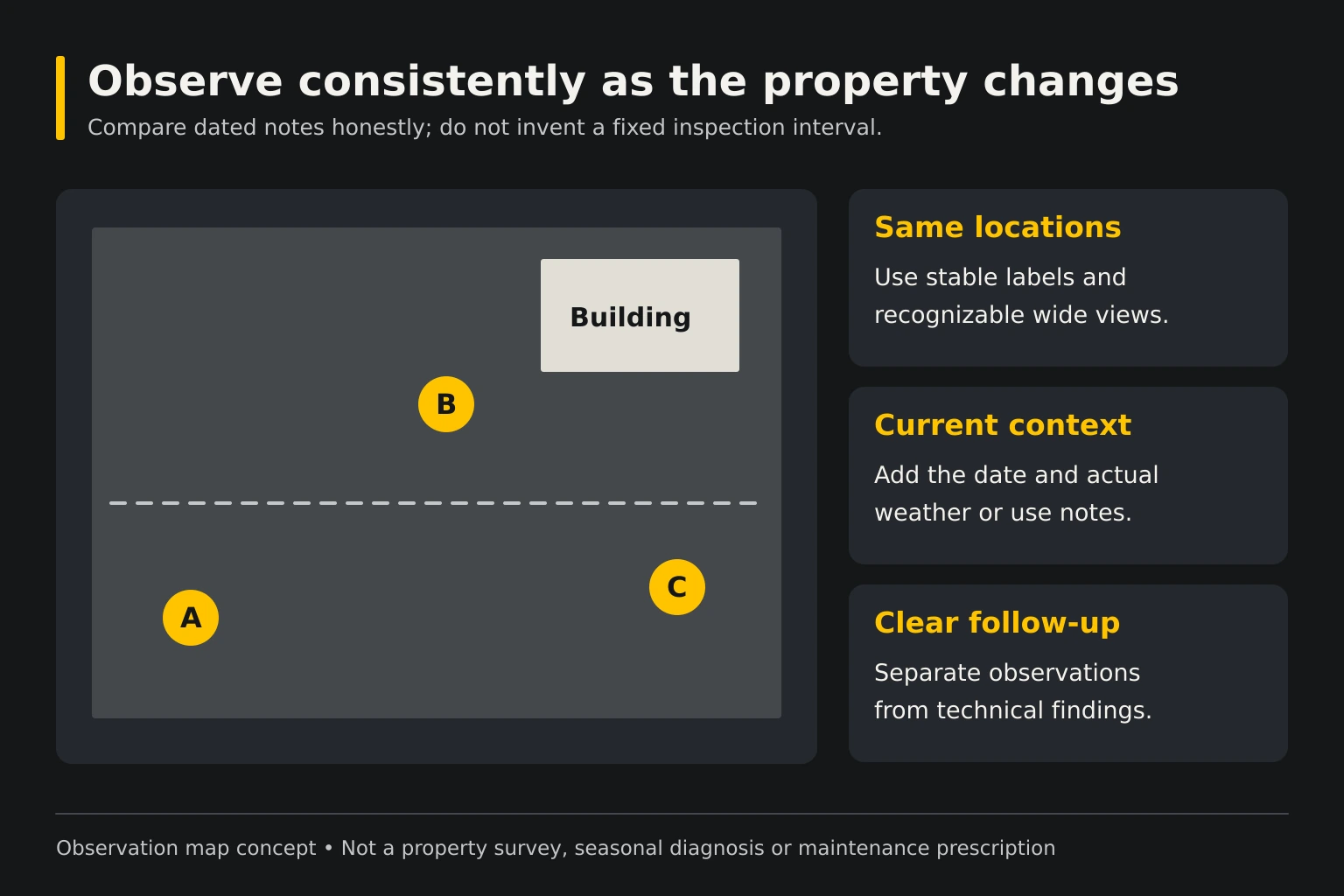
Start with a simple route around the property that can be repeated from season to season. Include entrances, travel lanes, parking areas, walkways and important service approaches. Use a map or sketch with stable references. The route should allow observations from safe positions without stepping into moving traffic or restricted equipment areas. If a section cannot be viewed safely, mark it for another appropriate review rather than entering it to complete a checklist.
Record the date and the general conditions during the walk-through. A dry-day observation and a review after rain may reveal different information. The checklist is a visible-condition record, not an engineering inspection or a guarantee that the property has no hidden problems. Its value is consistency: the next person can see what was observed, where and under what circumstances.
Review entrances and pavement connections
Look at driveway and parking-lot entrances together with their connections to the street or access lane. Record visible broken edges, surface changes, raised transitions or areas that affect vehicle movement. Include gates, curbs, garage thresholds and adjoining walkways where they meet the pavement. A small connection can have a large operational effect even when the broader surface appears unchanged.
Use photographs with enough context to locate the concern. Compare them with earlier views where available, but avoid declaring a cause from appearance alone. Note whether the issue affects normal vehicles, trailers or a provider route. Keep suspected explanations separate from the visible change. A future quote discussion will be more useful if it starts with a clear location and actual use rather than an assumed technical repair.
Record surface concerns with plain descriptions
Identify visible holes, cracks, loose material, broken edges or low areas using ordinary language. Give each concern an area reference and an approximate extent if that can be recorded safely. Label approximate measurements as approximate. Do not assign a repair depth or construction detail based on the checklist. Different conditions can appear similar in photographs and need actual review.
Note whether the condition is new, recurring or apparently unchanged from the previous record. Keep earlier observations rather than overwriting them. If the concern has already been discussed with a contractor, connect the current entry to that history. An observation that remains outside an accepted project should not be marked complete because nearby work occurred. The checklist needs to preserve the actual status of each location.
Observe water at appropriate times
After rain, record where water remains or appears to travel from a safe position. Note the timing relative to the event and include visible nearby features such as inlets, downspouts, ditches or retained pavement edges. Do not enter flooded or active traffic areas to obtain a photo. A missing view can be listed for later review without turning the checklist into a reason to take a risk.
Separate observations from a diagnosis. A puddle shows water at a location; it does not by itself explain the underlying condition or who controls the source. If repeated observations show a pattern, retain the dated images and descriptions. When requesting work, ask how the proposed scope addresses the actual concern and what drainage responsibilities are included. The seasonal record supports that discussion without deciding the construction method.
Check the routes used by people and providers
Review the normal pedestrian entrances and the routes used by deliveries, waste collection or other providers. Note visible pavement concerns that affect those movements. Include changes in operating hours, tenant use or vehicle type that are actually known. The condition of a rarely used corner and the same condition at a busy entrance can have different planning significance.
Do not treat a shortcut as an acceptable alternative route simply because it avoids a damaged area. For a business or shared property, involve the responsible party where access requirements need review. Record the operational issue and the next action rather than declaring the route compliant or unsuitable without the appropriate assessment. The checklist should identify questions clearly and assign them to someone who can arrange the right review.
Review earlier repair and maintenance locations
Locate areas addressed by previous work and compare the current visible condition with the project record. Use the accepted boundaries, approved changes and final photographs to identify the actual area. Do not assume that every nearby issue belongs to the earlier repair. Retained pavement outside that scope may still require attention.
If a concern has appeared within the completed work area, document it specifically and review any offered follow-up terms in their written form. Send the relevant address, area reference and photos when contacting the contractor. Avoid rewriting the history or assuming a guarantee beyond the agreement. A factual seasonal record helps distinguish a new planning question from a follow-up discussion about work already performed.
Prioritize the next discussion without selecting repairs
Group concerns by location and operational effect. Identify which should be discussed promptly, which need more observation and which are part of longer-term planning. The checklist can support priorities without authorizing construction or specifying a method. Keep observations, owner priorities and accepted repairs in separate fields so their status remains clear.
Where several areas need review, send a concise map and selected photos rather than an unorganized archive. Explain the main decision you want to discuss and any budget or scheduling constraint. A contractor can then identify what further information is needed. Do not assume that the largest visible defect always deserves the first construction phase. Access, use and the actual condition all belong in the conversation.
Update the record and hand it off clearly
Add the walk-through notes to the maintenance folder with the date, map references and photographs. Identify the person responsible for each next action. If a quote is requested, record that status; if work is approved, attach the actual accepted scope. Keep seasonal observations separate from a completed project record so a future manager can understand the sequence.
Send Asphalt Solutions the exact property address, relevant observations and useful images to begin a discussion. The company serves Greater New Orleans and the Northshore, and the Slidell contact location is by appointment only. Call or text before arranging an in-person visit. A consistent observation routine helps the owner make informed decisions without pretending that a checklist can reveal every hidden condition.
Include changes around the pavement
Note nearby building, landscape or utility work that occurred since the previous observation. Record the information actually known, such as a new downspout outlet or a changed delivery route. Do not assume that the timing proves the cause of a pavement concern. Keep a clear chronology so the relevant parties can review the connections later.
Ask the people operating the property whether anything important has changed that the walk-through does not show. A provider may now use different equipment, or a tenant may have changed its busiest hours. Add confirmed information to the record and label unresolved assumptions as questions. The seasonal review becomes more useful when it combines visible condition notes with actual operational changes rather than relying on photographs alone.
Keep the next action practical
At the end of the walk-through, choose the next action for each significant observation rather than leaving a long list with no owner. Some items may need a quote discussion, others a provider question or an appropriate professional review. Identify who will arrange that step and what information is still needed. Keep the action separate from authorization to perform construction.
If the property needs a maintenance-budget discussion, send the relevant map references and selected images together. Explain which operations are affected and which timing constraints are confirmed. Do not turn a seasonal priority into a promised repair method before review. Record the outcome of the discussion when it occurs, including a decision to defer work. The checklist should remain a reliable history of actual observations and decisions, not an accumulating collection of assumed solutions.
Questions before you request the estimate
Turn the property facts into a clear next step
Explore the asphalt repair service guide, project planning checklists and photo gallery. Bring the actual property address, useful photographs and access needs to the quote discussion.