
Explain a trailer-related driveway request in Madisonville
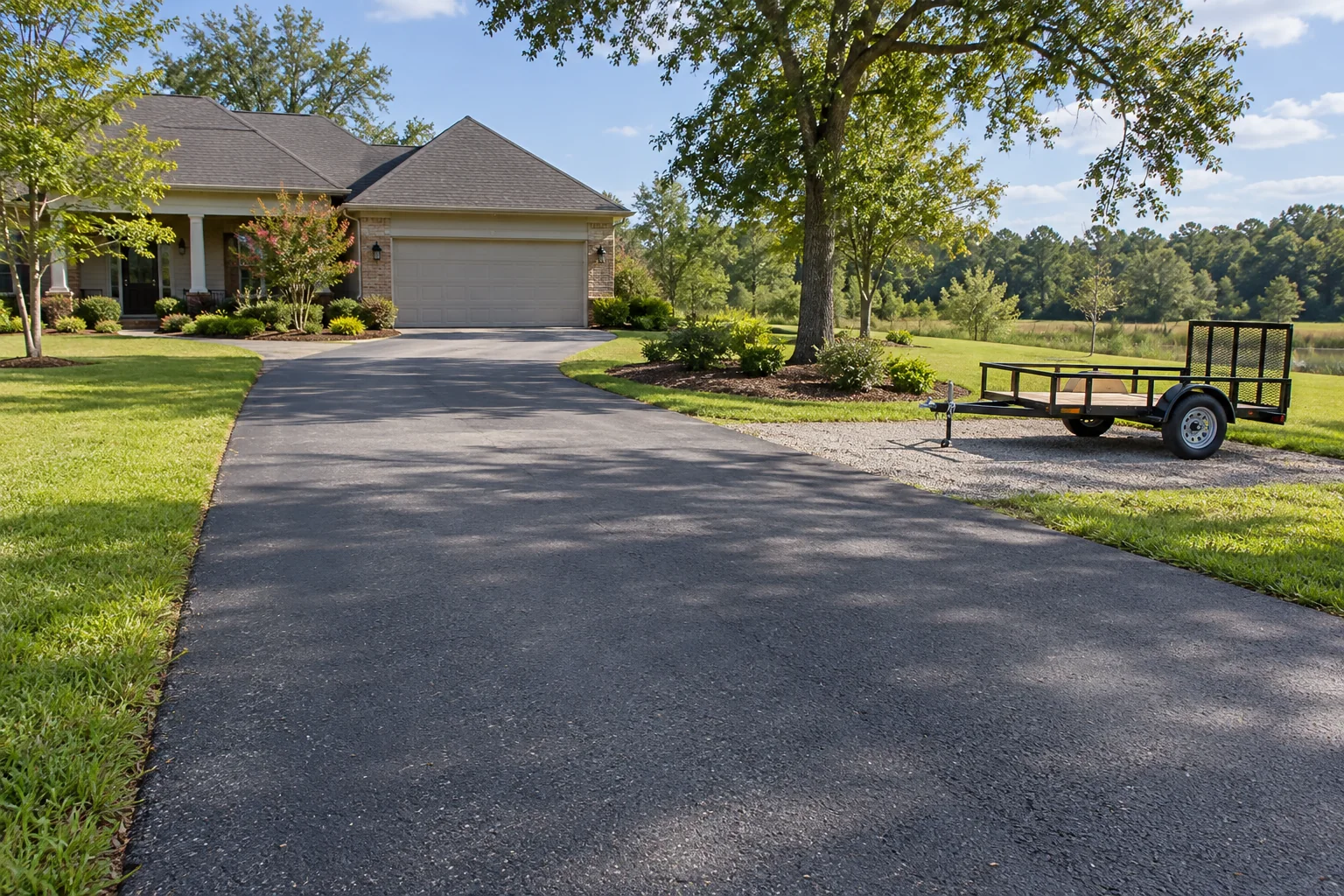
If a Madisonville driveway project involves trailer parking or another occasional vehicle use, explain the actual movement and the area you want reviewed. State what is known about the vehicle and use without inventing weights or present a photograph as proof of pavement capacity. The provider can identify what further information or appropriate evaluation is needed for the proposed task.
Show the approach, intended stopping area and relevant garage, gate or walking connections from a safe location. Do not perform a turning or loading demonstration on an uncertain surface to support a quote request. An owner sketch can identify the question, but it should not be presented as an approved layout or a determination that every movement will work.
Ask whether the proposal concerns the parking area, the approach or both, and how retained pavement is treated. Different boundaries can represent different projects even when the goal is described with the same phrase. Keep related drainage, access and specialist questions visible before comparing prices or assuming that a larger surface area alone resolves the intended use.
Keep ordinary and occasional users in the access discussion
Describe how household members, guests or customers reach the property while work is planned. An occasional trailer movement should not obscure the everyday walking or vehicle connection that must also be considered. Identify who can authorize restrictions and communicate the actual arrangement to users before they arrive.
After a site visit, retain the provider's explanation of the proposed boundary, remaining questions and any separate responsibility. If the project proceeds, follow instructions for the actual work and intended use rather than infer readiness from an example timeline. Keep genuine completion images and relevant directions with the agreement for a future review.
Contact Asphalt Solutions with the Madisonville address, use and current concern. Most projects take place at customer job sites. Visits to the Slidell contact location require an appointment; listed hours mainly concern phone availability. Call or text to arrange the next discussion and confirm the actual site access separately from posted phone hours.
Begin with the actual Madisonville property
Madisonville’s official town description highlights its setting along the Tchefuncte River, marinas, recreational boating, restaurants and shops. That local context makes a practical question useful for a paving inquiry: how is your particular surface used? A household driveway, trailer approach and guest parking area can involve different movements. Describe the actual address and use instead of treating every property as a riverfront or boat-related project.
Asphalt Solutions discusses driveway paving, asphalt repair, parking lot work, maintenance and related concrete services in Madisonville and across the Northshore. Start with the part of the property involved, the concern you observe and the result you want. A request for a smooth surface, a wider parking arrangement and a repair of recurring damage may lead to different defined options.
Use a simple sketch and wide photographs to show entrances, parking positions and retained features. Add a detail photo of damage from a stable location. Identify a shared route or nearby feature that affects the work. These observations prepare assessment questions; they do not determine buried support, final quantities or the complete construction scope from a picture alone.
Describe trailers and vehicle movements where relevant
If the driveway accommodates a boat trailer, recreational vehicle or occasional service vehicle, show its route and standing position. A rectangle representing the parked vehicle does not show the space needed to approach, reverse or turn. Explain those movements and any narrow connection. The intended use should inform the assessment, even when the vehicle is absent during the site visit.
Identify where wheels travel near the pavement border and whether turning repeatedly crosses an old repair or material transition. Describe the observed damage without assigning the cause from appearance. A wider driveway or different parking arrangement can be discussed as a separate option, with its own boundary and connection to retained pavement. Do not assume added width is included in restoration of the existing edge.
Tell the estimator about expected deliveries or household projects that may change vehicle use around construction. Coordinate their timing with the actual paving sequence and reopening guidance. A finished-looking driveway does not establish readiness for every turning or standing activity. Ask specifically about the movements and vehicles discussed for your property rather than apply another project’s instructions.
Give guest and customer access its own plan
For a restaurant, shop or another occupied business, show how guests arrive, park and reach the entrance. Add employee routes, deliveries and refuse collection separately. The Town describes a community that welcomes visitors, but each business has its own operating pattern. Share the actual peaks and constraints instead of assuming one quiet interval is suitable for every property.
Trace each necessary route through the proposed construction phase. A small closure at a narrow entrance can affect an entire lot, while a larger area elsewhere may have a usable alternative. Preparation can need working space beyond the finished surface footprint. Ask which activities require closure before promising normal access during the complete project.
Agree on who communicates with customers, staff and outside service providers. Use the approved boundary and access arrangement in notices. Have the responsible property team review applicable site and pedestrian requirements for the actual route. A general paving example or available parking space cannot determine whether every guest can use the proposed temporary connection.
Assess water and fixed features together
For a property with observed water collection, show where the water arrives, where it remains and the nearby visible outlet or fixed surfaces. Record the circumstances and dates where useful. A location near the river does not by itself diagnose driveway damage, establish the property’s flood exposure or identify the complete drainage condition. Use the observations from your actual site.
Ask how the proposed paving meets garage thresholds, retained concrete, drain structures and bordering ground. Resurfacing increases surface height, so those connections need discussion. A patch in a low area can change the water path without supplying an appropriate outlet. Clarify what drainage-related review or correction is included and what remains outside the construction boundary.
Identify responsibility for adjoining public or privately shared features before scheduling work that affects them. A Madisonville mailing address and a broad driveway description do not determine every authority or approval. Use the Town’s official contact resources or the responsible jurisdiction for the specific property and operations. The paving proposal should reflect the actual approved arrangement where coordination is needed.
Compare the treatments by what they change
Localized repair, resurfacing and replacement retain or rebuild different material. Ask each option to define removal, preparation, limits and finished connections. A lower total may describe a narrower operation with different retained conditions. Compare the intended result and exclusions alongside the price so the chosen scope addresses the concern you described.
Sealcoating is maintenance for suitable asphalt. It does not replace missing pavement, rebuild a failed edge or establish a new driveway elevation. Separate repair needs from a wish for a fresh finish before reviewing a maintenance quote. Ask which repairs occur first and which areas remain excluded rather than assume a single treatment resolves every condition across the property.
For concrete work, show the retained driveway, walkway, curb or apron it must meet. Discuss intended use, preparation, placement and joints through the actual proposal. Confirm whether related work is separate. A finish sample or photo is useful for appearance discussion, but it does not establish all construction details or promise an invisible match to an older surface.
Turn the inquiry into a usable project record
Send the exact address, overall photos, defect details and the routes that affect access. Include prior repairs and the known vehicle use. For a business, add operating hours and service patterns; for a household, describe parking relocation and necessary entry. Approximate dimensions help begin the conversation without replacing measured quantities or a review of actual conditions.
Before approving work, identify how discovered conditions are raised and who can authorize a change. Keep the selected options and any deferred concerns with the proposal. Agree on the construction boundary and contact for schedule updates. A preferred date remains a planning constraint until the project team confirms the actual scope, sequence and access arrangements.
Use the general quote form for a home or an initial project question and the commercial form for an occupied business site. Call or text (985) 788-0493 to discuss your Madisonville property. Retain the written scope, approved changes, dated photos and care instructions after completion. Those records support later assessment without becoming a guarantee of a fixed pavement lifespan or construction appointment.
Questions before you plan the work
Bring the property facts to the conversation
Driveway paving, asphalt repair and concrete services address different project questions. Compare the appropriate scope for your property.
Madisonville references and project routes
Official local references: Madisonville’s town description and Town Hall contact resources. Confirm current, property-specific requirements through the responsible jurisdiction.
For business operating constraints, start a commercial inquiry. Explore Mandeville and Covington service guidance.