
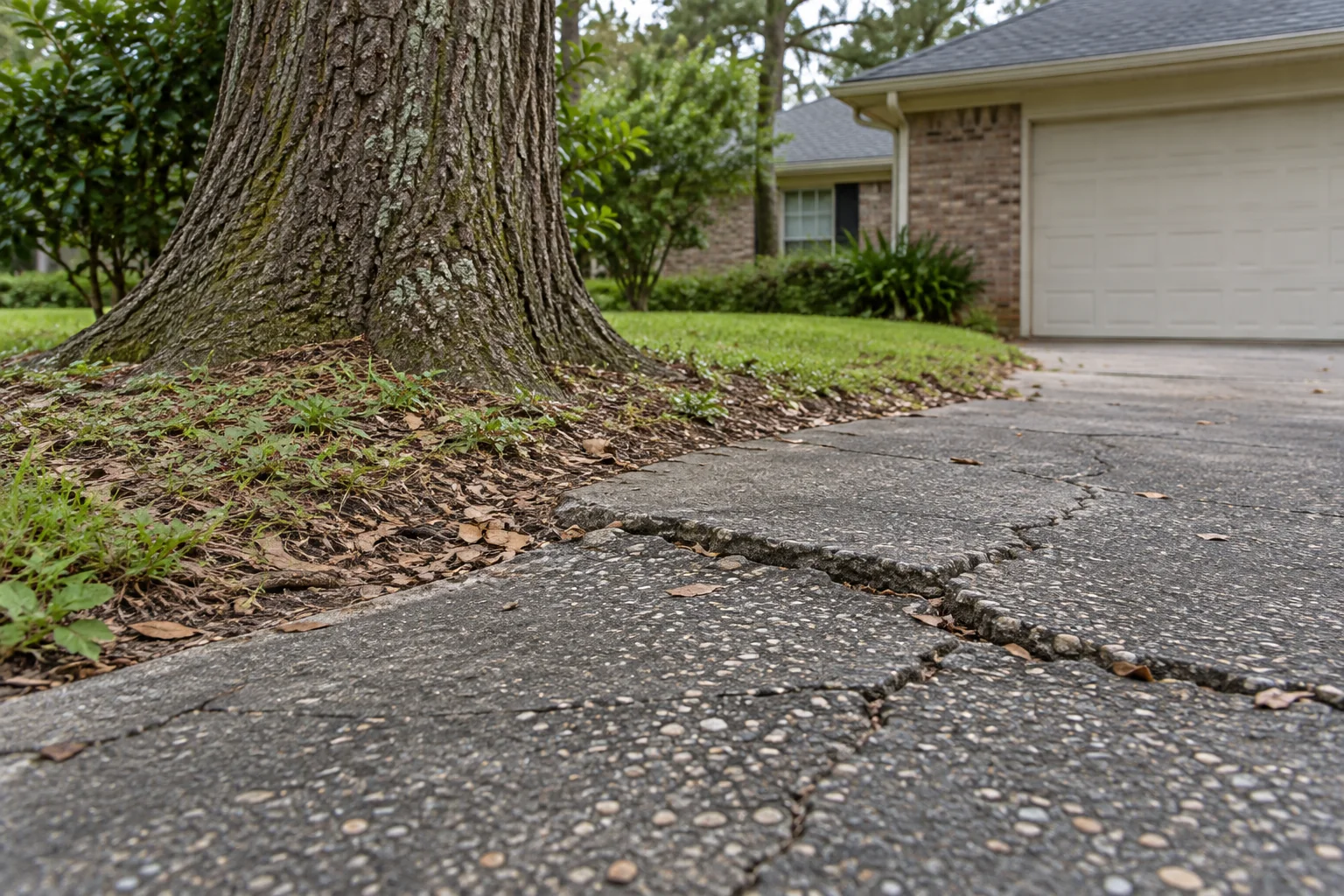
Start with the tree and driveway together
A raised driveway beside a mature tree needs a review that includes both the pavement and the tree. An isolated close-up of cracked asphalt cannot show the trunk location, available working space or the route vehicles use. Start with a wide view, then add closer photographs of the raised area. Describe the practical concern: a walking obstruction, vehicle clearance, a changed water path or damage spreading beyond an earlier patch.
Do not label every nearby crack as root damage. Tree proximity is an observation, while the cause and extent of pavement movement remain questions for the site review. Describe when you first noticed the change and whether the raised area has changed since then. If several concerns exist, identify them separately rather than presenting one assumed explanation for the entire driveway.
A useful initial request is specific: the driveway has lifted beside a retained tree, and you want to understand the pavement options and any tree-related review needed before work. That gives the contractor a starting point without authorizing excavation or root cutting before the consequences have been considered.
Coordinate qualified tree advice before excavation
The International Society of Arboriculture explains that construction can affect trees through root damage and changes around their growing area. Its guidance supports involving an arborist during planning. For this driveway concern, the important practical step is coordination: the person advising on the tree should understand where pavement removal, excavation, access and material storage are proposed.
Ask who will arrange the qualified tree review and how its findings will reach the paving contractor. A verbal instruction to save the tree is difficult to translate into a work boundary. The relevant parties need to understand which activities are being considered, what remains uncertain and what must be settled before the crew starts. A pavement estimate alone should not be read as an arborist's opinion.
Avoid asking a crew to cut whatever roots appear when the old driveway is removed. If conditions encountered during work differ from the agreed plan, there should be a clear pause and communication step. The owner can then obtain the needed advice before authorizing a change, rather than make an irreversible tree decision under time pressure.
Record changes without disturbing the evidence
Photograph the tree, the driveway edge and the affected pavement from positions that are safe to reach. Include nearby garage entrances, walkways, drainage features and other fixed points. Show where a crack ends and where the surface becomes level again. A marked copy of an overall property photograph can help identify several separate raised areas without confusing their locations.
Keep genuinely dated earlier photographs if you have them. Describe whether the concern followed known construction, landscaping, driveway repair or another documented activity. If you do not know when the movement began, state that plainly. The review is better served by an honest unknown than an estimated date presented as construction history.
Leave roots and soil undisturbed while arranging the review. Digging beside the driveway to prove a suspected cause changes the site and may affect the tree. There is no need to uncover roots for an initial photo submission. Explain what can already be seen and ask what additional investigation the qualified reviewers consider appropriate for this property.
Compare pavement options against real constraints
The discussion may involve a localized pavement repair, a larger replacement area, a different alignment or another approach that needs further evaluation. These are possibilities to examine, not promises that every property can accommodate them. Available space, existing elevations, the condition of retained pavement and the tree advice all influence which options deserve a detailed proposal.
Ask the contractor to explain the purpose of each option. One might address the present raised surface while another changes a broader connection. Find out what each option assumes about the retained tree and what it leaves unresolved. A comparison is more useful when it identifies these differences than when several prices are presented as equivalent fixes.
Discuss the limits of any prediction about recurrence. The existing photograph does not establish future tree growth or guarantee that movement will stop. Any proposed warranty or exclusion should be stated in the actual agreement. Keep the distinction clear between the work being provided now and the uncertain behavior of living trees and retained site conditions over time.
Include drainage, access and neighboring features
A change in driveway elevation can affect more than the damaged spot. Show where water currently travels, especially if the raised area appears to divert it toward a garage, walkway or neighboring surface. Dry-weather and after-rain photographs can provide different context. Take them from safe positions; do not stand in traffic or enter water to document the concern.
Tell the contractor which entrances must remain usable and whether the driveway is the only vehicle access. Include delivery needs, household parking and people who rely on the walking connection. Temporary arrangements should be discussed alongside the work sequence. A plan that addresses pavement removal still needs an understandable way for the property to function during the closure.
Identify irrigation, lighting, fences and known utilities near the work. Share available records without claiming they establish every buried feature. Ask how utility coordination and tree protection will be handled before excavation. Responsibility for adjacent landscaping restoration should also be explicit, particularly where several providers will work around the same tree and driveway edge.
Put the decision points in the written scope
The proposal should locate the pavement work and describe what is being removed, retained and restored. Ask it to identify the information still needed before finalizing the approach. If an arborist's recommendations are part of the plan, clarify who supplies them and how changes will be incorporated. Do not leave separate providers assuming that another person has already resolved the tree question.
Discuss what happens if roots, unsuitable material or other unexpected conditions become visible during authorized work. The agreement should explain who is contacted and how additional work is priced and approved. An allowance is different from a firm inclusion, and an observation made after removal is different from a condition verified before the estimate.
Keep before-work photographs, the agreed boundary, relevant tree advice and any approved changes together. At closeout, review the pavement connection, retained surfaces and restoration included in the scope. Record remaining questions while the work is still easy to identify. A clear record supports later maintenance discussions without claiming the repair guarantees a permanent resolution of every tree-related concern.
An example of a coordinated decision
Suppose the raised pavement is close to a tree the owner wants to retain, while the driveway also serves a garage with a fixed floor level. A proposal to remove a rectangular area of asphalt does not yet answer how the tree is protected or how the new surface meets the garage. Ask the arborist and paving contractor to work from the same marked boundary and identify the information still needed. If one option changes the driveway alignment, compare its effect on parking and drainage before accepting it. If another keeps the existing alignment, ask what assumptions it makes about excavation near the tree. The point of the comparison is a clear decision with stated limits. It does not establish that either option is suitable until the relevant property conditions and tree advice have been reviewed.
Arrange the review at the property
Send Asphalt Solutions the actual project address with an overall driveway photograph and a short description of the raised area. Mention the nearby tree and whether qualified tree advice has already been obtained. This helps the initial conversation focus on the relationship that needs attention and the information that must be shared before a pavement proposal can be settled.
Most projects are handled at customer job sites. Visits to the Slidell contact location are by appointment only, and the listed phone availability is separate from a site appointment. Call or text to discuss access and the next step for your property. Bring questions about the proposed work boundary, tree coordination and drainage to that conversation so the review can address the complete driveway connection.
Questions about roots lifting a driveway
The direct answer
Tree roots may be relevant where pavement lifts near vegetation, but the full site should be reviewed before deciding on root or pavement work.
What to discuss before choosing a repair
Coordinate pavement work with appropriate tree advice where roots are involved.
What to observe and record
- Show the tree and raised pavement
- Record tree-to-pavement distance
- Note drainage changes
A mistake to avoid
Cutting roots without understanding the tree can create a different problem.
Continue with the right next step
Property conditions determine the final scope. These planning notes do not replace a site evaluation. How to use our pavement guidance
Background reading: ISA guidance on avoiding tree damage during construction. General guidance does not replace evaluation of the actual property.