
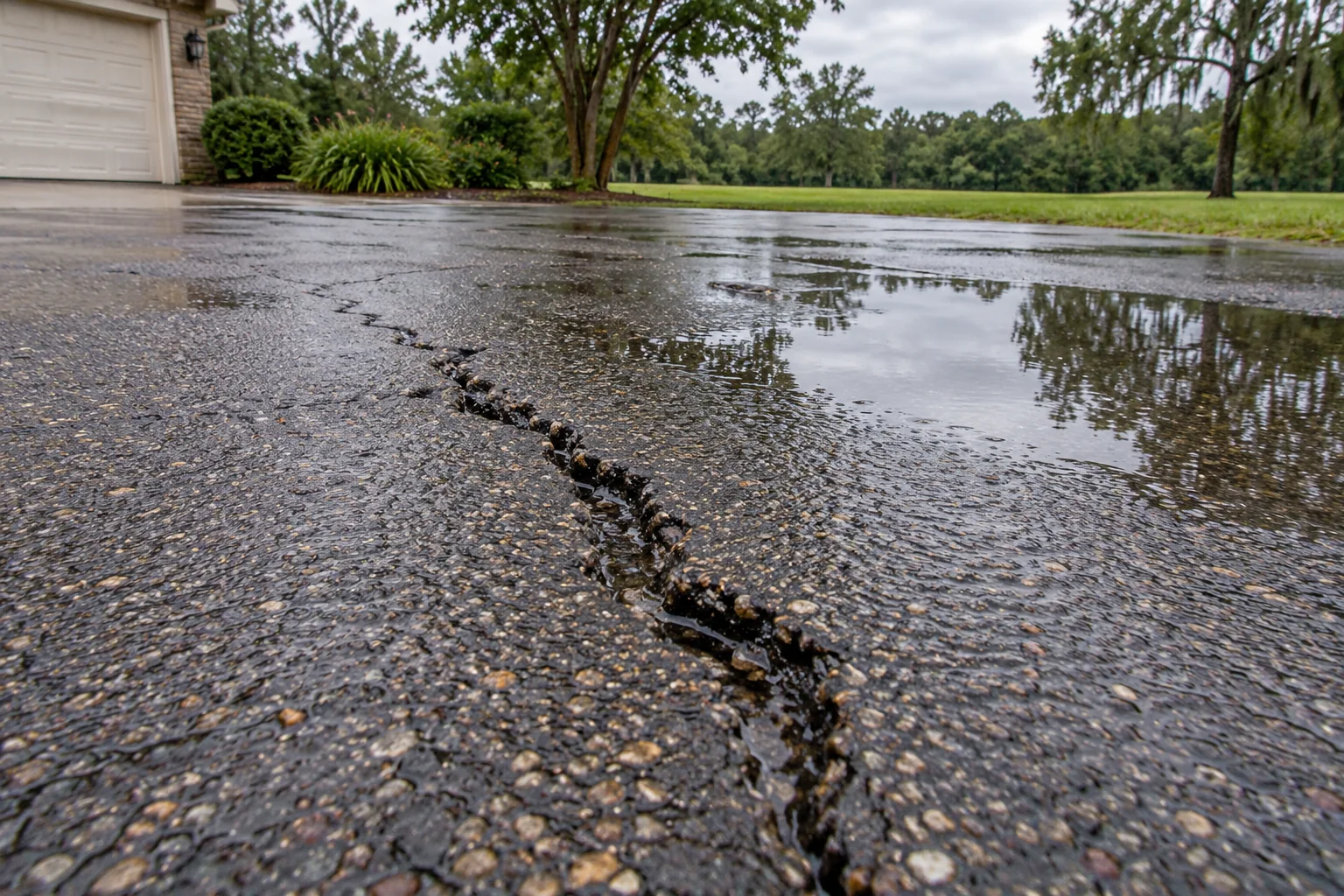
Treat water at a crack as an observation to review
Water visible at an asphalt opening raises useful questions about maintenance, surrounding pavement and the property's drainage context. Begin by describing what you can actually see: the crack location, whether water collects nearby and how the area is used. A photograph of a wet opening does not reveal the full path of water below the surface or establish the condition of the supporting layers.
Keep that limit clear when requesting work. Ask for an assessment of the crack and related pavement condition rather than assume one treatment resolves every water concern. The appropriate scope depends on the actual location and findings. This page helps organize the owner conversation; it does not prescribe a material, application method or hidden structural diagnosis from an image.
Observe from a safe location after natural rainfall when practical. Do not create an artificial test, enter standing water or stand in traffic to capture a closer view. If the location presents an immediate use concern, tell the responsible property operator and arrange appropriate review. Clear observations support the next decision without asking someone to demonstrate failure.
Map the opening in the larger pavement area
Start with an overall photograph showing where the crack sits in the driveway or lot. Include relevant entrances, pavement edges and nearby collection areas. Add closer views of the opening and surrounding distress if they can be obtained safely. The wider scene helps a reviewer understand whether the concern is isolated or part of a broader pattern worth examining.
Identify the location with a plain reference such as the garage approach, entrance lane or curb beside a particular building. If several openings are involved, distinguish them in your note. Avoid sending a series of unlabelled close photographs that could all show the same place. A simple, honest location record makes the initial conversation more precise.
Describe what is visible without assigning a crack classification you are unsure about. Note connected cracks, an edge break, loose material or a nearby patch as observations. Let the responsible provider interpret their relevance. A map prepared by an owner can organize a visit, but it does not substitute for inspection, measurements or the design of any proposed repair.
Record actual rain behavior and its limits
If you have safely observed the area during or after rain, note where water collects and how it approaches the opening. Retain genuine dates and explain whether an image was taken soon after rainfall or later. Do not invent a duration or storm intensity to make the record appear more complete. Uncertainty is useful when it prevents an unsupported conclusion.
Include surrounding pavement and nearby drains or edges that may matter to the discussion. A wet line in a close image can show surface moisture without establish how much water entered the pavement. Likewise, a dry image does not prove that no water was present earlier. Share the actual sequence and allow the reviewer to identify what additional evidence is needed.
If the condition changes over time, keep earlier photographs rather than replace them with the newest view. Explain any maintenance or repair that occurred between observations. A useful history distinguishes before-work conditions, the actual task performed and later behavior. That sequence helps avoid attributing every change to a treatment without considering other relevant property circumstances.
Ask what crack maintenance can and cannot address
Discuss whether the observed opening is a candidate for maintenance and what preparation or related work the actual provider considers necessary. Ask how the proposed task is defined and which conditions fall outside it. A broad phrase such as sealing cracks should not leave the owner guessing which locations are included or what outcome the provider is describing.
Crack maintenance is not the same scope as rebuilding supporting layers or resolving a wider drainage problem. Keep those questions separate in the proposal. If movement, deterioration or water collection suggests another assessment is needed, identify that dependency rather than rely on a surface treatment to stand in for work it was not intended to perform.
Avoid treating a neat finished line as proof of hidden structural restoration. Appearance is one part of the completion record, while the actual task and condition determine what has been addressed. Ask for relevant care and access instructions for the specific work. This guide does not provide a universal cure period, product selection or promise about future crack development.
Include adjacent distress and the history of prior work
Tell the reviewer about genuine prior crack treatments, patches or resurfacing at the location, with dates if available. Keep the original work description where possible. An owner may know that something was applied without knowing the material or preparation. State that honestly instead of infer a product from its color or current appearance.
Show nearby distress in the same overall record. A recurring opening, loose edge or damaged patch may need discussion alongside the visible water. Do not assume all defects share one cause or require the same response. Identifying them separately helps the provider explain which observations belong within the proposed maintenance task and which need another scope.
If an earlier treatment did not meet expectations, describe the expectation and what actually occurred. Keep contract or warranty questions tied to the relevant agreement. This educational page does not decide whether a prior installation was defective or assign responsibility. A factual history gives the responsible parties a better basis for reviewing the current condition and any follow-up.
Make drainage and pavement responsibilities explicit
Ask whether the surrounding water behavior needs review before selecting pavement work. The relevant area may extend beyond the opening itself, including nearby grades, collection points or fixed features. A crack photograph cannot establish a complete drainage solution. Keep the broader question visible if water remains across an entrance, walking connection or recurring low area.
Clarify who evaluates drainage, who performs pavement maintenance and who approves any related work. Those responsibilities may sit with different providers or property parties. A limited crack-maintenance quote should not silently be interpreted as a comprehensive drainage assessment. Written boundaries and exclusions help the owner understand the actual service being considered.
If a separate evaluation must occur first, include it in the project sequence. Avoid scheduling on the assumption that every question can be settled during application. The owner should know what findings support the chosen task, what remains uncertain and how a changed scope would be approved. Clear coordination is especially useful where continued property access limits when providers can examine the location.
Compare the proposal with the observed locations
Give each provider the same address, location photographs and history when comparing estimates. Ask which openings are covered, how the surrounding condition was considered and what separate work is excluded. Two prices may represent different boundaries or different tasks. A useful comparison explains those differences before the owner decides which scope fits the property.
Confirm access restrictions and who communicates release for the actual work. Include residents, tenants, deliveries or ordinary driveway use as applicable. Do not infer readiness from a darkened or dry-looking surface. Follow the provider's specific instructions and keep them with the proposal and completion record so users receive consistent information.
For example, an owner may notice rainwater along a crack near a previous patch while the rest of the driveway appears dry. A complete request shows that location in context, includes the patch history and distinguishes water observation from a claim about underground damage. The reviewer can then explain whether maintenance is appropriate and whether adjacent pavement or drainage questions need separate evaluation. The resulting record should identify the actual task and its limits, with genuine before and after images when available.
Contact Asphalt Solutions with the project address, crack locations and photographs. Most projects take place at customer job sites; visits to the Slidell contact location are by appointment only. Listed hours mainly concern phone availability. Call or text to discuss the observations and arrange the appropriate next review for the actual property.
Questions about water entering asphalt cracks
The direct answer
An open crack can provide a pathway for water, but the pavement condition determines whether crack treatment alone is suitable.
What to discuss before choosing a repair
Discuss crack preparation, material and any larger damaged areas.
What to observe and record
- Map openings
- Show nearby distress
- Record standing water
A mistake to avoid
Sealing a crack does not resolve every source of water beneath the pavement.
Continue with the right next step
Property conditions determine the final scope. These planning notes do not replace a site evaluation. How to use our pavement guidance