
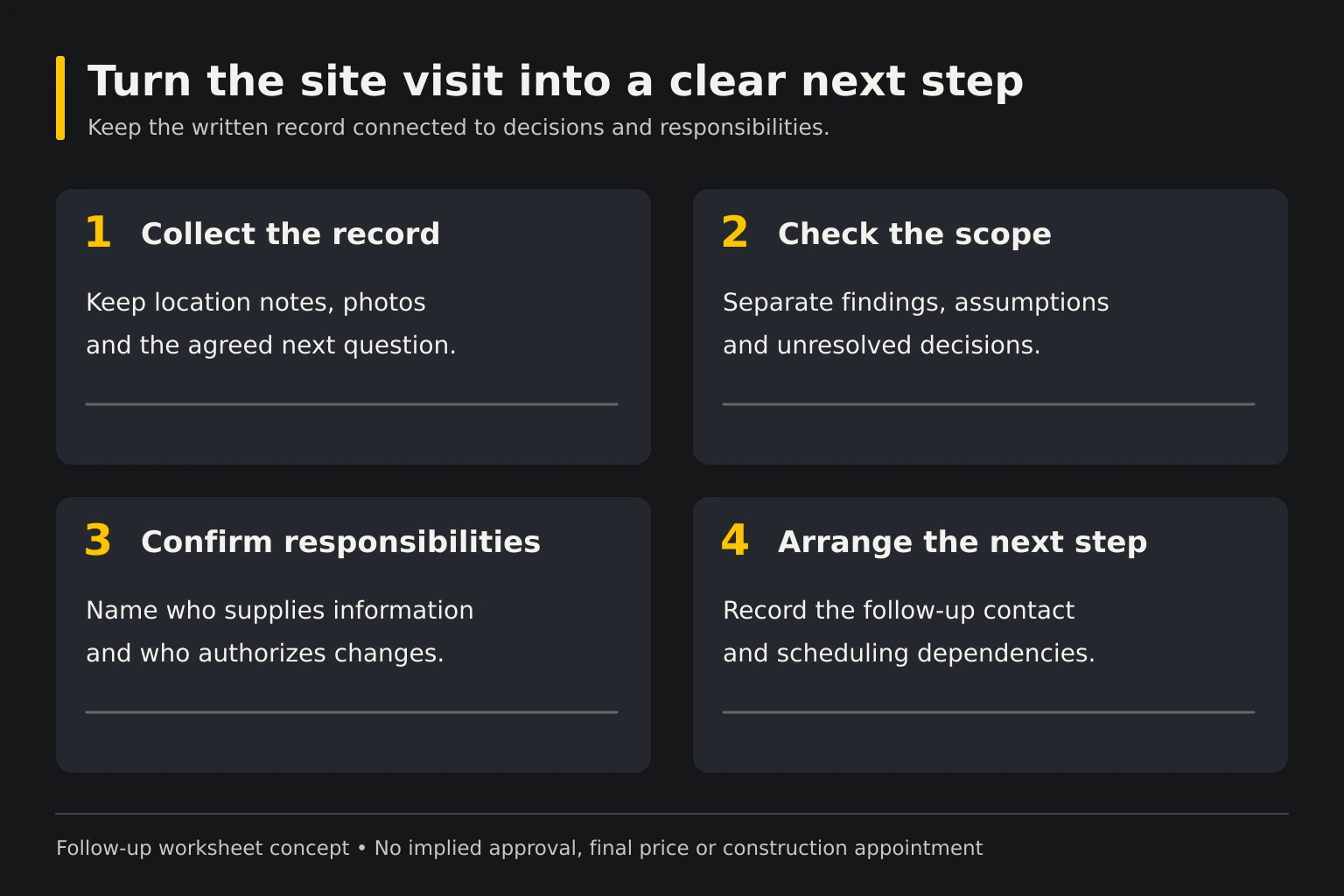
Write down what was actually reviewed
After the visit, record the date, property address and people who took part. Identify the areas viewed and any section that could not be accessed. A site conversation can cover many concerns quickly, so a short record helps distinguish what the contractor saw from what the owner described. Do not assume that every item mentioned in passing has become part of the proposed work. List the main decisions discussed and the next step expected.
Keep useful photographs or a marked sketch with the notes. Use stable references for individual areas so later questions can be connected to the same locations. If the visit involved several properties, create separate records rather than combining them into one conversation summary. The purpose is to preserve the facts needed for estimating and approval, not to reproduce every casual remark or turn preliminary comments into a final construction instruction.
Separate observations from recommendations
Make one list of visible conditions discussed and another of the proposed approaches. A recurring hole, broken edge or puddle is an observation. A particular repair method is a recommendation that should be explained in the written proposal. Keep those categories distinct so the record does not imply that a visible condition establishes the entire cause or the needed construction details.
If the contractor described alternatives, note what would make each relevant and which questions remain open. Ask for clarification where your notes do not reflect the discussion confidently. Avoid filling the gap with a technical assumption from the internet or another job. A follow-up question is easier to resolve before approval than after the owner and contractor discover they remembered different scopes. The final proposal should be the source for the work being purchased.
Confirm the proposed work boundaries
Use a photograph or sketch to identify where work is expected to begin and end. Mark retained areas and any optional extensions separately. If the contractor pointed to a location during the visit, ask for a written boundary that someone absent from the conversation can understand. A phrase such as repair the entrance may describe different areas to different people.
Record damage outside the proposed work without treating it as included. If the recommended boundary differs from the visible defect outline, ask why. The explanation can help the owner understand preparation or connection decisions without pretending to specify the construction. Keep the marked boundary with the current proposal version. If the work area changes during follow-up, request a revised record rather than leaving the original sketch to conflict with the new description.
List unresolved conditions and review responsibilities
Identify information still needed before a firm scope can be agreed. This might include ownership, provider access requirements, design input, a drainage question or a condition that cannot be known until removal. Ask who is responsible for obtaining the information and how it affects the estimate. An open question should have a next action, not simply remain a vague concern in the notes.
Where concealed conditions may change the work, ask how findings will be documented and additional scope approved. Do not interpret a site visit as a guarantee that every condition below the surface has been established. The owner should understand what has been reviewed and where uncertainty remains. Keep any required professional or authority review separate from the contractor's preliminary recommendation so the approval process follows the actual responsibilities.
Check transitions and water-related discussions
Review the notes for connections to streets, garages, curbs, walkways and drain inlets. Ask whether the proposed work includes changes at those features or retains them as they are. A surface repair can look simple in a broad description while the important decision is at the connection. Photographs from the visit can help clarify what was discussed.
If water was part of the concern, confirm whether the proposal addresses it and what drainage work is included or excluded. Keep the observation separate from a confirmed explanation. The contractor seeing a puddle does not automatically mean every water-related task will be included in the quote. If another party must review a building or drainage issue, record the responsibility and sequence before treating the pavement proposal as ready for approval.
Carry access needs into the proposal
Write down the operations that must continue and the closures discussed during the visit. Include vehicle parking, pedestrian entrances, deliveries, waste collection and any special scheduling constraint. Do not assume the contractor remembered an operational detail that was mentioned while walking between areas. Provide a concise follow-up list where those details matter to the work sequence.
Ask whether the estimate will include a phase plan or whether the access arrangement remains to be agreed. Identify who will coordinate providers, move vehicles and communicate with tenants or family members. The expected construction date should not replace project-specific reopening instructions. Keep the access questions in the record until they are answered, because an otherwise clear repair proposal may still be impractical for the property's operation.
Request a written version of the agreed next step
If the next step is an estimate, confirm what areas and alternatives it will cover. If more information is needed first, identify what to send and who will review it. A site visit may end with a recommendation, a request for documents or a plan for further review. Record that outcome rather than assuming the company has everything required to schedule construction.
Read the written proposal when it arrives and compare it with the marked limits and operational notes. Ask about a difference before approving the price. The purpose of the follow-up record is not to enforce every remembered phrase; it is to make the actual purchase clear. Keep optional work, exclusions and unresolved conditions visible. Confirm the version being accepted so later revisions do not create conflicting instructions.
Keep one current approval record
Store the current proposal, visit notes, marked photographs and supporting information together. Name the person who can approve the work and any changes. If a manager is collecting the estimate for an owner, make sure the owner's questions are returned to the contractor rather than answered with an assumption. A short summary of settled and open items can help a remote decision maker.
After approval, retain the accepted version and record later authorized changes. Keep old versions as history but identify which one currently applies. Send Asphalt Solutions the exact address and the questions from the site discussion when following up. The company serves Greater New Orleans and the Northshore, and the Slidell contact location is by appointment only. Clear records make the next conversation more useful without pretending that a preliminary visit is a complete construction agreement.
Prepare the people who were not at the visit
Share the practical result with the household, tenants or staff affected by the proposed work. Explain what is under consideration, what has been approved and what remains undecided. Someone hearing that a contractor visited may assume construction has already been scheduled. Clear communication prevents vehicles, deliveries or other operations from being changed prematurely.
Ask those users whether the recorded access needs are complete. An occasional provider or stored trailer may have been overlooked during a quiet visit. Bring relevant new information back to the contractor before acceptance. Keep it attached to the property record so the proposal is based on the actual operation. The follow-up process should turn a useful conversation into a reliable decision rather than create a chain of informal instructions that different people interpret differently. If the owner is deciding between immediate work and a later phase, ask for that choice to remain visible in the proposal. A deferred area should not disappear from the notes and then be remembered as part of the approved project. Likewise, a planning priority is not an instruction to begin construction. Keep the status of each decision explicit so the follow-up record supports the actual agreement instead of creating a second, contradictory scope based on the visit conversation.
Questions before you request the estimate
Turn the property facts into a clear next step
Explore the asphalt repair service guide, project planning checklists and photo gallery. Bring the actual property address, useful photographs and access needs to the quote discussion.