
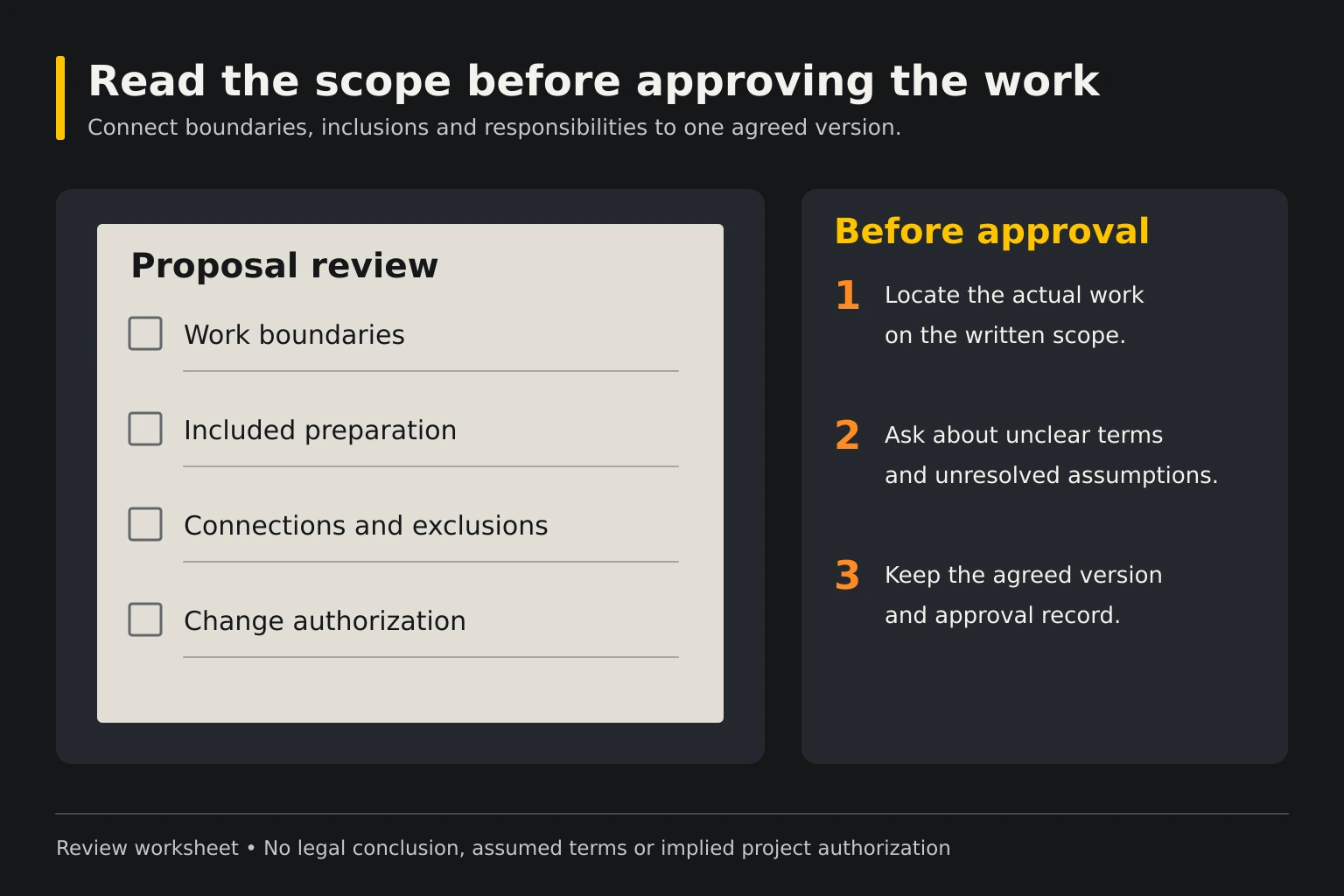
Identify the exact proposal being approved
Start by confirming the property address, proposal date and version. Make sure the document describes the location and work you intend to authorize. If there have been several revisions, identify the current version and retain the others as history. An approval message should refer to a specific scope rather than a remembered price from an earlier conversation. This is especially useful when a manager collects an estimate for an owner who has not visited the site.
Check that the main problem and intended result are understandable. A project title alone does not explain what is included. If the request concerns a driveway entrance, recurring repair or parking-lot maintenance, the proposal should identify the relevant work areas and decisions. Ask for clarification before approval where the description leaves you unable to explain the purchase in ordinary language.
Confirm repaired and retained areas
Review the marked photograph, sketch or written boundaries associated with the proposal. Identify where new work meets pavement, curbs, walkways, garages or streets that will remain. Make sure optional areas are separated from the base scope. A visible defect outside the marked limits is not automatically part of the purchase simply because the contractor saw it during a visit.
If the recommended work boundary differs from the outline of visible damage, ask for the explanation. The answer may involve a connection or preparation decision that the owner should understand. Do not change the boundary informally while accepting the original price. Request a current written scope that reflects the final decision. Keep that record accessible to the person who will be present during construction.
Understand preparation and the proposed construction
Read what the proposal says about removal, preparation, material and the treatment of retained connections. Ask why the approach fits the stated problem and intended use. Do not make the approval depend on one isolated detail borrowed from another property. Construction decisions need context, and a sales description should not be treated as a complete design assessment where other professional input is required.
Clarify responsibility for any unresolved design or review task. If additional information is needed before a final scope can be set, do not treat it as settled merely because a price has been provided. The owner can request a clear process without attempting to become the technical designer. A proposal should make the next decision understandable and explain which assumptions the price depends on.
Resolve water and connection questions
If water, a low area or a threshold connection is part of the reason for the project, confirm how that concern is addressed. Ask what drainage-related work is included, excluded or pending further review. A new surface should not automatically be assumed to solve a broader water problem. The proposed connection to retained features deserves attention before approval.
Review any changes involving drain inlets, ditches, curbs, garages or adjoining surfaces. Identify other parties responsible for features outside the contractor's scope. Do not assume that a contractor's visit authorizes alteration of a feature controlled by someone else. Keep any required coordination and its effect on the sequence in the project record. The final decision should reflect the actual responsibilities at the property.
Confirm ownership, approvals and adjacent work
Identify who controls the area being altered and who will confirm any required permission or review. A street connection, shared property or leased commercial site can involve responsibilities beyond the person requesting the estimate. Share existing documents and ask what remains unresolved. Do not infer a requirement or exemption from a nearby job that may have different conditions.
List related work by other trades, such as gates, irrigation, enclosure repairs or building connections. Confirm which tasks are included and which are separate. Agree on the order of work and who confirms that a preceding task is complete. This prevents approval of a pavement sequence that depends on something nobody has arranged. A clear scope identifies these handoffs rather than hiding them in a general expectation of complete restoration.
Approve an access plan the property can carry out
Review closures, equipment access, pedestrian routes, parking and provider arrangements. Confirm that the household, tenants or staff can complete their assigned actions before work begins. A proposal that assumes an empty work area is impractical if the property has no plan to move vehicles or stored equipment. Ask the contractor what staging space is needed beyond the finished pavement footprint.
Coordinate deliveries and waste collection where routes change. For a business or shared property, involve the responsible party in reviewing temporary access requirements. The schedule should identify the planned sequence while allowing for actual conditions and weather. Ask how updates will be communicated. Keep reopening instructions separate from the expected construction finish so people understand when different uses may resume.
Agree on changes and commercial terms
Ask how concealed conditions and owner-requested additions will be documented, priced and approved. Name the person authorized to make those decisions and a backup where appropriate. Do not leave approval to whoever happens to be at the property when a question arises. A clear process protects the practical relationship between the accepted scope and later work.
Confirm the company's stated payment, scheduling and follow-up terms directly. Read any offered warranty language for its actual coverage and conditions rather than inferring a guarantee. Keep optional items and allowances understandable. If the proposal expires or depends on a scheduling assumption, record that condition. The goal is a current agreement both parties can explain, not an approval based on several conversations with different remembered details.
Record the final decision and next actions
Before sending acceptance, list any questions that remain and obtain the necessary clarification. Keep the final proposal, marked limits, access plan and supporting records together. State which optional items are accepted and which are deferred. If another person will coordinate construction, share the actual accepted scope and decision responsibilities with that person.
After approval, confirm the next scheduling step and the property preparations required. Do not assume that accepting a quote automatically establishes a crew arrival date or unrestricted access. Send Asphalt Solutions the exact property address and specific proposal questions when following up. The company serves Greater New Orleans and the Northshore. The Slidell contact location is by appointment only, so arrange contact before an in-person visit.
Check that the approval reaches the right people
Make sure the authorized owner or representative and the contractor are working from the same accepted version. If a tenant, household member or employee will provide access, give them the practical instructions without implying that they can change the scope. Identify how they should raise a concern during construction and whom they should contact.
Keep a dated record of the acceptance and any supporting clarification. This record is useful when scheduling shifts or the property contact changes. It should preserve the actual agreement without turning informal advice into additional promises. A good approval handoff leaves the construction team with clear limits, the property with clear responsibilities and open questions resolved before they become decisions made under pressure at the work site.
Use a final list of settled and open items
Review the proposal with a short list that separates decisions already agreed from questions still awaiting an answer. This is particularly useful for a property with multiple owners, tenants or providers. Keep the list tied to the proposal version so it does not become an independent instruction that conflicts with the agreement. A major access or ownership question should remain visible until the responsible party has resolved it.
When the answer changes the work, ask for the relevant proposal or plan to be revised. Do not approve the original version and rely on an unrecorded understanding that it means something different. The final list should help the owner decide confidently while making the contractor's instructions clearer. Retain it with the acceptance record as a concise explanation of how the open questions were settled. Keep the final acceptance date visible.
Questions before you request the estimate
Turn the property facts into a clear next step
Explore the asphalt repair service guide, project planning checklists and photo gallery. Bring the actual property address, useful photographs and access needs to the quote discussion.