
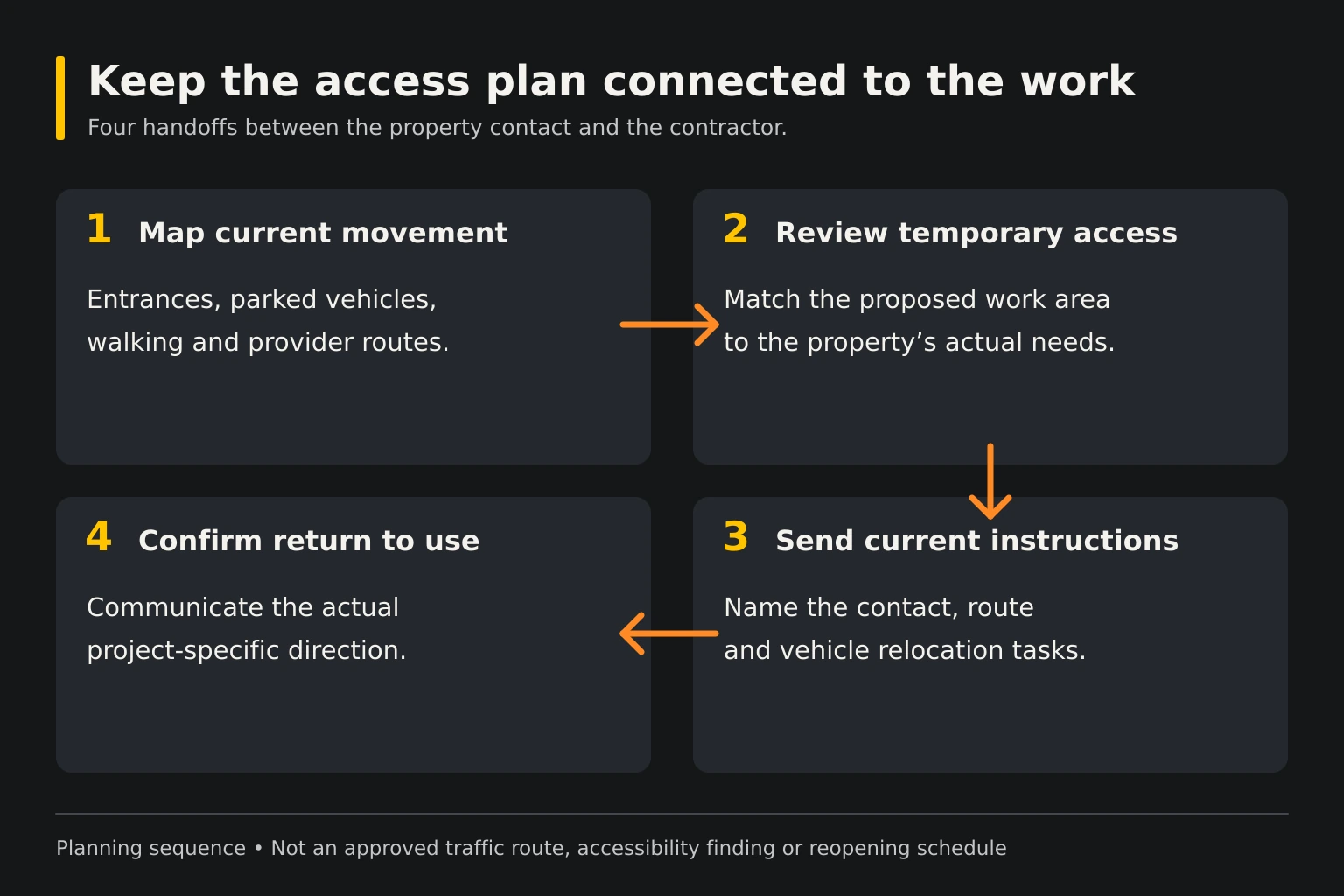
List the people and operations that rely on access
Begin with a normal day at the property. Identify residents, customers, employees, tenants, delivery drivers, waste collection and other providers who use the pavement. Write down where each enters, parks, walks or loads. A construction plan based only on the number of parking spaces may overlook the route to a door or the lane used by a service truck. Ask the people who operate the property about the movements that are easy to miss when looking at an empty site.
Separate flexible activity from activity that has a fixed time or special requirement. A household can sometimes move cars before a closure, while a business may need a specific delivery window or entrance arrangement. Share those facts before the contractor sets the sequence. Do not promise that operations can be paused unless the responsible person has agreed. A clear access plan starts with the actual needs of the property rather than a general expectation that everyone will work around the crew.
Map the work zone and retained routes
Use a simple sketch to show the proposed work area, equipment approach and routes expected to remain open. Ask the contractor what space the work requires beyond the finished pavement footprint. Materials, equipment movements and removal can affect adjoining lanes or parking. A narrow strip that looks open in a drawing may not be a usable route during construction. Review the actual arrangement before telling people it is available.
Mark the points where vehicles or pedestrians would cross the construction boundary. Avoid relying on informal shortcuts through the work zone. If access must be maintained at a particular entrance, identify how that requirement affects the sequence and whether other responsibilities need review. Keep the accepted sketch with the written plan. A map is useful for communication, but it needs accompanying instructions about who may use each route and when.
Assign temporary pedestrian-route decisions
Identify every door normally reached across the proposed work area. Discuss the people who use it and whether another route can serve them during construction. A temporary path across grass, loose material or an active service lane is not automatically appropriate. For a business or shared property, involve the party responsible for the property's access requirements. The contractor and owner should not discover this question after the primary walkway is removed.
Agree who will install and maintain the notices and barriers used to communicate the route. Give staff a short explanation they can share consistently with visitors. Where a temporary route changes as phases progress, identify the date or condition that triggers the change. Check that communications refer to the current arrangement. Avoid sending an old map simply because it was the first one prepared. The practical objective is a route people can understand and use as intended.
Coordinate vehicles before the crew arrives
Tell residents, tenants and employees which vehicles must be moved and where they may be parked. Include trailers, stored equipment and vehicles used only occasionally. A parked item can block removal or material placement even if its owner does not need access that day. Confirm who can contact the owner if the item remains. Do not assume the contractor has responsibility or permission to move someone else's property.
If the property has a second entrance, confirm that it is suitable for the intended vehicles and can remain open during the work. Discuss gate access, turning space and any provider restrictions. A route used by a passenger car may not work for a delivery vehicle. Keep temporary parking separate from the equipment approach so the plan does not create a new obstruction. Record when vehicles may return based on the contractor's actual reopening guidance.
Arrange delivery and collection alternatives
Give the contractor the normal delivery, waste collection and service schedule. Contact the providers about closures that affect their route or stopping position. Ask whether a temporary arrangement is acceptable and record who confirmed it. The paving contractor should not have to improvise a missed collection or delivery after work begins. A brief call before scheduling can prevent an avoidable interruption to the property's operation.
For a business, identify deliveries that require a particular door or loading area. Do not reroute them through an unsuitable pedestrian entrance without review. If a provider cannot change its schedule, discuss whether the construction sequence can accommodate that constraint. Keep the approved temporary arrangement with the access plan and assign a contact who will communicate changes. A provider arriving outside the agreed window should know whom to call instead of driving into the work area to find someone.
Make the phase sequence understandable
Where work is phased, describe each stage in ordinary language: the area closed, the access retained, the work expected and the condition required before the next stage begins. Do not treat phase numbers alone as instructions. The owner should be able to tell a tenant what will happen without interpreting a construction drawing. Identify any transition between new and retained pavement that remains temporary during the sequence.
Ask what circumstances can change the plan, including weather or conditions exposed during removal. Agree how updates will be communicated and who can approve a revised sequence. A plan can allow flexibility while still keeping the property informed. If a change affects a promised route or provider arrangement, notify those users before they encounter the closure. The written sequence should be updated when the decision changes, rather than leaving several contradictory versions in circulation.
Separate completion from permission to reopen
A surface can look finished before it is ready for the intended use. Ask for instructions covering pedestrians, normal vehicles, trailers, deliveries and concentrated loads where relevant. The contractor's guidance should reflect the actual materials, work and conditions. Avoid applying a waiting period from an unrelated project. A household or business reopening the area needs to know what is permitted, what remains restricted and who will confirm the change.
Assign responsibility for retaining barriers and communicating the reopening decision after the crew leaves. If work is complete in one area but continues elsewhere, make those boundaries clear. Do not let a single message saying the job is done imply that every route is unrestricted. Keep the reopening guidance in the project record and share it with providers whose equipment may put different demands on the pavement than ordinary passenger vehicles.
Keep contacts and records ready for changes
Prepare a short contact list for the owner, authorized property representative, contractor and affected service providers. Include the person who can approve changes when the main contact is unavailable. Share only the necessary contact information with each party. The purpose is to resolve access decisions promptly, not to create a long communication chain in which nobody knows who can act.
Retain the final access plan, notices, approved revisions and reopening instructions with the accepted proposal. After the project, record what arrangements worked and what should be changed for a future phase. To discuss a pavement project with Asphalt Solutions, send the exact address, desired work and the operations that need to continue. The company serves properties around Greater New Orleans and the Northshore. Its Slidell contact location is by appointment only; call or text before arranging a visit. Walk through the agreed plan with the property representative before construction begins. Check the entrances, provider stopping points and areas where notices will be placed. This review is an opportunity to catch a conflict while the sequence can still be discussed. If the property has staff working different shifts, make sure each shift receives the same current instructions. Keep the walkthrough notes with the plan and update any route that changed. A plan understood only by the person who arranged the estimate is harder to carry out when that person is absent. Confirm the current instructions again when the crew's actual arrival date is established.
Questions before you request the estimate
Turn the property facts into a clear next step
Explore the asphalt repair service guide, project planning checklists and photo gallery. Bring the actual property address, useful photographs and access needs to the quote discussion.