
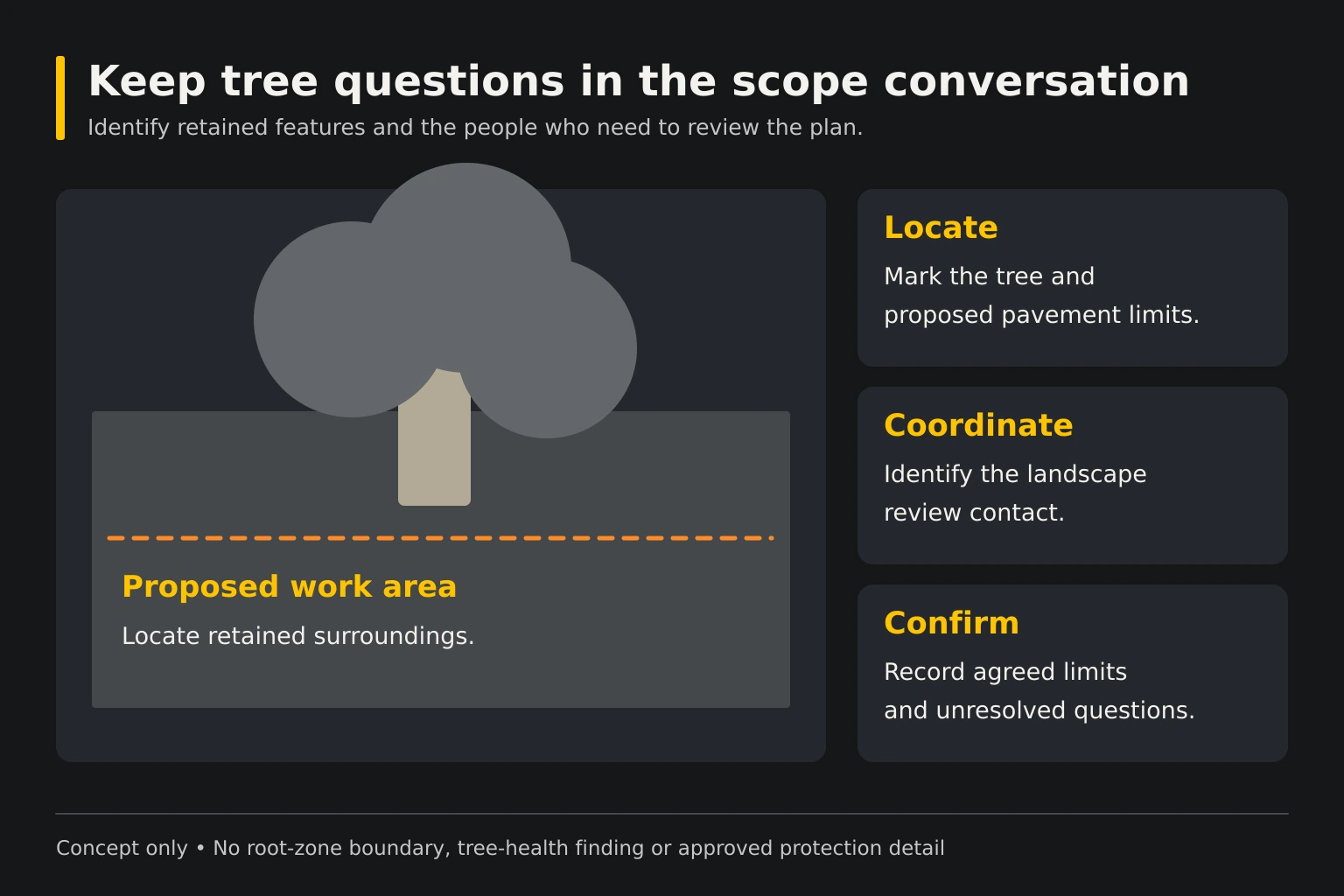
Document the tree and pavement relationship
Begin with overview photos that show the pavement, nearby trees and the proposed work area together. Include the trunk position, visible landscape border and the connection to retained pavement. Describe what you want to change and what you want to preserve. A close-up of a crack beside a tree does not show the whole setting and does not establish that roots caused the damage. Separate visible observations from a suspected explanation.
Note whether the pavement concern involves a raised edge, broken surface, settlement or water collecting near the planting. Record how the area is used and whether equipment would need to pass close to the tree. Share any existing advice or records from a tree professional. Those records can help coordinate the discussion, but do not assume that an old assessment authorizes a different construction plan. The actual work boundaries and access route need their own review.
Set preservation expectations before estimating
Tell the contractor which trees, planting beds and landscape features the owner wants to retain. Do not wait until equipment arrives to explain that a particular tree is important. Mark the features on a simple sketch and distinguish them from items that may be moved by another trade. Ask how the proposed pavement work and equipment access relate to those expectations.
Avoid relying on a broad promise to protect landscaping when the plan requires excavation or traffic nearby. Identify the questions that need appropriate professional review and assign who will arrange it. A paving contractor's scope does not automatically include an assessment of tree health or the effects of root work. The owner should know which responsibilities are part of the pavement proposal and which remain separate. Clear expectations allow the quote to reflect the arrangement actually being considered.
Involve the appropriate tree professional when needed
If the proposed work may affect roots, the surrounding grade or the tree's condition, ask whether a qualified tree professional should review it before the pavement scope is finalized. Do not authorize root cutting as an incidental addition to a repair. The presence of a raised panel or broken edge alone does not identify the appropriate tree-related action.
Share the proposed pavement boundaries and equipment route with the person reviewing the tree concerns. Keep any recommendations with the project records and ask how they affect the paving plan. If the recommendations change the work limits, obtain a revised proposal rather than assuming the original price and sequence remain valid. Coordinate the parties directly where possible so the owner is not left interpreting conflicting advice about excavation, protection and construction access.
Review equipment and material access
Show the contractor the route from the property entrance to the work area. Include trees, branches, gates, narrow passages and landscaped borders along that route. Ask what space equipment and material handling will require. Do not assume that a route suitable for a passenger car is suitable for the planned construction operation. The contractor should discuss the access needed before the owner commits to keeping every surrounding feature untouched.
Ask where materials and equipment may be placed and whether that location needs landscape review. Keep the accepted staging area on the project sketch. If the property changes the available route or storage area after estimating, notify the contractor before scheduling. A change in access can affect the sequence even when the finished pavement area is unchanged. The plan should identify practical limits rather than rely on a verbal instruction to be careful near the trees.
Define excavation and retained boundaries
Mark the areas proposed for removal and the surfaces or landscape borders that will remain. Ask how the contractor will handle a condition discovered during removal that was not visible at the site visit. Where roots or other features may be encountered, agree on a stop-and-review procedure instead of authorizing an unspecified action in advance. Identify who can make the decision and whether another professional needs to be consulted.
Keep additional-work authorization separate from the initial repair scope. A photograph of a newly exposed condition should support the discussion, but the owner should receive a clear description of the proposed change and its effect on work limits or price. If the plan calls for another trade to complete work first, document the sequence. This avoids a situation in which the pavement crew arrives before the landscape or tree-related decision has been resolved.
Discuss water and grade connections
Observe where water travels around the pavement and nearby landscaping after rain. Include visible drains, downspouts and low areas in the photos. Changing a pavement edge or its connection to the ground can affect those relationships, so discuss the intended elevations before approving the work. Do not assume that raising pavement beside a tree is a harmless way to remove a puddle.
Ask what drainage or landscape-grade work is included and what remains outside the proposal. Where a tree professional's advice affects grade changes, keep that advice connected to the pavement plan. The quote should distinguish the requested surface work from a broader drainage redesign. Describe water observations without diagnosing the underlying cause from photos alone. This keeps the discussion grounded in the actual property and identifies the questions that require a site review.
Specify protection and restoration responsibilities
List the landscape features, irrigation equipment and other items that need protection or coordination. Ask whether the quote includes removal, reinstallation or restoration where access or excavation affects them. An owner may expect a complete landscape restoration while the contractor has priced only pavement work. Resolving that expectation before approval is easier than arguing about it after completion.
If another trade will restore planting or irrigation, identify when that work occurs and how it connects to the paving sequence. Confirm the appropriate utility-location responsibilities before excavation. Visible landscape features do not reveal every buried service. Keep protection instructions practical and available to the people carrying out the work. A written plan is more reliable than relying on the person who requested the estimate to repeat every instruction on construction day.
Compare the coordinated scope and preserve records
Compare proposals for pavement limits, preparation, access, tree-related coordination, drainage responsibilities and landscape restoration. A lower number may exclude work or review included elsewhere. Ask which decisions remain open before treating a proposal as ready for approval. Where a tree or landscape recommendation changes the plan, keep the revised scope with the accepted version so the construction team has one current record.
After completion, photograph the pavement connections and retained landscape features without presenting the images as proof of tree health or concealed conditions. Keep the review notes, approved changes and reopening instructions for future work. Send Asphalt Solutions the exact address, pavement concern, preservation priorities and useful overview photos to begin the conversation. The company serves Greater New Orleans and the Northshore. Its Slidell contact location is by appointment only, so call or text before arranging a visit.
Keep the decision points visible during construction
Identify the conditions that require a pause and further discussion before the crew proceeds. This may include an unexpected buried feature, an exposed root condition or a change in the available equipment route. The owner and contractor should know whom to contact and what information to record. Do not use a broad instruction to proceed carefully as a substitute for a clear decision process where another professional's review may be needed.
Keep the relevant recommendations and contact details available to the authorized property representative. If that person will be absent, arrange a backup who understands the agreed limits and can coordinate the appropriate review. A delay caused by an unanswered question is easier to manage when the sequence anticipates it. Record the final decision with the scope and photograph reference so later maintenance discussions do not depend on someone remembering what happened at the excavation.
Questions before you request the estimate
Turn the property facts into a clear next step
Explore the asphalt repair service guide, project planning checklists and photo gallery. Bring the actual property address, useful photographs and access needs to the quote discussion.