
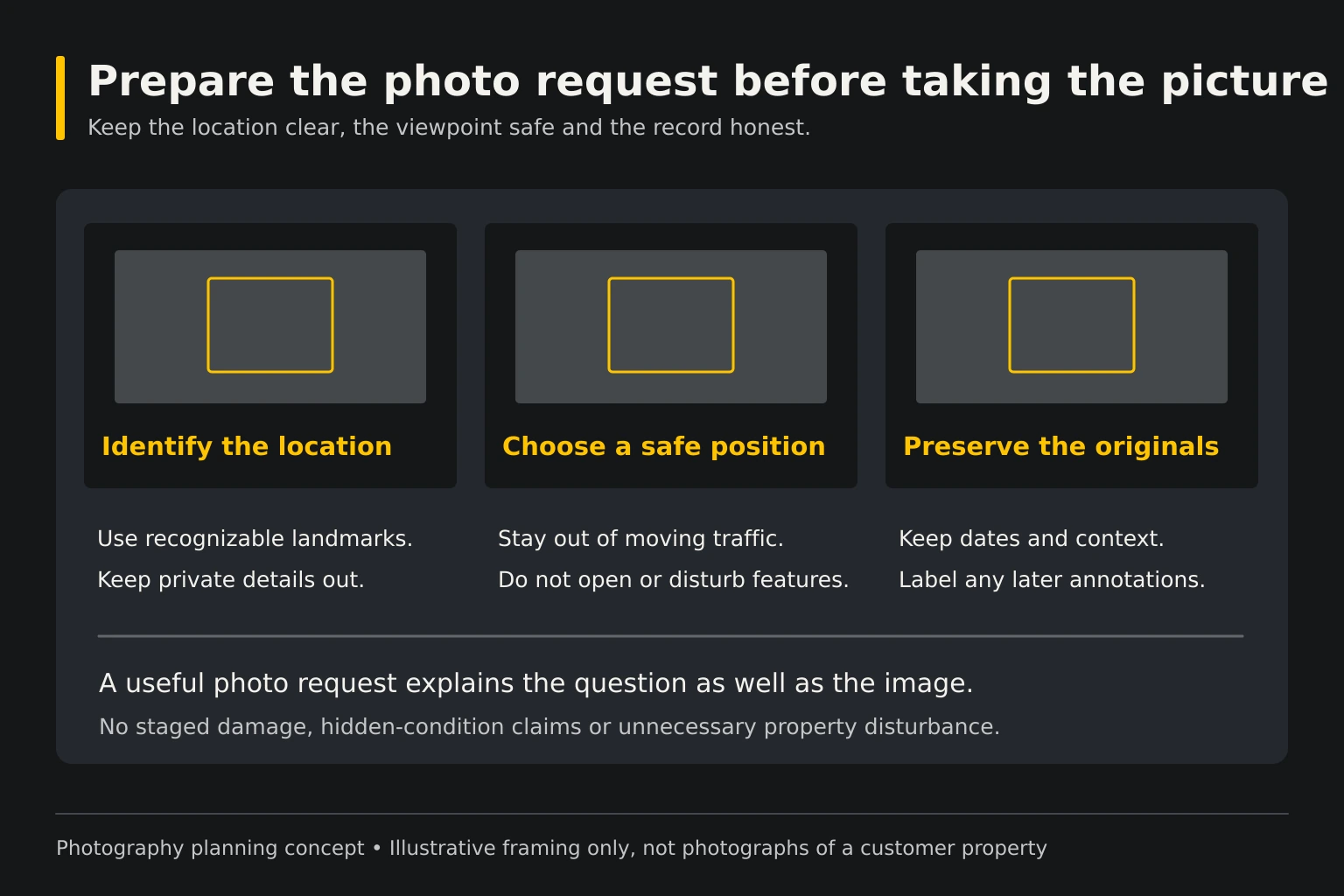
Define the work area before taking pictures
Start with the exact property address and a short description of the concern you want reviewed. Identify whether the request covers a driveway, selected repairs, a parking area or a future maintenance plan. A photo set is more useful when its purpose is clear. You do not need to select a repair method before contacting the company, but you should explain the result or operational problem you want to discuss.
Mark the intended area on a simple sketch or note the landmarks that identify it. Separate optional future work from the immediate request. If several properties are involved, prepare a distinct set for each address. A building visible in an image is not a substitute for the work-site address. Good preparation helps prevent photos from being attached to the wrong proposal or treated as a complete record of an area they do not show.
Choose safe viewpoints and access times
Plan to take photographs when the area can be viewed without entering moving traffic, active loading operations or restricted equipment zones. You do not need to interrupt a provider or stand in a roadway for a better angle. If a useful connection cannot be photographed safely, describe it in the message and note that it needs review during a visit.
For a commercial property, coordinate with the person who controls access and operating hours. A quieter period may provide a clearer view, but confirm that the area is actually available. Keep pedestrians and providers in mind rather than treating the property as an empty photo location. The objective is an understandable estimate record. A safely obtained overview and clear description are more useful than a risky close-up.
Move only items the property can legitimately move
Identify vehicles, bins, tools or stored items that obscure the proposed work area. Arrange movement with their owners where practical and permitted. Do not assume the person taking photos has authority to move a tenant's vehicle or service equipment. If an item must remain, explain what it obscures and whether it can be moved before a site visit.
Avoid changing the condition being documented just to make the picture cleaner. Do not conceal damage, fill a concern for appearance or move a feature that is part of the operational question. Ordinary movable clutter can be separated from a fixed obstruction, but the contractor needs to understand the actual property. Keep notes about what was temporarily moved and what normally occupies the area when that information affects use or access.
Prepare overview and connection views
Begin with a viewpoint showing the proposed work and its surroundings. Include entrances, buildings, retained pavement and landscaped edges that locate the area. For a long driveway or large lot, take overlapping views with simple labels. A series of close-ups is difficult to use when none shows how the locations relate to one another.
Plan specific views of transitions to garages, streets, curbs, walkways, drains or adjoining surfaces. These connections often carry important scope questions. Tell the contractor which features are intended to remain. If another trade will change a threshold, gate or drainage feature, include that fact in the message. The photo preparation should support the actual planned property, not only the arrangement present on the day images were taken.
Collect detail images with location references
After the overview, photograph the visible concern from a position that makes it understandable. Include a second image with enough context to locate it. Use a simple label matching the sketch, such as entrance A or garage connection. Approximate dimensions can help when safely recorded, but mark them as approximate and do not treat them as final construction measurements.
Use normal camera settings where possible and keep the original files. Extreme perspective or heavy image editing can make a condition harder to judge. Do not remove cracks, alter the apparent surface or combine different areas into one misleading view. If a copy is cropped or brightened for readability, retain the original. The purpose is to communicate the condition honestly so the company can discuss what further review is needed.
Plan water photos around actual observations
If the concern involves water, record where it remains or moves and when the observation occurred relative to rain. Include visible nearby inlets, ditches, downspouts and retained surfaces from safe viewpoints. Do not enter flooded areas or traffic to complete the set. Where the event has passed, describe what was observed and provide the later photograph with its timing.
Keep suspected causes separate from the photo description. A puddle image does not establish the whole drainage problem. If several dated observations are available, choose the ones that add useful information and retain the rest as history. The contractor needs a clear description of the concern rather than a large collection with no explanation. Ask what water-related questions require a site review instead of expecting images to finalize the scope.
Show equipment access and normal property use
Include the approach from the entrance to the proposed work area. Photograph gates, narrow passages, low branches or retained features that may affect equipment movement. Explain which obstacles are movable and which are fixed. Do not promise construction access because a passenger car can use the route. The contractor should review the actual arrangement.
Describe normal vehicles, delivery activity and provider schedules in text. A photo of an empty parking lot does not show its busiest period or the equipment used for collection. Mention operations that must continue during work. If the property has an alternate route, identify it as a possibility for discussion rather than a confirmed construction solution. The photos and written facts together create a more useful inquiry than either alone.
Organize the final set and protect private details
Choose images with distinct purposes and give them labels that match the location references. Keep originals in a separate folder and avoid mixing older images without dates or explanations. Where several people contribute photos, ask one person to assemble the final set and confirm which address each belongs to. This prevents an apparently continuous record from containing a different property or a different stage of work.
Keep unnecessary faces, private documents and identifying details out of the set where practical. Share only the material relevant to the estimate discussion. Public gallery use should be considered separately from supplying images for a quote. Do not assume that an estimating file authorizes a case study or a caption with an inferred location, date or construction scope. Accurate public information needs confirmation from the actual project record.
Send a concise inquiry and retain the next steps
Include the address, requested work, main concern, labeled images and access restrictions. Mention a deadline and whether it is flexible. Identify the person who can arrange a visit or answer property questions. If dimensions or vehicle details are unknown, say so rather than inventing them to complete the request. A well-prepared inquiry makes the remaining questions easier to identify.
Keep the sent set with the later estimate and site notes. If the scope changes, update the marked image or sketch and identify the current version. A preliminary photo discussion is not a final quote or a guarantee about concealed conditions. Asphalt Solutions serves Greater New Orleans and the Northshore, and the Slidell contact location is by appointment only. Call or text before arranging a visit. Clear preparation helps the next conversation focus on the actual property and the decision you want to make. Before sending the set, ask someone familiar with the property to review whether the locations and labels are understandable. A person who did not take the photos should be able to match the main concern to the overview and sketch. If that is difficult, add context instead of more close-ups. Check that the message includes the current address, the actual work request and the contact responsible for the next discussion. This final review helps the company use the set as intended.
Questions before you request the estimate
Turn the property facts into a clear next step
Explore the asphalt repair service guide, project planning checklists and photo gallery. Bring the actual property address, useful photographs and access needs to the quote discussion.