
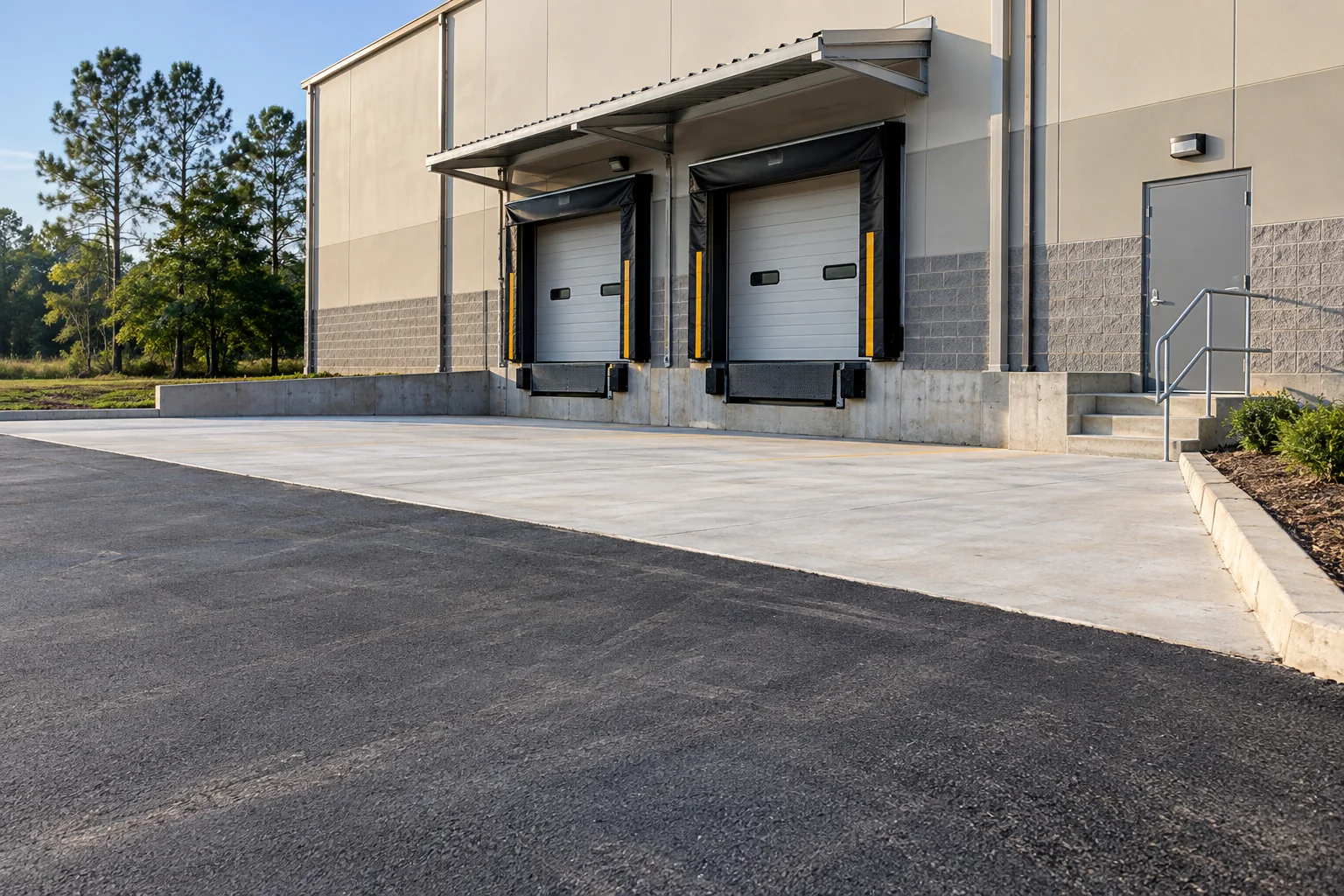
Review the approach as part of the loading operation
A commercial loading concern can extend beyond the spot where a vehicle stops. Show the approach, retained loading surface and relevant entrance or service connection together. Describe actual movements and known operating needs without inventing weights or presenting a photograph as proof of pavement capacity. The provider can identify what additional information or appropriate evaluation is needed for the proposed task.
Suppose a repair area lies between an active delivery route and a retained concrete apron. A proposal for the visible defect does not automatically describe how loading will operate during each phase. Ask the responsible operator and providers to identify the actual arrangement, including which activity can be rescheduled and which requires a reviewed alternative. Keep the complete connection in the conversation.
Clarify whether another provider controls loading equipment, the retained structure or another related task. A paving price should not silently become a promise to adjust every adjacent feature. Identify the handoff, needed information and decision authority before the sequence is treated as confirmed. The owner should understand what is included and which question remains open.
Keep release instructions specific to the agreed use
Before an area returns to service, follow instructions for the actual work and intended activities. A completed-looking surface does not independently establish that every movement or loading operation can resume. Clarify who receives the provider's direction and communicates it to the people managing arrivals. If another task remains, identify the interim arrangement and responsible contact.
Keep current instructions consistent with the approved phase. A change to the work boundary may affect the approach even if the loading destination remains the same. Record the authorized revision and update the relevant operating message before users arrive with an expectation based on an earlier plan. Avoid asking drivers or staff to improvise around an uncertain connection.
At closeout, retain the final scope, approved changes, genuine photographs and any relevant findings. Identify deferred or excluded areas separately from completed work. If a later concern is observed, record the location and actual behavior without assigning a hidden cause or assume it belongs to the same task. A usable history supports a more focused future evaluation.
Call or text Asphalt Solutions with the property address, loading concern and known constraints. Most projects are at customer job sites. Slidell contact-location visits require an appointment; listed hours mainly describe phone availability. Arrange the actual site discussion and work sequence directly, with the appropriate operator and approval contact involved.
Describe the loading activity at the connection
A loading approach is more than the visible strip of pavement next to a building. It includes the route a vehicle takes, the turn into position, the location where it stands and the transition to fixed loading features. Explain each of those uses before comparing repairs. The paving area’s size alone does not describe the demands or the connections that the project must address.
Provide the vehicle types and known operating pattern, including occasional larger deliveries. Show where vehicles wait, turn and stand, and identify any route shared with passenger or pedestrian traffic. The assessment should reflect the actual activity discussed rather than assume that a loading approach functions like an ordinary parking stall.
Photograph the overall route, damaged areas and fixed interfaces. Include known prior repairs and changes in vehicle use. Mark observations without treating them as a diagnosis of buried support. Photos prepare a site-specific conversation but cannot establish every existing layer, final quantity or suitable construction detail.
Explain what failed and what the repair will retain
Recurring distress near a turning or standing location deserves a discussion of the broader condition and use. Ask the assessment to explain the proposed boundaries and what the new approach changes compared with earlier work. A small visible opening can be part of a wider affected area, so the repair limit should be defined rather than guessed from one photograph.
Compare localized repair, resurfacing and replacement by preparation, removed material and retained structure. Ask why each proposed option is appropriate for the loading activity. A new-looking layer does not establish that the existing support is suitable or that every recurring concern has been resolved.
Where concrete and asphalt meet, identify the operations and boundaries for each material. Ask how the work connects and which related tasks are separate. A broad asphalt quote should not be mistaken for a complete correction of every fixed loading feature or adjoining concrete concern.
Review fixed elevations and drainage
Show the approach where it meets retained concrete, a loading position, curbs, drains or other relevant fixed features. Describe what must remain and how vehicles use the interface. Adding material can change elevations, so the proposed method should explain the finished connection instead of assuming another layer improves the transition.
Record water collection from safe locations, including the nearby drains and apparent water path. Ask whether correction is part of the scope and which existing conditions remain. Surface renewal alone should not be treated as a universal solution for water entering from another area or a low connection beside the building.
Clarify the responsible review for any change outside the defined pavement operation. A general planning guide cannot establish a site-specific loading detail or authorize alteration of another party’s feature. Keep the physical connections and coordination tasks explicit so the proposal can be reviewed as a complete set of included work.
Plan construction around a working delivery route
List arrival windows, loading commitments and the route that must remain available. Identify which operations can move and who has authority to coordinate the change. The contractor’s sequence does not automatically reschedule carriers or change the way a building receives deliveries.
Trace the available route during each proposed phase, with closed boundaries shown clearly. A small closure can prevent access to a larger loading area if it affects the only suitable approach. Ask whether removal or preparation needs a different restriction from placement before deciding that a partial closure preserves normal operation.
Have the responsible parties review the proposed route and relevant site requirements. Do not assume that an open parking zone is an approved substitute loading approach. Communicate the actual agreed arrangement to staff and outside drivers before scheduling work that depends on their cooperation.
Assign clearing and reopening responsibilities
Identify trailers, stored materials, vehicles and equipment within the work area. Assign relocation and access responsibilities through property operations. A pavement scope should not be assumed to include moving stored property or coordinating every carrier. The contractor needs the agreed cleared area and route requirements before starting the included operations.
Ask for written reopening instructions for the actual method and intended use. Straight travel, turning, standing loads and loading activities need discussion as appropriate. A visibly complete surface does not establish readiness for every activity. Share the instructions with the people directing vehicles and service providers who are not present during the explanation.
Name the person who confirms a route can return to use and the operational contact who communicates changes. Keep the instructions with the phase map. An early preferred date should not become a guaranteed loading appointment when the actual conditions call for a revised arrangement.
Compare bids and keep useful project records
Give bidders the same work limits, vehicle use, fixed connections and operating constraints. Compare preparation, quantities, repair boundaries, allowances and exclusions alongside the total. Different retained structures and interfaces can make two prices descriptions of different work, even if both are titled loading-area repair.
Identify the authorized approver and establish how discovered conditions will be discussed. Financial approval and daily delivery coordination may involve different people. Keep those roles clear so the contractor receives a consistent instruction path rather than competing requests when the loading operation is under pressure.
Retain the agreed scope, route map, prior repair records, dated completion photos and reopening guidance. Start a commercial inquiry with these property facts and the address. Ask for a site-specific assessment of the loading approach before committing vehicles or service operations to a construction arrangement.
Questions before you plan the work
Bring the property facts to the conversation
Parking lot paving, asphalt repair and pavement maintenance address different project questions. Compare the appropriate scope for your property.