
Make the approval record usable by the next HOA contact
An association pavement project may be discussed by several people before one person communicates the approval. Keep the actual proposal, work boundary and decision authority clear in the record. This guide does not determine ownership or legal authority. Resolve those questions through the appropriate parties and identify the person who can authorize the specific work and any later change.
If a board or management contact changes during planning, hand over the current documents and remaining questions. An early estimate may still be useful history without being the instruction everyone should follow. Identify which version is current and which items remain outside the approved task. The next contact should not need to reconstruct the project from scattered recollections.
Keep the distinction between a current repair and a longer-term plan visible. An area identified for future consideration is not automatically included in today's scope. If a phase or boundary changes, retain the explanation with the authorized proposal. That helps residents and future managers understand the actual decision rather than assume every marked or photographed location was approved for construction.
Connect resident communication with the approved phase
Use the actual work sequence when preparing notices. Identify the affected area, relevant arrival connections and current contact, while the on-site arrangement gives consistent direction. A general message that paving is planned does not explain how residents reach their destination during a particular stage. The complete route and actual user needs may require appropriate review.
Agree who receives an access concern and who can approve a response. Volunteers or management staff can communicate the authorized arrangement without improvising a technical or operational change beyond their role. If a phase changes, update the notice and physical direction together so residents do not arrive expecting an unavailable route.
Before reopening, follow instructions for the actual work and identify any separate-provider task that remains. Keep release information, approved changes and genuine completion images with the association record. Later observations should identify a specific location and behavior without assigning a hidden cause or treat a reference image as evidence of the community's condition.
Contact Asphalt Solutions by call or text with the association property address, current scope question and relevant operating constraints. Most projects take place at customer job sites. Slidell contact-location visits are appointment only, and listed hours mainly concern answering the phone. Coordinate the actual visit, decision authority and work sequence directly before dates are communicated as final.
Identify the pavement the association can authorize
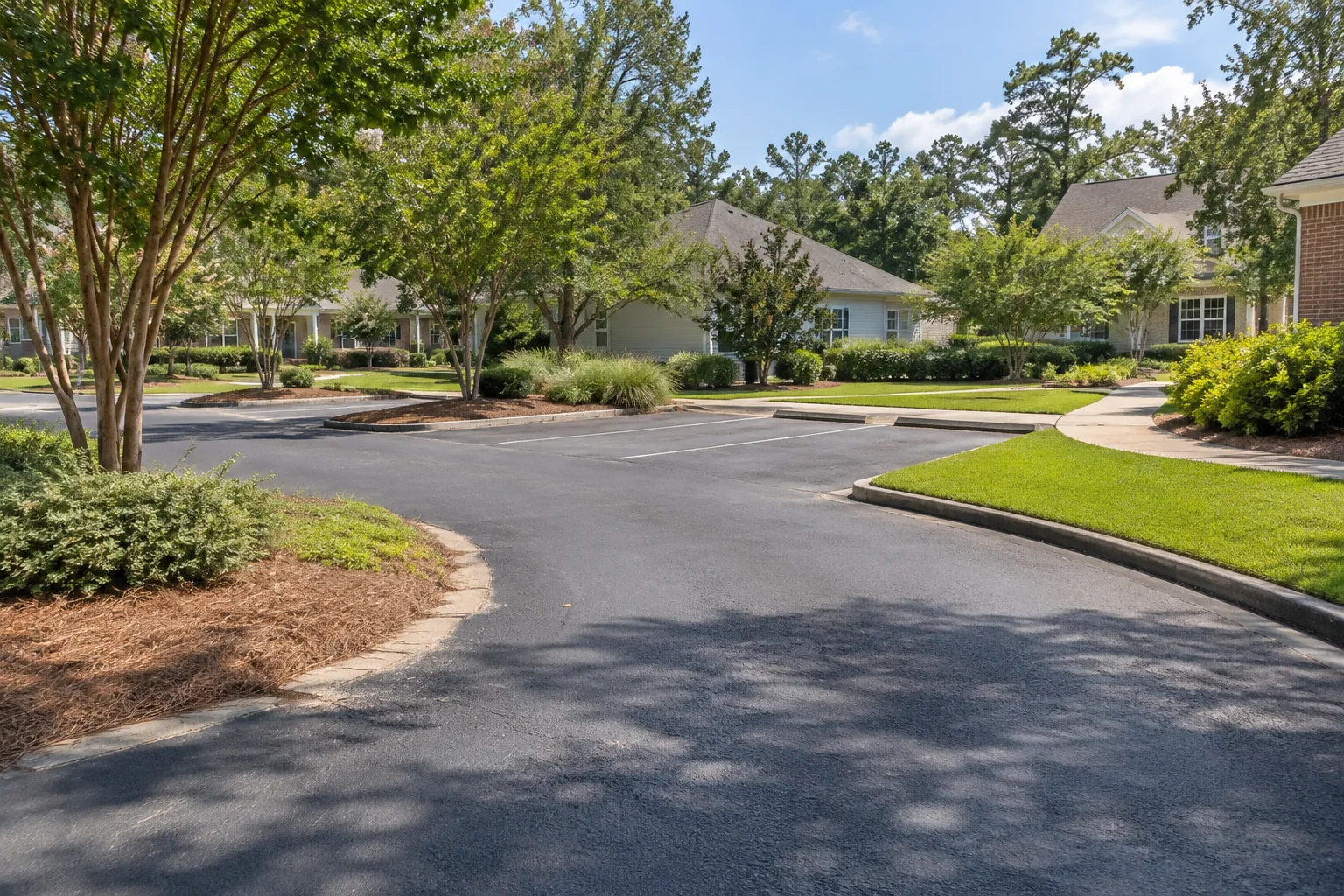
Start with a map of the common paved areas and the routes they support. Shared drives, parking zones, walking connections and service approaches can have different uses and ownership arrangements. Identify what the association is responsible for and which features need another party’s coordination. A broad maintenance conversation is not itself authorization to alter every paved area near the community.
Describe the regular vehicle and pedestrian pattern, including resident arrivals, visitors, deliveries, refuse collection and occasional larger vehicles. Explain where traffic turns, stands or uses a shared entrance. The assessment needs actual use rather than assumptions based on the parked vehicles present during one visit.
Map observed defects and connect them with wide and detail photos. Include recurring repairs, water collection and fixed transitions. Keep the observations separate from a diagnosis of buried conditions. A common map is useful when a board member or approving owner is not present at the site and needs to understand the locations discussed.
Give decision makers a defined scope
Identify the association’s authorized decision process before seeking construction approval. The estimator needs a clear approving contact and an operational contact for resident access. These can be different roles. Do not assume that an informal committee discussion or a resident’s request has the same authority as the property’s required approval.
Compare localized repair, maintenance, resurfacing and replacement by what each removes or retains. Ask why the proposed approach is suitable for the observed concern and intended use. A coating or new-looking surface does not establish that every supporting or drainage issue is resolved. Decision makers should understand retained limitations as well as the desired appearance.
Give bidders the same boundaries, concerns and operational constraints. Compare preparation, quantities or allowances, fixed connections, exclusions and related work. A lower total can reflect a smaller repair area or less included preparation rather than an equivalent scope at a better price. Use the itemized differences to support an informed decision.
Separate current approval from the longer budget plan
An association may discuss several years of pavement priorities while approving only one current project. Keep those purposes distinct. Record which concerns the approved stage addresses and which remain deferred. Ask how later operations connect with retained work so the community does not mistake a limited repair for complete renewal of all common pavement.
Treat proposed replacement years or future treatment dates as planning assumptions to review, not guarantees. Condition, vehicle use, drainage and prior work can change. Consistent photographs and scope records support a more useful budget conversation than automatically repeating a treatment or relying indefinitely on one projected date.
Ask what optional items add and how they affect access or later phases. Record accepted options before scheduling. Explain any allowance, how discovered conditions will be discussed and who can authorize a change. A clearly defined current scope is easier for residents and future board members to understand.
Plan resident access and communications together
Trace the routes available during each proposed phase. Identify the homes, parking areas and shared facilities served by a closed connection. A small work area can affect a much larger part of the community when it includes a necessary entrance or crossing. Ask whether preparation needs different boundaries from the final placement operation.
Have the responsible party review applicable parking, pedestrian and temporary-access requirements for the actual property. A general planning page is not a determination that an alternative route is suitable. Discuss necessary connections before communicating a construction arrangement to residents.
Assign the resident communication, vehicle clearing and provider coordination tasks explicitly. Notices should use the approved phase map, clear locations and current reopening instructions. The paving contractor’s scope does not automatically include enforcing community parking arrangements or contacting every resident and service provider.
Review water paths and shared connections
Record water collection near common drives, walking connections and drains from safe positions. Include known observations after rain. Ask which drainage-related correction is included and which existing conditions remain. Surface maintenance or another asphalt layer should not be treated as a universal correction for water reaching the pavement from an adjoining area.
Photograph retained curbs, sidewalks, drain covers, entrance transitions and other fixed features within the proposed work. Ask how the finished pavement meets them and who handles separate tasks. Comparing complete transitions and work boundaries helps an approving group understand why superficially similar proposals may produce different results.
Confirm markings, signs, wheel stops and related concrete operations explicitly where relevant. Review the intended common-area layout through the responsible party. New paving or refreshed paint is only part of the property’s arrangement and does not by itself establish that every access or layout requirement has been addressed.
Preserve instructions for the people who inherit the project
Ask for reopening guidance based on the actual work and intended activities. Discuss passenger travel, pedestrians, deliveries and turning or standing loads as appropriate. The person communicating with residents should use the same instructions as the contractor. A surface looking complete is not enough information to decide that all community uses can resume.
Keep the approved proposal, decision record, work map, notices and dated completion photos together. Record the retained areas and written care instructions. These facts make the maintenance history usable when board members or managers change, and help explain what the association purchased if new concerns arise later.
Start a commercial inquiry with the community address, ownership or responsibility boundaries, defect map and necessary routes. Include the authorized contact and desired timing. Ask for a property-specific assessment and defined options before the association confirms a construction arrangement or presents a budget forecast as an approved work schedule.
Questions before you plan the work
Bring the property facts to the conversation
Parking lot paving, asphalt repair and pavement maintenance address different project questions. Compare the appropriate scope for your property.