
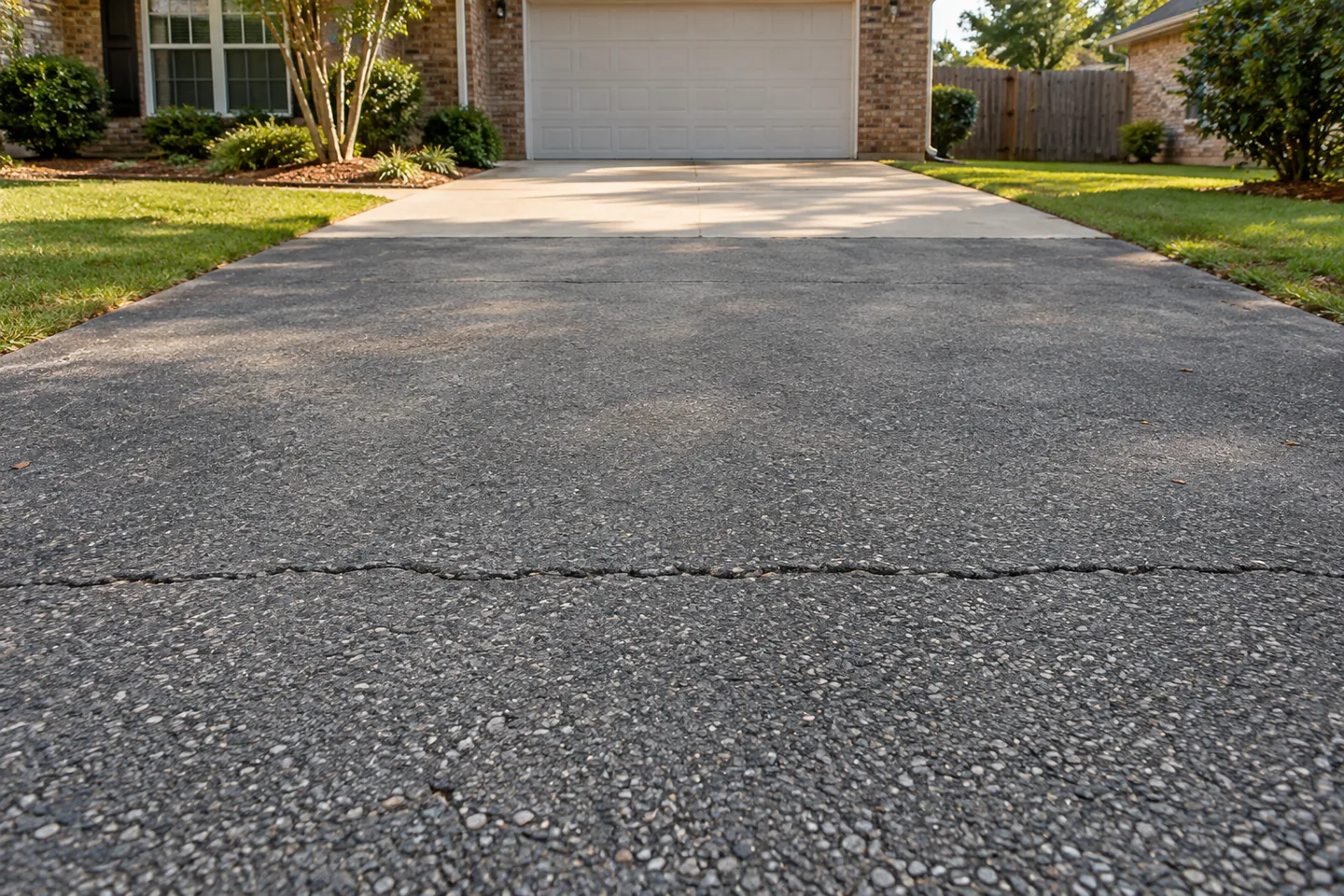
A crosswise crack needs a location-specific discussion
Transverse cracking runs across the pavement rather than generally along its length. For a homeowner, that may look like a line crossing the driveway; in a lot, it may cross a drive aisle or another defined section. The name describes orientation. It does not establish the crack's depth, movement or cause. Use it to communicate the visible concern, then ask what the contractor needs to assess before recommending an operation for the property.
Several crosswise cracks do not necessarily belong to one identical repair scope. Their surrounding surfaces, retained features and repair histories may differ. Record where each line crosses the property and whether the pavement beside it has other visible damage. A general description of cracks across the driveway can be a starting point, but a proposal should identify the areas considered and the specific work offered instead of treating every line as interchangeable.
The direction term is also different from a cause-related explanation. If someone says the crack relates to an older joint or repair, ask what information supports that assessment. A visible line alone does not prove the history below it. Keep known records separate from interpretations. This makes the site discussion clearer and prevents an owner from expecting a treatment selected around an unverified explanation of how the crack developed.
Photograph the crossing and both approaches
Take a view showing the full crosswise line where it can be photographed safely. Include the pavement approaching it from each side and fixed references such as the driveway entrance or garage apron. A close image of the center can miss damage at the edges. If the crack stops or changes appearance partway across, show that distinction. The record should locate the observation without assigning a final construction boundary.
Where a line crosses a normal walking route, note how people reach the building. Where it crosses vehicle access, show turning and stopping movements nearby. Do not ask people or drivers to demonstrate the concern by crossing a suspect area for photographs. The contractor can discuss the operating context from a safe record. User movement matters for access planning, but does not by itself establish why the crack formed or which hidden layer needs treatment.
If more than one line is present, use simple references on a sketch. For example, identify the crossing nearest the street separately from the crossing near retained concrete. Add dates and distinguish known measurements from visual estimates. This prevents an estimate discussion from losing track of which location received which recommendation. The owner can then match photographs and questions to the proposed areas without trying to specify construction quantities from image perspective.
Ask what the proposed operation addresses
A crosswise crack may lead to discussion of maintenance, localized repair or a broader surface project after assessment. Ask the contractor to explain the purpose and limitations of the recommended operation. The word transverse does not select the treatment. Likewise, the appearance of a repaired line does not establish what was done beneath it. Compare the written work and retained conditions rather than choosing solely on whether a proposal promises a darker or smoother-looking surface.
If crack treatment is proposed, request the included locations and preparation description. Ask whether connected edge damage or nearby missing material is treated separately. If removal and replacement are proposed, ask for the marked repair limits and explanation of retained pavement. These details make two prices comparable. A short estimate that says repair crossing cracks may leave significant differences in scope, even when both contractors looked at the same property.
Discuss uncertainty before the work. Some recommendations may depend on what is visible after preparation or removal. Ask how findings are recorded and how additional work is priced and approved. Name the person who can make a decision during the work window. This approach lets an owner accept a defined initial scope without assuming that photographs or a preliminary visit predicted every concealed condition throughout the crossing.
Include retained edges and water observations
Show where the transverse crack meets a grass boundary, curb or concrete surface. If the adjacent feature is also damaged, record it as a separate observation rather than assuming its repair is included. Ask what connection work is proposed and who is responsible for any retained-feature adjustment. A line that crosses the driveway can end at features controlled by different people or covered by different scopes, so clear boundaries matter.
Observe nearby water from safe positions when conditions allow. Note whether water appears along the line, at its ends or in a separate low section. Show the wider route so the contractor can understand the setting. Do not infer a concealed drainage mechanism from the photograph. A crack treatment and an assessment of the wider water concern may be different decisions, and the proposal should explain the offered work rather than bundle them through assumptions.
Prior surface work can be important history if verified. Share known overlay, repair or utility records and any earlier photographs of the same crossing. If a crack was observed after a project, give the date and location without declaring that the sequence proves responsibility or cause. The contractor can discuss what additional assessment is appropriate. An accurate chronology is more helpful than labeling every later line as evidence that an earlier project failed.
Compare the areas, sequence and record
Use the same location sketch when comparing proposals. Write the recommended operation beside each crossing, then add preparation, repair extent, exclusions and any allowance. Ask for clarification when contractors recommend different approaches. They may be describing different purposes or retaining different material. Understanding that difference is useful before comparing totals. The owner does not need to force one approach; the owner needs to understand what the accepted proposal actually covers.
Review the closure plan against the crossings. A repair across the only driveway may affect all vehicle access, while several sections in a lot may require phased notices. Identify the route users will follow during work and how changes are communicated. Keep reopening instructions with the proposal and pass them to the people using the surface. The contractor's actual directions should govern use rather than an online example or the apparent dryness of the top.
At completion, take photographs showing the treated crossing and retained connections. Keep the accepted scope, changes and care instructions together. If the line or surrounding area later changes, record its date and observable form at the same location. This supports a specific follow-up discussion without claiming to measure hidden movement or diagnose deeper conditions. For an Asphalt Solutions inquiry, provide the project address, safe photographs and the crossing locations you want reviewed.
Crosswise-crack comparison worksheet
List each crossing with a simple location reference, such as nearest the street or beside the garage apron. Show both ends and the pavement approaches in photographs where safe. Record additional visible features separately, including missing pieces, connected branches and retained concrete. Keep known prior work beside the appropriate crossing and label unknown history. This gives the estimate discussion a clear location record rather than a general request to treat all lines.
For each proposed item, note the operation, boundary and stated purpose. Add preparation, excluded adjacent damage and any discovery procedure. Compare these entries across estimates before comparing total prices. Record how the crossing affects access during work and who communicates reopening instructions. Later, the same worksheet can identify which area was treated and which remained outside the contract. It supports a specific conversation without selecting a technical method from the crack's orientation alone.
Questions about transverse cracking
Meaning in plain language
Transverse cracking runs across the pavement. It may occur for several reasons, so repair planning should consider its condition and how the pavement behaves around it.
A practical example
Note the spacing of cracks that cross the surface. A wide photograph is more useful than a close-up that hides the repeated pattern.
Use the term in your project discussion
Ask whether cracks are suitable for treatment or need a more extensive repair.
Details that matter
- Opening width
- Movement
- Adjacent damage
A mistake to avoid
Not all cracks across a driveway require the same material or technique.
Continue with the right next step
Property conditions determine the final scope. These planning notes do not replace a site evaluation. How to use our pavement guidance