
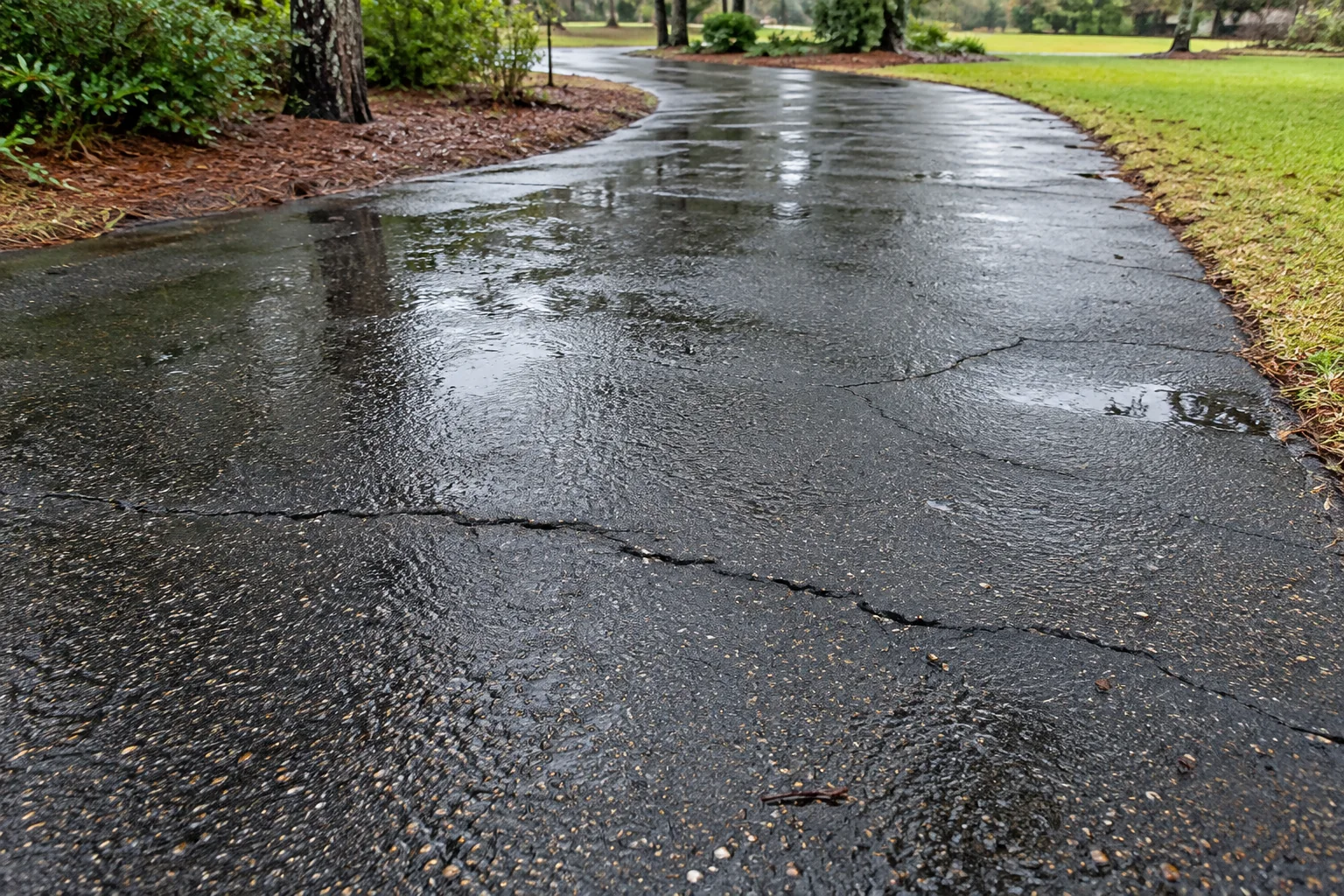
Keep the timing observation separate from the cause
Cracks noticed after a rainy period should be documented with dates and previous condition information. Timing is useful context, but it does not prove that water caused every visible change. Describe what was first noticed and where before assigning a single explanation or choosing a repair based only on the weather sequence.
Show the pattern and surrounding pavement. A new-looking line, loose edge, depression and water collection are different observations. Identify them separately and explain the practical concern. A photograph cannot establish affected depth or verify the supporting material. The evaluator can explain which findings and further information are needed for an appropriate recommendation.
If you do not know whether a crack existed before the rain, state that plainly. A wet surface or changed lighting can affect what is noticed in an image. The owner can prepare a useful request without a definitive before-and-after claim. The goal is a factual condition record that helps the site review distinguish actual documented change from uncertainty.
Use genuine earlier images and clear locations
Retain dated earlier photographs of the same area if available. Compare identifiable locations rather than unrelated close-ups. Mark the new observation on an overall property view and add representative safe close images. The reviewer needs to see where the pattern lies and how it connects to retained pavement or earlier repairs.
Describe visible differences without inventing measurements or a change rate. If several cracks or areas are involved, identify each separately. A single close image should not be presented as proof that the whole driveway or lot changed uniformly. Include nearby apparently unaffected surface where useful to show extent and transitions.
Do not widen cracks, remove edge material or excavate to create evidence. Leave the condition available for review and ask what measurements or examination are appropriate. Safe photographs and an honest account can start the conversation. Any investigation should have a defined purpose and limits rather than become an improvised owner test of hidden condition.
Record water behavior safely and specifically
Provide safely obtained observations of collection or flow with approximate timing after rain. Include the wider context, nearby grades and visible drainage features. One wet image does not establish duration, every water source or the condition of buried infrastructure. Keep observations from different events separate and identify what is actually known.
Do not enter standing or moving water, approach traffic or recreate runoff to prepare the request. If a useful observation cannot be obtained safely, say so. The reviewer can identify appropriate next steps without require an owner to stage a water test or complete a guessed drainage explanation.
Ask whether the water question is part of the pavement review or needs another provider. A repair estimate should not silently represent inspection of every pipe, outlet or adjacent drainage feature. If a finding is needed before the surface decision, identify the dependency and responsible party so the work does not proceed on an unresolved water assumption.
Share actual work and use history
Provide known paving, resurfacing, repair, utility and drainage records with dates and boundaries. If history is incomplete, state that. The present crack pattern does not establish an accurate original assembly or construction date. Confirmed records give the evaluator a better basis than an explanation inferred from weather and appearance alone.
Describe changes in vehicle use or nearby work that can be confirmed. These events may be relevant context without independently proving a cause. Keep them distinct from suspected mechanisms so the recommendation can be discussed against actual findings. Do not ask drivers to repeat loading or turning events to demonstrate what might have happened.
If work is recent, retain the agreement and instructions and contact the responsible provider about the observed change. Timing does not alone settle fault or warranty coverage. A current condition review can identify appropriate next questions without imply it determines another party's obligations or proves that one earlier activity caused all new observations.
Compare maintenance, repair and investigation decisions
Ask the contractor to explain what findings support the proposed activity and which questions remain. Maintenance of a suitable crack, removal of damaged pavement and additional investigation have different purposes. A material name or a rainfall date does not by itself explain why one activity is appropriate at this location.
If investigation is proposed, clarify the question, location, extent, limits and restoration and how the result informs the next decision. Findings from one point should not be treated as complete knowledge of the entire property. The owner should understand what can be decided now and what depends on additional information.
Compare alternatives by function, boundary and retained conditions before price. Identify preparation, related-provider work and exclusions. Agree who receives unexpected findings during authorized removal and how changes are priced and approved. A clear process makes the choice reviewable without treating a photograph as a guarantee of hidden condition or weather timing as a universal diagnosis.
Set priorities and access against actual use
Identify cracks at entrances, walking connections, parking positions and delivery routes. Location and consequences can influence the owner's priorities alongside the visible pattern. Explain what access must continue and any operational deadline rather than assume the most dramatic close-up always defines the first work area.
Discuss closure and temporary arrangements for the actual activity selected. If drainage or another provider's task is a dependency, identify sequence and handoff. The property should have an understandable route plan instead of leave users to interpret an active work area or assume every stage has the same restrictions.
Follow actual reopening and care instructions for the work and conditions. Do not use a waiting period or treatment method from another project. Agree who communicates the release and changes. A surface that looks complete is not a universal signal that every vehicle and walking operation can resume while related tasks remain unfinished.
An example of using weather timing accurately
Suppose an owner sees cracks after several rainy days but has no clear earlier image of that exact area. State that the cracks were noticed afterward and that their earlier presence is uncertain. Share safe observations of water and any genuine records for the property. Ask the evaluator what needs checking before maintenance or a repair is selected. If another area has identifiable earlier photos, keep that comparison separate rather than apply its history to the whole lot. The proposed boundary should follow actual findings and intended purpose, not an unsupported claim that every visible line was newly created by the same storm. Record any investigation question, related drainage dependency and approval process before work. At completion, identify retained areas and instructions so later observations can be discussed against the actual scope. This approach makes timing useful without turn it into proof of one hidden mechanism or require an owner to recreate runoff or excavate a crack for evidence.
Keep later observations connected to the record
At closeout, retain genuine photos locating completed activities, the agreed scope and approved changes. Identify retained or deferred areas. The record should explain what was addressed without imply every future crack or rain-related observation is covered by one surface activity. Expectations and warranty provisions belong to the actual agreement.
If another change is observed later, provide its location, timing and the known conditions. Separate a new crack, reopened line, loose material and water collection rather than label all of them the same recurrence. The before-work record and actual history help the provider understand follow-up without an owner proving hidden cause through an improvised test.
Contact Asphalt Solutions with the project address, safe views and genuine earlier images if available. Most work occurs at customer job sites. Slidell contact-location visits require an appointment; listed hours mainly describe phone availability. Call or text to discuss the review needed for the observed changes without assuming rain timing supplies the complete explanation.
Questions about new cracks after a rainy period
The direct answer
Rain can make water movement and existing weaknesses easier to observe. The timing is useful but does not by itself establish causation.
What to discuss before choosing a repair
Discuss the crack pattern, support and drainage as connected conditions.
What to observe and record
- Record the dates
- Photograph water pathways
- Show changes from older photos
A mistake to avoid
A weather event occurring before damage is not proof of the exact failure mechanism.
Continue with the right next step
Property conditions determine the final scope. These planning notes do not replace a site evaluation. How to use our pavement guidance