
Describe the business day in useful time windows
Prepare a short operating schedule that shows customer peaks, staff arrivals, deliveries and service visits. Confirm the information with the people who actually manage those operations. A quiet photograph taken before opening can hide an essential route used later in the day. Explain which activities are flexible and which have a fixed requirement so the contractor can discuss a realistic sequence.
Include occasional events or deliveries expected during the proposed work period. Do not promise a closure window until the responsible business contact has reviewed it. If the property is leased or shared, identify the person who controls the pavement and who must approve the work. The business can describe its operational needs without assuming it has authority to change every surface or entrance. Keep those responsibilities visible before a construction date is requested.
Separate customer-facing routes from service movements
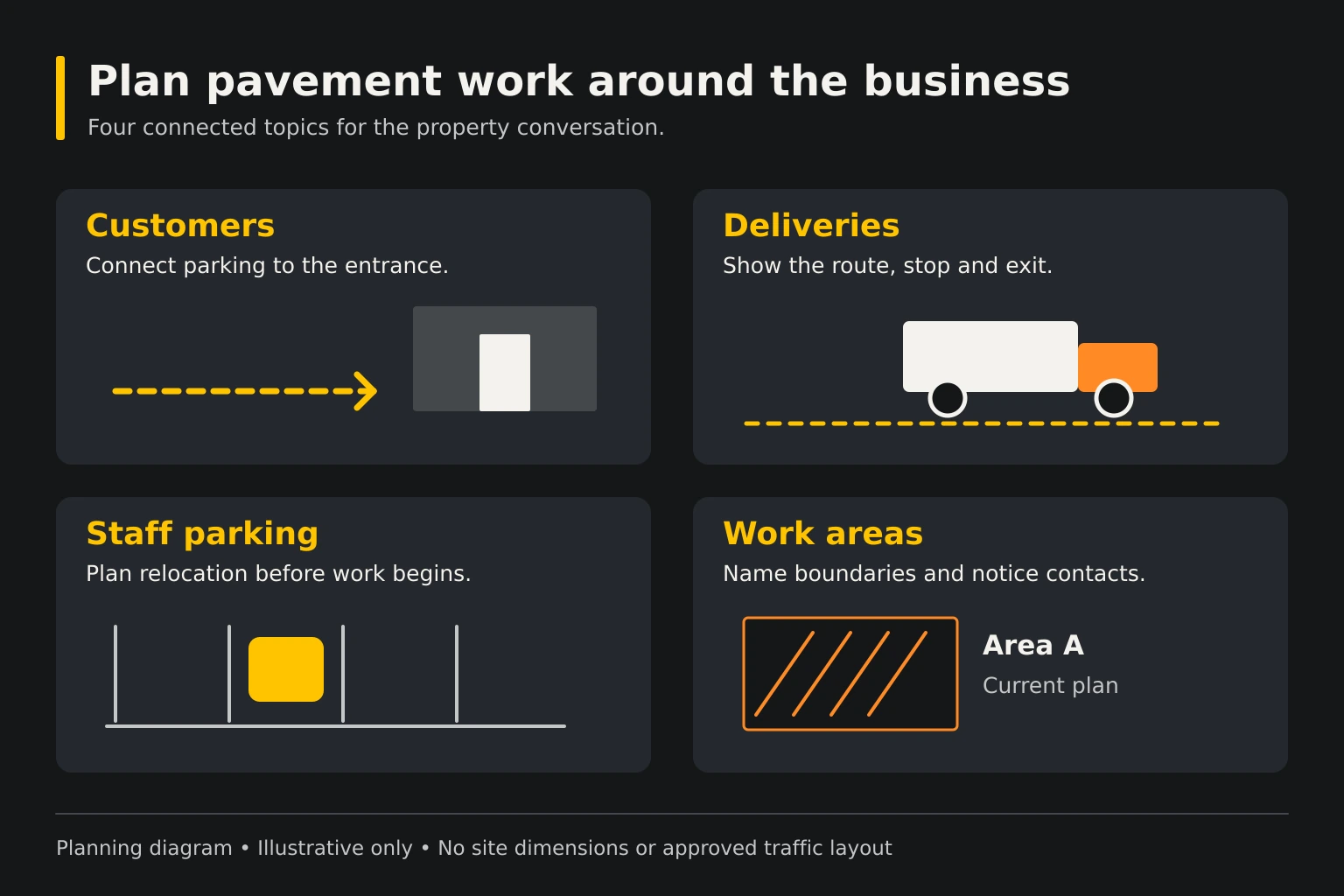
Map how visitors arrive, park and reach the entrance, then show the route used by delivery and collection vehicles. Where those movements share a lane, identify the times and turning areas involved. A temporary arrangement that works for a customer car may not work for a service truck. Ask providers to confirm any revised route or stopping location before the work is scheduled.
Review pedestrian access with the party responsible for the property's requirements. Do not treat a route across a lawn or through a loading area as suitable simply because it avoids the repair. Give staff a clear current explanation of entrances and temporary parking so they can guide visitors consistently. If the arrangement changes between phases, identify who will update signs and instructions. The customer experience depends on the actual route, not only on the number of parking spaces that remain open.
Match the requested work to the operational concern
Describe what the visible pavement problem does to the business. A recurring hole in a delivery path, a broken entrance edge and faded parking markings can require different scope discussions. Use photographs and stable location references without diagnosing the cause. Ask which proposed work addresses each concern and which issue remains outside the estimate.
Keep maintenance, repair, layout changes and drainage responsibilities distinct in the proposal. A single line described as improve the lot can conceal different assumptions about preparation and retained surfaces. If a new tenant or vehicle operation is expected, share the confirmed information before approving the scope. The contractor needs the intended use of the property, while the business needs an understandable explanation of the construction being proposed. Neither should rely on a generic detail copied from another site.
Create a workable preparation and communication plan
Before construction, assign who moves employee vehicles, stored equipment and any item occupying the work area. Confirm temporary parking permissions and provider arrangements. Give the contractor a contact who can resolve an access question, plus a backup if that person will be away. Someone providing a gate code should not automatically be treated as authorized to approve added work.
Prepare notices that explain the practical change and the current route. Avoid publishing a firm reopening time that has not been confirmed for the actual work. Weather or exposed conditions may change the sequence, so agree how updates reach staff, visitors and providers. Keep the work zone and pedestrian instructions aligned with the contractor's plan. The goal is clear coordination that the business can carry out, rather than a promise that all operations will somehow continue unchanged.
Retain the project decisions for future operations
At completion, connect final photographs and reopening guidance to the accepted work limits and approved changes. Identify any restrictions relevant to deliveries, collection vehicles or concentrated loads. Share those instructions with the people who allow access so a driver does not decide the pavement looks ready. Keep offered follow-up terms in their actual written form rather than inferring a guarantee from a general conversation.
Record deferred improvements separately from questions about the completed scope. If the business or provider operation changes later, retain that information for the next pavement discussion. A new vehicle type or route should not automatically be assumed covered by the original plan. Send Asphalt Solutions the exact property address, main concern and confirmed operating needs to begin an inquiry. The company serves Greater New Orleans and the Northshore; the Slidell contact location is by appointment only.
Review the plan with the staff on the ground
Before work begins, walk through the current access arrangement with the staff who will be present during the closure. Identify the open entrance, temporary parking, provider stopping points and location of notices. Ask whether the plan conflicts with an operation that was missed during estimating. Bring a relevant conflict back to the authorized contact and contractor before changing the route informally.
Make sure different shifts receive the same current instructions. A business can have a good plan that fails because one employee uses an old notice or tells a delivery driver to use the usual entrance. Name the person who communicates updates and the contact staff should use when someone arrives outside the agreed window. Avoid giving a general instruction to work around construction without a usable route and decision process.
After completion, review which arrangements worked and what should change for a future phase. Keep that practical feedback with the project record. It can help the next estimate conversation describe the business more accurately, especially where the original coordinator leaves or a provider changes its operation. The record should support actual decisions without turning an informal staff suggestion into an approved construction instruction.
Questions for the property discussion
Start with how the property operates.
A retail lot, restaurant entrance, office driveway, and warehouse approach experience different traffic. Identify the busiest periods, delivery vehicle types, and areas used by pedestrians.
Describe the access routes that can close and those that must stay open. Where there is only one entrance, the scheduling plan needs particular attention.
Check the points that carry the most stress
Turning areas, dumpster approaches, delivery stops, and pavement edges can deteriorate differently from lightly used parking stalls. Include close photos and the traffic that each area receives.
Plan the finished surface and layout together
Review drainage, parking configuration, pedestrian routes, markings, and signage as separate scope items. Any accessibility or permitting requirements need appropriate review for the actual property.
Plan pavement work around customers, staff and deliveries
The business schedule is useful information for a pavement estimate. Explain customer arrivals, delivery windows, employee shift changes and waste collection before requesting construction dates. Show how those activities use the site. A lot can be quiet at one hour and still have an essential route that cannot be closed during the proposed window.
Make access requirements part of the work plan
Ask who will direct site coordination and how customers will find the open entrance. Discuss temporary parking and walking routes with the people responsible for the property. If work can be phased, have each phase identify its boundaries and reopening conditions. When work cannot be divided safely or practically, the estimate should make the required closure understandable.
Compare the proposed work before comparing prices
Include the areas that do the hardest work. Loading points, turning corners and service entrances may deserve evaluation separate from passenger parking. Describe the vehicle types and repeated movements. Ask what support, thickness, connections and drainage are included in the proposal without assuming a generic passenger-vehicle detail fits the entire site.
Keep a record that survives the project
Retain the agreed scope, dated condition photos, changes approved during the work and written reopening instructions. At closeout, connect any questions to a specific area and the agreed description. This record helps with future maintenance decisions and avoids relying on memory of how the surface looked immediately after construction.
Keep facts and assumptions separate. A photograph establishes an observed condition at a particular time; it cannot prove support depth or the cause of a defect by itself. Ask which questions require site investigation and how additional work would be documented before it is authorized. Do not assume a maintenance treatment includes unrelated repair or drainage work.
Useful planning guides
Call (985) 788-0493
Reviewed October 14, 2026. Guidance is for project preparation; final design and construction details depend on the property.